People have been asking me, am I glad to be home? The answer I give is, yes and no. It's bitter-sweet. I love the closeness and familiarity of the UK. I love how intimate our countryside is by comparison with the states. Flying over my home county of Kent demonstrated just how 'green and pleasant' it still is, despite it appearing to be a concrete jungle at eye level.
There is, or at least appears to me, to be an urgency about life in California that isn't happening here (yet), even the dog walkers and mothers out walking their babies in strollers, are not walking at all, but running.
Yet, I did love so much about the west coast. I am already missing those huge, open spaces where I felt like a (wimpish) Crocodile Dundee, not knowing quite what I might discover, and how dangerous it might prove to be. Americans seemed much more open to stopping to chat with you and would regale you with tales such as..."Did you hear about the 74 year old guy who got air-lifted to hospital after being bitten by a rattler?"

At an amazing place I had heard about (and so of course wanted to visit) close to Santa Cruz, where the monarch butterflies all congregate to pass their winter; although there were none to be seen when I arrived of course, I bought this field guide to American spiders...

The author describes how he overcame his fear of spiders by taking a 5-day, field school class in the Sierra Nevada Mountains and asks that others try to overcome their own fears, and even help to protect them...

In case this proves tricky to read should you be viewing my blog on a phone or tablet, it says that "Too many people fear these beneficial creatures. Spiders need human friends to educate others and protect them from being needlessly killed."
And so, with that mantra in my head, I shall do my part here by sharing a few of the photographs that I took. You can educate yourself a little by trying to look at these pictures rationally...can't you? Ok then...bugger off for a moment whilst those with an open mind do so, and I will see you back here post 'spidergate'...

Or....you could lock yourself away in a cupboard somewhere and spend the next few minutes giggling to yourself like a little schoolgirl about the fact that there is a bird-turd spider!

 |
| Phidippus audax |
Phidippus audax, commonly called bold, or daring jumping spiders, range in size from around 13 to 20 millimeters. That is much bigger than our largest salticid here in the UK, the fence-post jumping spider: which is about 10 millimeters in body length. These spiders have been known to jump from 10 to 50 times their own body length, which they achieve by suddenly increasing the blood pressure in the third or fourth pair of legs. Like most jumping spiders, P. audax tends to prefer relatively open areas to hunt in, as they actively seek and stalk prey and do not build webs to catch food.
I was trying to be clever and get a natural light shot of this one, but it was late in the day when light was poor.
Phididppus johnsoni, or Johnson jumping spider, or even as I like to call them 'JJ' spiders, are one of the largest and most commonly found jumpers of North America. Sometimes (wrongly) confused with the venomous red back spider. They quickly became one of my personal favourites and I would always be on the lookout for them on my walks. Sometimes the abdomen can be bright red; the females, as in my first picture here, have a black stripe on the abdomen.
 |
| Phididppus johnsoni (f) |
 |
| Phididppus johnsoni (m) |
From the largest, to what must surely be some of the smallest jumping spiders I have ever seen...


I have not been able to get to species level with either of these yet but neither was more than 5mm in length.
This next little gallery is of the crab spiders that I photographed, well, some of them...


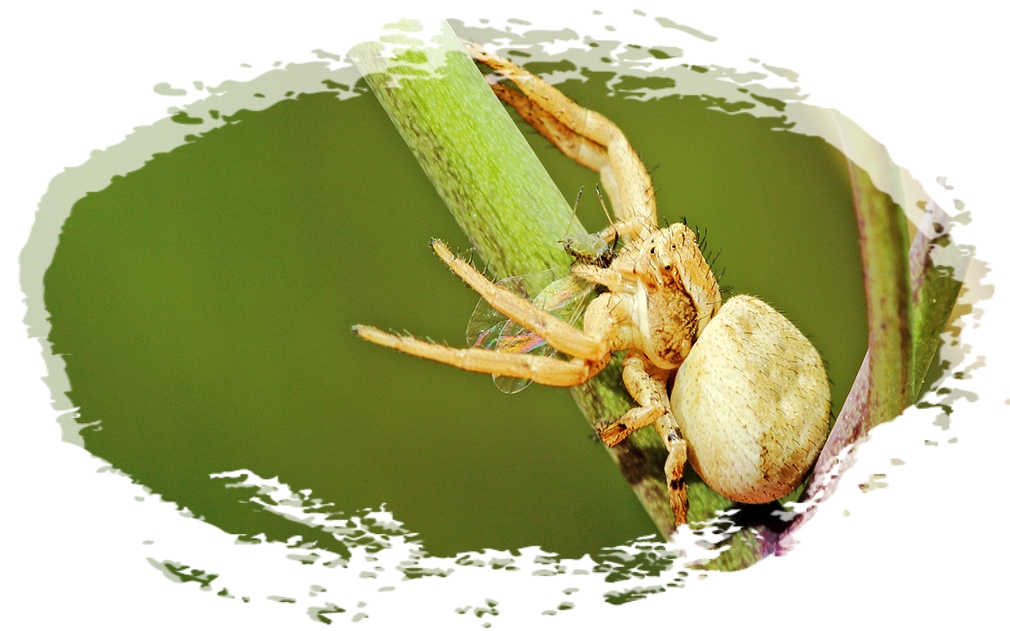

Incidentally, that first crab spider is Misumena vatia, or the goldenrod spider. I read that they sometimes get called banana spiders too, because of their striking yellow colour. In fact, these spiders have a real clever trick that helps with camouflage whilst sitting on goldenrod, or any other flower: any other flower that happens to be white, yellow or green that is, because they have the amazing ability to change between these colourways. Like this...


That's probably more than enough arachnids for one update and so let's move on to something that might appeal more shall we.
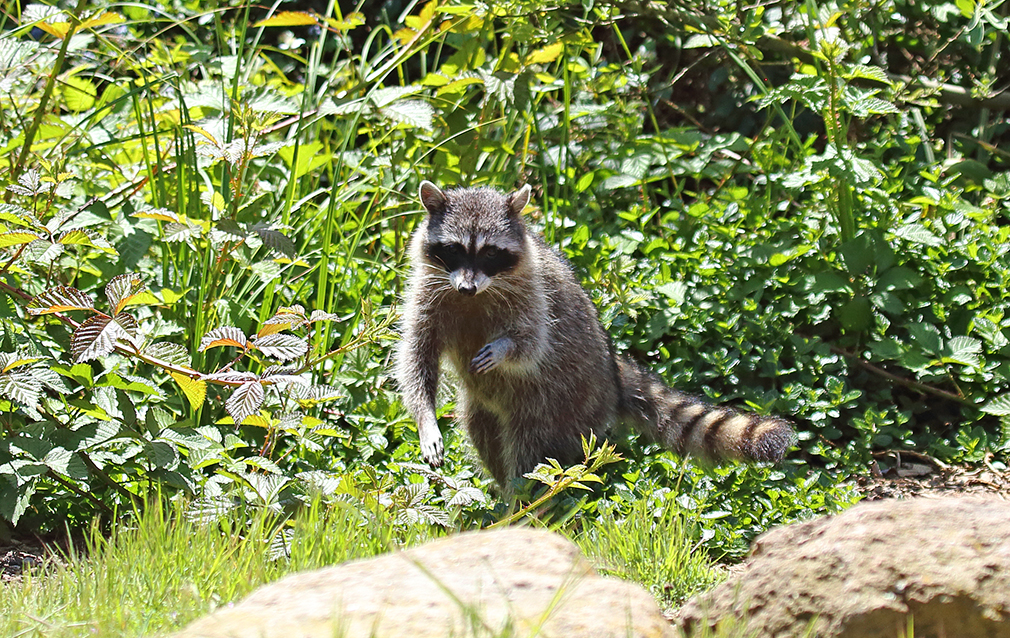
This raccoon was living in one of the large parks, where people are actually feeding them. Usually nocturnal animals, they are encouraged into the daylight by easy pickings.
Raccoons are apparently noted for their intelligence: studies show that they are able to remember the solution to tasks for up to three years.
 |
| A weevil threesome |
And I thought I was enjoying the sunshine!

I didn't see too many butterflies but there seemed to be several species of skipper butterflies around. I think this one could be a Fiery Skipper (Hylephila phyleus)
 |
| Perhaps the only wasp I spotted (no ID as yet) |
This next find was something of a moment for me: I would not have seen it at all had I not decided to lift a largish stone to see what, if anything, was beneath...

Potato Bug - Jerusalem Cricket - Child of the Earth: Take your pick, all of these names refer to this insect. Despite their name, Jerusalem crickets aren’t native to Jerusalem, and they are in fact mainly found in the western half of the United States. (Incidentally, they aren’t true crickets either.) They can be found throughout Arizona, New Mexico, and all along the Pacific coast of the country, being found all the way from British Columbia down to Baja California and many other parts of Mexico. Habitat wise the Jerusalem cricket mainly lives in underground burrows, but they can be found above ground in warm damp places.
Jerusalem crickets can grow up to two and a half inches long, and they have long spear-like legs that they dig into soil with.

I did lift a few other stones, as well as some bark, and you can discover what else I found lurking beneath in my next USA update.
A couple more photos then before I bring this already overlong update to a close...
 |
| Anthrenus species - Carpet Beetle |
And finally this photo of an American politician.....sorry! I mean this reptile: a Western Fence Lizard that seemed to be omnipresent: again, I don't mean this actual lizard you understand, rather this species of lizard.

Phew! I apologise profusely for dragging you all the way down here to the eventual end of this humongous entry; and after starting with all those spiders too. I am forever in your debt for having stuck with it...you did stick with it didn't you? Yes, you must have done, or you couldn't be reading this. If there is anything I can do for you (sans lending you hard currency) then do please let me know.
I am away now to dowse my laptop-sore eyes with Optrex. You have a lay down in a darkened room followed by a cup of green tea, and before you can say Peter Piper picked a peck of pickled pepper, all will be well with the world once more.
'Keep it real, peace out'