Showing posts with label Eurygaster testudinaria. Show all posts

Wednesday, June 27, 2018

Bug porn at Brakey Bank...


When I unexpectedly had to buy a replacement mobile phone recently, this place came to mind. Purchasing the phone didn't exactly break the bank, but it was a bit of a trial (yes, I know the sign says trail - it's called word-play ☺)


And so...early one morning, just as the sun was rising,


 I fell out of my bed and into the car; drove for about 35 minutes and when I arrived at Brakey Bank, my phone (Grrr!) still only said...


That's a.m. by the way. Way too early in my day for bug porn: but that's what I was faced with soon after I arrived. I call it porn, but it may have been nothing of the kind; they may have been in a loving, long-term Coleoptera relationship for all I know...

Bonking beetles

And then, no sooner had I left these two, wet as an otter's pocket, and still 'apud tantra', than I came across (no pun intended) these two wired up weevils...I tell you, Brakey Bank is a den of iniquity early mornings...


I suspect those are Figwort weevils. They look very much like it to me, and after all, that is Figwort they are perched on; not that it is conclusive proof because as I am always saying, bugs can't read (that we know of) and so they don't understand the reason why they are sometimes named after a particular plant.

Take this mullein moth larva for instance...


Was it Mullein that I found this on? Nope..t'was...Figwort again. UK Moths has this species of caterpillar feeding on Figwort and Buddleia. Still, I did notice that the internet signal was almost non existent at Brakey Bank and so I doubt this larva has even seen their terrific website. 

At the far side of the meadow, there is a wooden seat. I sat down for a while, and I guess my eyes must have relaxed for a few seconds, possibly from lack of sleep! I found myself staring into the middle distance almost cross-eyed, I must have looked like somebody trying to focus on one of those magic eye pictures. Anyhow, I noticed a tiny circle on a grass stem that looked like a chocolate button. 

Should I investigate? Yes, I should...

I stood up, took just one pace towards the chocolate button, and...fell over my camera bag! Thankfully, at that time of day, there was nobody else around to witness my blasphemous outburst. I know, because I checked; it's the first thing you do when you fall over right? Check to see if anybody saw you. And what was this chocolate button in reality? 


Not sure? Maybe a closer look will help...


It's actually an early instar nymph of the Scutelleridae family: Eurygaster testudinaria, the Tortoise Bug. Although at this stage they are no larger than a gnat's nipple, the adults are sizable shieldbugs.


As I sit here writing (Tuesday 26th June), the clock on the wall says 11:33 pm and so I think I will leave you to contemplate this next picture whilst I get some much needed shut-eye. No rush: I shan't return until morning. By which time you will be confident that you know what creature features in this...magic eye picture, won't you? A clue? OK, there is more than one critter in the image. Good luck, see you in the morning...

Not sure if this'll work if you are viewing via your phone?

Bugger! A full moon: will I be able to sleep I wonder. Oh! You don't care huh? 

Anyhow, I 'Googled' it and it isn't actually a full moon until Thursday, so I reckon I will be alright. Of course it could be Thursday by the time you read this, I'm not sure if that will be more confusing for you, or for me. 


Yes, a new day has dawned and it's already 65 deg in the garden at 8.50 am. I did sleep well, despite what did look like a full moon, I think you will agree... 


Back to my adventure at Brakey Bank then. BTW, if you are wondering exactly where this place is, here's a little map...


Yes, it's part of those green areas on the map, which are Tudely Woods. Anyway, let's crack on; my next find was a first for me. I have never seen these particular dragonflies locally...

Cordulegaster boltonii  A Golden-ringed Dragonfly


This is the only member of the Cordulegaster family in the country, and one of our largest dragonflies; I think the female (this is a female) may be the longest.  BDS (The British Dragonfly Society) describes the habitat thus 'Breeds in acidic rivers and streams of all sizes. May be found away from its breeding habitat over heathland.' Probably why I have never seen them at home then, no acidic rivers, streams, or heathland. 

After finding so many parasitised bug eggs this year, it was nice to see these looking okay (at this stage)...


And these must have been successful I guess...


Of course empty eggs doesn't mean that bugs emerged rather than parasitic wasps, but I think the previous ones I have observed where it has been wasps, haven't had the little hinged lids open like this.

I also discovered this lovely pair........of Puss moth eggs...


This poor little cricket had met its end at the hands of a female Misumena vatia crab spider. It was only a young spider and similar in size to its prey, but I guess the cricket had no defense? I did find an even smaller spiderling in the garden at home; same species too...
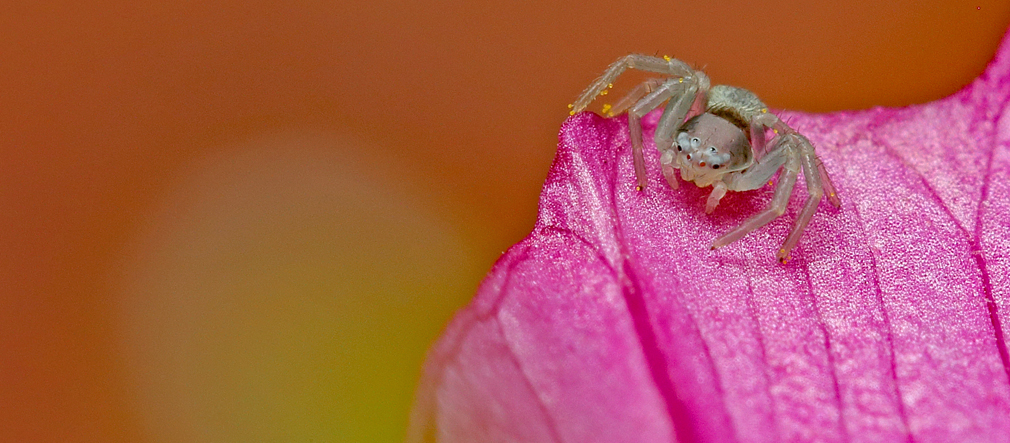


Not sure of actual size, but at a guess I would say about 3-4mm.

Another top spot in my garden was this recently moulted Woundwort shieldbug nymph...


I struggle with recalling the scientific names for these bugs and it doesn't help when they seem to be constantly changing. For instance, these used to be known as 'Eysarcoris fabricii'. But then the people who have the power to rename bugs decided that something more snappy was required I guess, and came up with 'Eysarcoris venustissimus' 


And finally, don't try (as I did) to take a series of shots with the intention of making an image stack, when your subject is constantly moving its antennae...


Wednesday, July 26, 2017

"Nature can be cruel, but she balances her books"

Even after all these years of photographing and studying invertebrates, I am amazed at how much I miss. I think I am fairly good at spotting bugs and insects and then will be quite selective and particular about the detail and content of the resulting photographs, and yet, to this day, I still fail to spot what subsequently seems like an obvious thing.

More on that in a bit: first I want to share the results of one night of running the moth trap. On July 17th I ran the trap all night and this was the result...


If my maths (or math? as the Americans say) is correct, there are 108 here. There were a further 42 that I didn't get to photo; mostly because they were more repeats of commonplace moths. Then there were the escapees, perhaps a dozen or so that made their escape as I opened the trap. I also had six green lacewings, one soldier beetle and three wasps. 

Probably one of the best nights for 3 years. Very pleased, even if it did result in a lot of work the following day.


I recently got to spend some time on Ashdown Forest. Home of Poo(h)...and there was plenty around as the cows and sheep wandered freely! It might be why the hoverfly I was messing around with, trying to capture in-flight, turned out to be a horsefly?


I also found this very teneral looking red-legged shieldbug...


And a late instar, together with an adult, tortoise shieldbug (Eurygaster testudinaria)


 And on the bracken, a freshly moulted vapourer moth larva...


Finally, at one of the ponds, the largest pond-skaters I have ever seen; they were huge. A photo doesn't really give a sense of scale, but they were enormous and other people were commenting on them too...


I had better return to my opening statement now though, before I forget. I posted a photo of a puss moth larva to Flickr a few days ago and here it is reproduced below...


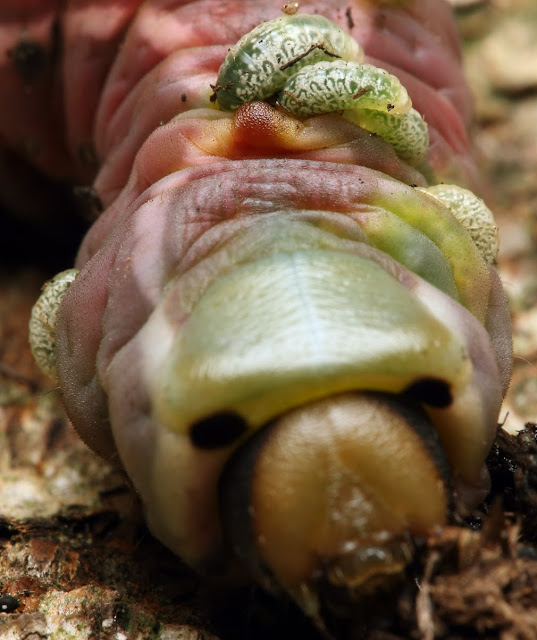
I was quite pleased to find this impressive larva because I rarely see them. Nothing exceptional about it, other than the fabulous colouring and size of it. Or is there? What I had failed to notice, were those tiny black dots around the 'neck' area, and one more towards the rear. I've highlighted them in the image below to make them more obvious. What are they though? They just look like bits of debris, or perhaps plant material, or even caterpillar poop, or frass as the experts call it. 

What they actually are, is something much more sinister, as I was about to find out as the story unfolded. 


Yes, we are talking about parasites here: or are we? Is it a  parasite or parasitoid? What's the difference? Well, the answer can be quite a grey area but in general, a parasite doesn't usually kill its host (but sometimes does) and a parasitoid always does. In this case we have a parasitoid, in fact I believe it to be the Ichneumon parasitoid 'Netelia vinulae'. A classic case of this parasitoid affecting a puss moth larva was documented on the AES website in 1995 and what I witnessed here, matches perfectly.


At this stage nothing is obvious; this is the colour the larvae change to prior to constructing a cocoon....


But, try as it might, the poor thing was unable to complete its cocoon; the very same thing happened in the 1995 observation...


Just a quick reminder that these videos may not show in the emailed version of this update.


Even in this picture below, you can just see that the eggs are starting to hatch out...


The parasitoid larvae grew at quite a pace and became green in colour, suggesting that they may be feeding on the caterpillar's 'blood' (haemolymph).


I wonder if that is what this next video shows. I had originally thought it might be the digestive tract at work, but if it is, then it seems to be heading in the wrong direction?


From what I have read about the 1995 observations, the parasitoid larvae failed to pupate. However, it took almost a full month before they left the caterpillar and wandered around looking for a pupation site, at which time, unable to do so, most eventually died. It went on to say this: "Clearly the conditions provided were unsuitable. On the assumption that pupation in the wild occurred within the puss moth cocoon, the few remaining larvae were placed in a small container, but these also died without pupating".

I am still observing mine and hope they will pupate, so that I can learn about the full life-cycle first hand, but expect that the outcome will probably be the same. I will let you know either way. Incidentally, the process I have been documenting here all began on exactly the same day as the one in 1995, but one month earlier - July 12th, and so if things continue at the same pace, I will not know until August how my story ends.


I can't leave you with a story about nature at its most gruesome, and so how about something a touch more uplifting. My local wood have been devoid of blue butterflies for the past couple of years. But this year thankfully has seen them return. Maybe not in the numbers I would have liked, but it's great to see these tiny common blue butterflies once again enjoying the sunshine and all that Comfort's Wood has to offer...


Monday, August 29, 2016

Featuring a red squirrel and a 7ft hedgehog...

EDIT: 03-10-2016
Apologies if you have received a notification of this update by mistake.


Following my last, rather dark update, I thought it was time to lighten up here a little and change the mood...


And remember; wherever you are in the world, and I know my little blog is read in at least 10 countries, we all laugh in the same language!

  Stats for my last update        

Just a thought: this is also ironic if you are smart enough?

This is a photograph of a female Misumena vatia crab spider that I took the other day. It is this species that can change colour from white to yellow and visa-versa. Whilst we are making merry with this particular update, perhaps it would be pertinent to mention that 'visa-versa" is also the title of a musical offering by German duo 'Funkstörung'. No? Well it made me chortle; I'm sure it must be an anagram of something rude!

The yellow version...
I guess this won't be the case right across our British Isles, but here in Kent the last few days have been hot and very humid. I am not complaining of course; we have waited far too long for a taste of summer. It has left me feeling a little sluggish though...

Arion distinctus (probably)
Yes it was a hot summer day when I photographed the slug; I hadn't intended such an exotic subject of course, but in the heat, it was all there was about. It really was a 'somnolent summer day', as they say (whoever they are).

-------------------------------------------------------------------
I know what you have been dying to ask me...

"What’s the difference between a pupa, a cocoon and a chrysalis?

How strange that you should ask me this at a time when I have been thinking about it too; here then, in layman's terms, is my very bestest go at an explanation:
 Pupa and chrysalis have the same meaning: the transformation stage between the larva and the adult. While pupa can refer to this naked stage in either a butterfly or moth, chrysalis is strictly used for the butterfly pupa. A cocoon is the silk casing that a moth caterpillar spins around it before it turns into a pupa.

All of which is a sneaky way of linking to this small white chrysalis that I happened upon a while back...
Pieris rapae pupa (green form, there is also brown)

I was able to witness this struggle to be free of the chrysalis casing when the adult butterfly emerged...
Pieris rapae
It did eventually manage to extricate itself, and after a good long rest to recover from all the exertion, was on its way. Which is all good news of course, but, I know what you are thinking now: what does 'layman's terms' mean?
Why ask me? I am just a humble country boy, my knowledge is finite. Alright, I will have a bash as they say (there they are again).

---------------------------------------------------------------

Let's start with the word layman: a person without professional or specialized knowledge in a particular subject.
Plain English (or layman's terms) is a style of communication that is easy to understand.

Back to the subject in hand then. The subject in my hand right now is 'BB' and I don't mean Bridget Bardot (ask grandad), nor Billy Bragg, neither Betty Boo. Nope, I am talking of the insect alliteration, Bumble Bee...

It seems to have been a good year for BB's this year


'In the pink'...there's another little saying that has me wondering about its origin. Whilst I wonder, here's a pink bug...

Eurygaster testudinaria


Not really a pink bug of course, only at this stage of development following a moult.

Maybe this next picture can out-pink the tortoise bug?

Mimas tiliae larva
It's another shot of the lime hawk-moth larva from a few weeks ago. Enough pink do you think? Me too; I am starting to see red!

Sciurus vulgaris
I was lucky enough to get a couple of hours at the British Wildlife Centre in Surrey recently and I spent most of my time in the red squirrel enclosure.

They have this huge, sculpture I suppose you would call it, of a hedgehog at the entrance to the park. It is 7ft high and was built by UKTV to mark the second series of David Attenborough’s Natural Curiosities. 


-----------------------------------------------------------

Here is what the adult tortoise bug will look like once it has coloured up, just in case you didn't know, which I am sure you did...


And at the other end of the scale, a teeny early instar of the same species...


Smaller still, by quite a margin actually, was this springtail...

Allacma fusca I think
One final photo for this update; a froggie...