Showing posts with label Hypera rumicis. Show all posts

Wednesday, June 20, 2018

Football v Nature...


Here in England, there is no escape from 'the beautiful game' (yeah, right) that is the FIFA World Cup. Apparently, erstwhile England manager Bill Shankly, once said that football is more important than life and death. If however you are one of the minority who even dares to admit that football leaves you cold, then may I suggest that you come on in to my latest blog update right now! 

It's lovely in here, honest it is: it even smells great, like wild English honeysuckle after summer rain. Despite what old shaky-Shankly thinks, there is more to life than kicking a pig's bladder around a park!  And as Van Gogh once said "If you truly love nature, you will find beauty everywhere". C'mon, do like Robbie Williams did at the opening ceremony, stick a middle finger up and...."Let me entertain you"...♫♫♫


(Click on any photo for a larger view)
Scathophaga stercoraria

What better to begin this update than this beautiful..........DUNG Fly! 

Yes, as its common name suggests, this fly is not only found on the feces of large mammals, but it also breeds there. If you find this abhorrent, then consider the following: the abundance of these flies has been directly influenced by intensive farming by us humans: and so now they are  integral in the animal kingdom, due to their role in the natural decomposition of dung in fields.

Shall we progress to something that is truly beguiling...


OK, I know it's only a fly, but come on, even flies look good in the right light huh? 

These few photographs are all from an early morning trip that I took to Marden Meadows recently. Marden Meadows is a nature reserve east of Marden here in Kent, and is managed by the Kent Wildlife Trust. It is also a site of special scientific interest. 

A Hoverfly (Estralis species)
The hoverfly pictured above, on one of the many large, white daisies that litter the meadows right now, is trying to emulate a honey bee. They are quite good mimics, but unlike the bees,  have only one pair of wings, and no sting. They can be tricky to tell apart, but I think this one is E.tenax.  

Whereas these next photos are of a honey bee, and a very wet one at that!


I also came across this tiny creature: I think this is a leaf beetle larva...


You can possibly tell from these photographs that it was quite a dewy morning. It must be a  fairly vulnerable time for the bugs as they cannot fly until all that water has dispersed, or has been evaporated by the sun,  from their wings. 


Way back in July of 2014 I blogged about a species of weevil called Hypera rumicis, I described the pupal cases of these weevils as being like 'wild spun sugar' (that blog entry is HERE by the way, if you would like to come back and view it after reading this update). Well, I managed to photograph some more of these structures, at Marden Meadows this time. As with everything else I found, they were covered in dew drops...


You can clearly see the larva inside this case

I walked across an empty land
I knew the pathway like the back of my hand
I felt the earth beneath my feet
I looked up and saw this ladybird so sweet...


I wonder if male ladybirds mind being called ladies?


And if all of these pictures haven't been enough to hold your interest...well, you won't be reading this I guess! Assuming that you are though, my final offering from my early morning photo shoot is this voyeur image of two bonking beetles. 


This next photo is one that I took closer to home a few days ago...

Pentatoma rufipes
This is a final instar (the last stage before becoming an adult bug) of the Red-legged Shieldbug. They are quite large bugs when adult; you can see an adult HERE in a post from 2011 that I wrote about bugs moulting.


Yes, time to blow the whistle on this particular update before we get into injury time. I shall leave you with a final thought on 'the beautiful game' (that's football, in case you were confused) from a guy called Graham, who called the radio show '5 Live Breakfast, to share these pearls of wisdom..."The game is run by spivs, chancers and gangsters, it's played by morons and it's watched by cretins". Phew! So pleased my name is not Graham...heresy! 


How about a triptych ending then? (couldn't be bothered keeping the football analogy going by calling it a hat-trick) Applying the term loosely of course; here are three photographs I took of a fabulous Puss moth larva...


If you are thinking that it is quite an odd looking caterpillar, just take a look at how it looks immediately prior to pupating...


That'll be all for now chums. Take care until we meet back here for update number 221 in which I will attempt to alienate all cricket lovers, by suggesting that it is the most boring sport...


My good 'Flickr friend' Jason, has some lovely photos of the green veined orchids at Marden Meadows that you might like to check out HERE

Saturday, June 24, 2017

There's a hole in my pupa, dear Liza...

I want to begin this update with an example of how a chance encounter, and further investigation, led me once again to discover more about nature than I would ever have known otherwise.

On a recent visit to my local hospital, I noticed as I walked back to the car park, an area of grass that had been allowed to do its thing and go to seed. On the long stems I spotted burnet moth pupae. One in particular caught my eye because it seemed to be a double: one directly on top of another. I decided to take it home to observe. I'd had it a couple of days when I did my usual morning check, to find a hole in each of them. Not where a moth had emerged, it was too small for that...


It looked like the work of a parasitic wasp; but I had no knowledge of wasps that attack burnet moth pupae, and so a little detective work was called for. 
Ironically, as I was settling in to that research, I was distracted by what sounded like something tiny hitting against my studio lighting. Ha! Two teeny wasps were buzzing around, and occasionally, hitting against, the strip lights. I managed to capture them both to photograph before releasing; they would also help confirm an identity...

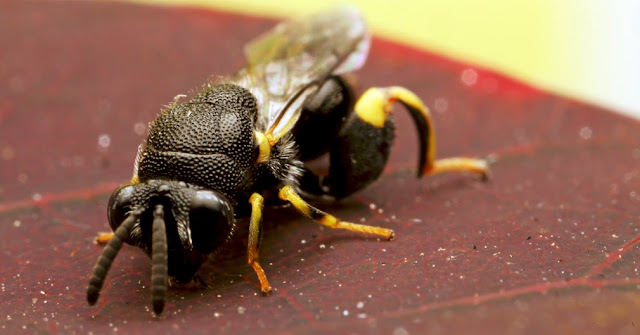
Brachymeria tibialis - A Chalcid Wasp

And what a hind femur and tibia this little wasp has huh? Now this is what I just love about having an interest in nature and discovering facts purely through being mindful enough to look past the obvious. This rarely seen, 5mm wasp turned out to be quite a special creature. Its habitat is grassland where moths of the Burnet family (Zygaena sp.) are found. Although, as with many invertebrates, it is probably vastly under-recorded, it was only added to the British list in 2008 and there were only three British records by 2009. Status: Nationally rare.


You have to wonder what the necessity for those rugby-player thighs is all about? 


Another recent, exciting find was these shieldbug nymphs...


Definitely the youngest nymphs I have seen of the hawthorn shieldbug Acanthosoma haemorrhoidale. Spurred on by my fellow 'Flickrite' Maria, who is queen of the shieldbugs and on a quest to find ova, I returned to the dogwood tree where I found these, to see if I could spot any eggs. What followed was one of those, oh so frustrating times that seem to blight my world way too often. 

Imagine my delight when after searching and searching, I finally found a clutch of eggs! I was overjoyed (temporarily anyway) even though I couldn't prove they were actually hawthorn shieldbug eggs. They were on the very same tree, so it was looking good. Delight soon turned to despondency though, when the adrenaline rush faded and my logical(ish) brain began to function once more: Hmmm...those eggs look a tad grey to me. When was the last time I saw some that looked similar? I know, when I found a batch a few years ago that had been attacked by a parasitic wasp...


Here they are anyway...


And here's what emerged a day later...


From bugs to beetles: you will have to cut me some slack regards quality of this video but watching this ground beetle amble along, I was struck by how it moved all six legs. What I should have done is recorded in slow-motion, instead this is just the original slowed down, which results in the rubbish quality. But it does demonstrate nicely what happens...


It seems to follow this pattern: Front and hind right, plus middle left, followed by front and hind left, plus middle right. Meaning that they are almost moving their legs in pairs; well , two lots of three, if that makes sense? I was about to say, let's move away and have a look at what I have found in the garden recently; but that beetle was in the garden, which, even though I say so myself, is looking fabulous (in parts at least) now...


 How about the discovery of a thick-headed fly...


This could well be Sicus ferrugineus, a Conopid, or Thick-headed fly. Strange? 'Ugly' seems to be the word most often associated with these flies. Their larvae are quite 'dark' characters too: they are endoparasites of bumble bees and they pupate and overwinter inside their victims. Endoparasite refers to those that live inside their hosts; whilst the parasites that choose to live on the outside of their hosts are called Ectoparasites.


This tortoise beetle was something of a photographic experiment. Wanting to use natural light, but retain as much depth of filed as possible, I went for a setting of f20 with an exposure of 0.8 seconds (yawn!)...


C'mon...if cuteness were a crime, this one would be in big trouble!

This little beauty is Cionus alauda - a bird-dropping mimic weevil. Associated with figwort and described as a 'local species', well it was certainly local to me, it was in the garden. The next one I am unable to provide a positive ID for based on the photograph. Probably an acorn weevil? 


The beautiful structures in the picture below, are a form of protection from parasites for the larvae of a weevil that I am pretty confident is Hypera rumicis. Maybe those shieldbugs would benefit from something similar?


Enough with the weevils; I will put an end to this update with a happier story. How about the smiling faces of a batch of common green shieldbugs that were healthy...


These avoided the dreaded parasitic wasp invasion and emerged as nature intended (although, I guess you might say that having wasps emerge instead is also as nature intended).


And they soon changed to a less teneral colour...


It's a strange irony that green shieldbugs begin life as green, then change to brown, before becoming green again, only to change back to brown come the autumn. Whilst you ponder that thought, I will away to the woods and meadows of the Garden of England to see what else I can discover...


Saturday, July 05, 2014

Wild spun-sugar...

When I discovered something whilst out walking in a local meadow, that at first glance you would be forgiven for thinking was wild spun-sugar, my interest was piqued.
Only small at around 5-7mm but beautifully formed, there seemed to be several of these miniature baskets adhered to both dock and sorrel plants.


Time for further investigation. I took some photographs and as I was wandering home, it dawned on me that I had actually seen something very similar a few years ago; but at that point, been unable to find an answer.
My research this time however soon provided a number of clues as to the identity of the creature that was responsible. To be 100% confident of the species would probably entail dissection, even so, I am reasonably happy that these enigmatic structures are actually the pupal cases of Hypera rumicis, a species of weevil.

Described as a pale-buff coloured weevil, with darker brown markings on the elytra (wing casing) of about 5mm in size. The weevil itself can be seen from late spring into summer, in areas that contain dock, or provide damp conditions.


If I didn't know better, I could make some kind of tenuous link with erstwhile England footballer David Beckham here; after all, world cup fever and all that? Lucky then that I do know better.
Whetted your appetite? Okay then, I'll elucidate-the intricate lattice-work of this cocoon, is sometimes referred to as a golden ball, or golden net ball (tenuous huh?) and is constructed by the larvae for its transformations. 

It resembles some of those made by caterpillars of moths. It's composed of loose threads, permitting the larva or pupa to be seen through the mesh.
Quite why nature has decided that this kind of protection from parasites is adequate escapes me; especially given that any movement in the leaf or stem the casing is attached to, seems to cause the larva inside to twitch and wriggle, drawing attention to itself.

I took a few shots of a larva beginning to make one of these fascinating creations...


I also managed a short video-well it wasn't that short actually, this is over half an hour's worth at its original timing. I have increased the speed to x8 to reduce the size for my blog and also...preventing boredom setting in.

The usual reminder here that videos don't show in the emailed version-you need to view this update directly on my BLOG

(The shiny-looking object bottom right is just my 'Plamp' to hold the plant steady)


A close up shot of this beautiful structure:


I don't know if this could be a similar, or even the same species but I found it recently on a birch leaf. Maybe it isn't a weevil at all?


That's about it for this update-I'll be back just as soon as time allows with another, my 137th I think..