Showing posts with label Argiope bruennichi. Show all posts

Saturday, September 11, 2021

Warning: this update contains arachnids...

This is going to be an unusual post, in as much as it concentrates on one subject. In fairness to my loyal reader, I think it's only fair to prepare you for what follows, so that you can choose whether to partake or not.

So then, clue number one...

   I have never used one of these, but do you know what it relates to I wonder?


Clue number two... (this should do it!)


Yes, this update is all about SPIDERS. There I said it! 

And so, if you belong in the 6% of people around the world who are terrified by spiders (even pictures of spiders) then I suggest that you abort now, especially if you are British, because we Brits are spider-phobic up to 45%!

If on the other hand you are savvy enough to be able to appreciate the beauty of these much-maligned creatures, even IF you are phobic, then you are in for a real treat.

September is spider month of course, the month when social media is awash with sightings of 'A huge spider I have never seen before' and 'Is this a Black widow' type posts.

I took a stroll through a local meadow, come wooded area a few days ago, and this update features some of the finds from just an hour spent there...

First up is this mother-of-all spiders...


Well, she could be a mum soon I guess, she looks pretty gravid. These are all 4-Spot Orb weavers (Araneus quadratus) by the way.


This very variably-coloured spider holds the British weight record.


The spider is not normally found in gardens. It is found on vegetation which has sufficient height and strength to support the large orb web. The web is usually found stretched across the gap between plants...


All of these spiders were found in one area, on a short walk, on one particular day...


The SHRS (Spider & Harvestman Recording Scheme) says this: 4 Spot-Orb Weaver spiders mature in late summer and autumn. The best distinguishing feature is the pattern of four large spots on the abdomen. These photographs are all of females...

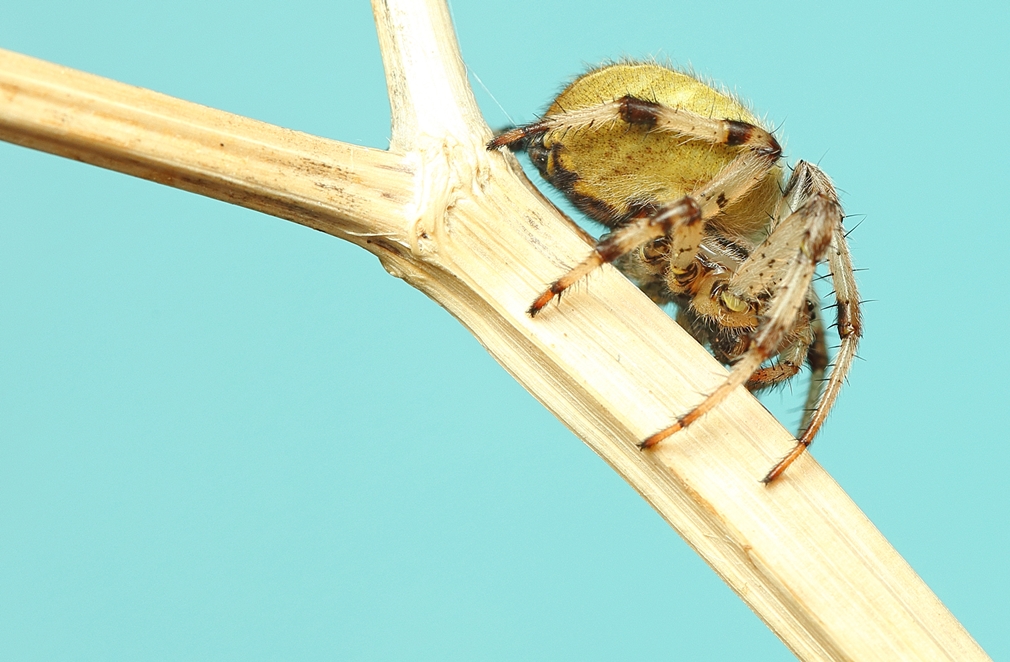


However, the males, which are quite a bit smaller, are just as impressive looking I think...


And now we arrive at that 'not too sure' moment. This next image could be another male 4-spot, but might also be a male garden spider?


I had to get the next one verified by the 'British Spider Identification' group. I had initially thought it might be a Marbled Orb-weaver, but have now had it confirmed as the very similar Bordered Orb-weaver (Neoscona adianta). 


Steven Falk on his excellent Flickr profile for this spider has this to say: This is a localised southern-biased species with the bulk off its population concentrated along the southern coast, the Home Counties, sandy areas of East Anglia, the New Forest and Dorset heaths. Favoured habitats include heathland, saltmarsh edge, fens and tall grassland.

It took a while for it to register in my rapidly ageing brain, but it eventually dawned on me that I had found this species 4 years ago, in exactly the same area; albeit a very different looking specimen...


Quite a nice example of how tricky identification can be though.


Two years after that spider find, I wrote a piece for a local magazine about the spread of an introduced spider that was first recorded in Rye in the 1920's.

I wrote that the first sighting of the species close to my home town, was probably in Ashford Kent in 1997 but that the population was exploding right across the country, and that 'You probably won't have met one of these spiders yet, but the chances are that sooner or later you will'. 

Well, a couple of weeks ago I was alerted to the presence of this species in Marden Kent by Lou Carpenter of Marden Wildlife, and so I went to see if I could find one for myself: what am I talking about? The fabulous Wasp spider (Argiope bruennichi)


Sure enough, I managed to locate one, although on that day I only captured one shot with the DSLR before it had a hissy-fit and shut down; the other image is from my phone.

However, that aside, it was encouragement enough to have a thorough search of an area right behind my house that I have suspected for a long time would be ideal habitat. That area just happens to be the same one in which I found the Orb-weavers. Would I be able to find one though? Erm...


I sure did: not only did I find this fabulous female, but I was lucky enough to spot a few more as well...


By the time I was heading for home, the tally was eight! I didn't find any males, but that's not unusual. Of course, it's in the nature of any budding naturalist that however good a day they might have had, and I'd just had a great one, well, great morning anyway, they always want more, think they could have done just that little bit better?

And so having called it a day with my spider hunting, I was mooching along towards home and thinking what would really top my spider finds, would be a wasp spider egg sac: I had been kinda looking out for them earlier, but had given up and concentrated on the spiders themselves. 

And then, right by the exit gate, something caught my eye low down in the grasses, it wasn't an egg sac, but I couldn't resist finding out what it might be, and so out came the camera again and I took this shot...


Once I got down to eye-level, I could see that it was a tiny Tortoise bug nymph. That's not all I saw either, for right behind was...an egg sac!


Wasp spider egg sacs are as you might expect, quite large, and at first glance look a little like a poppy seed pod. Boy was I pleased that I stopped to investigate that other little bug: here is proof, if proof were needed, that the spiders are indeed living and breeding locally.

That's just about it for the spider-special. Thanks to anyone who stayed with me to get this far. With any luck, and a following wind, by posting some pictures on my blog from time to time, familiarity with these intriguing creatures will go some way to assuage your fears? Probably not: but I live in hope!


Friday, August 10, 2018

Often new, but seldom true...

There's an old proverb that goes something like this: The mature fruit is cooked in August and dished out in September.


Well I certainly feel like mature fruit, or even, slightly overripe! But it is true that this month sees nature's crops ripening. Just the other afternoon I was out walking on yet another day of high temperatures, and having forgotten to take a drink with me, was able to pick a few juicy blackberries. I noticed lots of brightly coloured berries on the rowan trees too...


Enough preamble, let's get on with this August update. In fact, how about beginning with a conundrum...


NO! That as you well know is  carborundum! I said...oh never mind; take a look at this photograph...


I found several of these 'things' attached to the buddleia in the garden one day. I have no idea as to what they might be. What I do know is that they all disappeared almost as soon after. Any ideas as to what they might be?


A clue to what comes next? Okay, how about this...


No, it's not Moeen Ali; although the clue would still have worked had it been him. How about this then...


Yes, I am talking about Gryllidae or Crickets to be common about it. I found two species of cricket inside the house recently; and neither were House Crickets, mainly because we don't have them here in the UK. Unless you have bought some dry roasted, to consume! 

Meconema thalassinum - a male Oak bush-cricket

Conocephalus discolor - A female Long-winged conehead cricket
As you can probably tell, I put them both outside to photograph. I assume that the oak bush-cricket being arboreal, was the reason I found it upstairs in the bathroom, with the conehead downstairs in the living room. 


I've probably mentioned this before, but for as long as I can remember I have had this mantra about bug hunting; it says that if I find just one interesting thing whilst I am out looking, no matter how long it takes, I consider it to have been a good day. 

And so when I spent a morning at a local nature reserve recently and came home with a lot of poor photos (my own fault) I wasn't phased. I had one superb find, and so even the frustration of spoiled images was not enough to damper my enthusiasm. Well, okay it might have just piddled on it a bit, but not enough to notice!

More of that in a moment; first this...

Elasmucha grisea - A Parent bug nymph

On a rare, rainy day, I went out in search of shieldbugs. It is something I rarely do, limit myself to one subject, because it is often doomed to failure. And so I wasn't really surprised when having been out and about for an hour or so, it began to rain again and at this point I had found nothing, zilch, nada, bugger all! 
So...I sheltered under a tree for a while, to escape the rain. What to do to pass the time until resumption of my bug hunt? I know, WhatsApp a friend. I hadn't been chatting long, when I got distracted by something crawling over my hand; would you believe it? Well would you? You might if I tell you that it was (assuming you are not ahead of me and have already guessed) a shieldbug nymph, of all things. Yes, a flippin' shieldbug nymph, after all that searching, one lands right on me! 

I'll spare you any further dialogue on the subject as this is already becoming quite verbose, save to say that it was the Parent bug nymph you see in the picture above. 

Yes M'am...because later that very same day, look what I went on to find...


Only a whole family of these lovely creatures. And what a family eh, what are there, 25 nymphs? These were in a different area to my first find and were on the underside of a birch leaf. 

Interestingly, an article I read by the Wildlife Trust, states that these are largely restricted to silver birch trees. My own experience differs from that though. I have found many of these, along with numbers of adult insects, and more often than not they have been on alder. True, birch is also used.

These bugs get their name from the habit of sitting on their eggs and babies to protect them from things like parasitic wasps.
 
An adult bug caring for its offspring

There are good and bad sides to the exciting find I mentioned earlier: good in that it is something that I have only ever witnessed twice before. Bad because I know that some of you wimps don't like spiders.

I'll ease you in gently with this phone photo that I took from a distance...


This is Argiope bruennichi, a species of Orb-weaver spider that has the common name of Wasp Spider. They are very large, probably the largest spider you will find in the UK, although they are not originally native.

This from BBC Earth:  In 1922 the first wasp spider  to be seen wild in England was found at Rye in East Sussex. These brightly coloured spiders are common in Continental Europe where they enjoy the warm weather they need to feed and lay their eggs.

Over the next few decades wasp spiders spread, becoming locally common in counties along the south coast of England where average temperatures are higher. More recently they’ve been recorded in inland areas, especially in south and southeast England, and some have even reached as far north as Shropshire and Derbyshire.

I rotated this photo for easier viewing


This is a female by the way; males are much smaller and brownish in colour. They are most likely dead too, eaten by the big female! 

 This shows the zigzag 'stabilimentum' on the orb web.
A wasp spider's web contains a band of thicker silk called a stabilimentum. This might act as a warning to birds not to fly into the nest which could destroy it. Or possibly as a lure for insects that are drawn to the ultra-violet light it reflects. It may even be a way of dumping excess silk – its exact purpose is still baffling scientists.

Meanwhile this special publication...
was upholding its usual standards by proclaiming...
"Exotic wasp spider that bites 
swarming across England"
The article eventually had this tidbit of useful information "They are a prickly, spiny spider so if you pick one up it can feel like you have been bitten. But they are harmless."
As somebody once said: "What appears in newspapers is often new, but seldom true."