Showing posts with label Araneus quadratus. Show all posts

Saturday, September 11, 2021

Warning: this update contains arachnids...

This is going to be an unusual post, in as much as it concentrates on one subject. In fairness to my loyal reader, I think it's only fair to prepare you for what follows, so that you can choose whether to partake or not.

So then, clue number one...

   I have never used one of these, but do you know what it relates to I wonder?


Clue number two... (this should do it!)


Yes, this update is all about SPIDERS. There I said it! 

And so, if you belong in the 6% of people around the world who are terrified by spiders (even pictures of spiders) then I suggest that you abort now, especially if you are British, because we Brits are spider-phobic up to 45%!

If on the other hand you are savvy enough to be able to appreciate the beauty of these much-maligned creatures, even IF you are phobic, then you are in for a real treat.

September is spider month of course, the month when social media is awash with sightings of 'A huge spider I have never seen before' and 'Is this a Black widow' type posts.

I took a stroll through a local meadow, come wooded area a few days ago, and this update features some of the finds from just an hour spent there...

First up is this mother-of-all spiders...


Well, she could be a mum soon I guess, she looks pretty gravid. These are all 4-Spot Orb weavers (Araneus quadratus) by the way.


This very variably-coloured spider holds the British weight record.


The spider is not normally found in gardens. It is found on vegetation which has sufficient height and strength to support the large orb web. The web is usually found stretched across the gap between plants...


All of these spiders were found in one area, on a short walk, on one particular day...


The SHRS (Spider & Harvestman Recording Scheme) says this: 4 Spot-Orb Weaver spiders mature in late summer and autumn. The best distinguishing feature is the pattern of four large spots on the abdomen. These photographs are all of females...

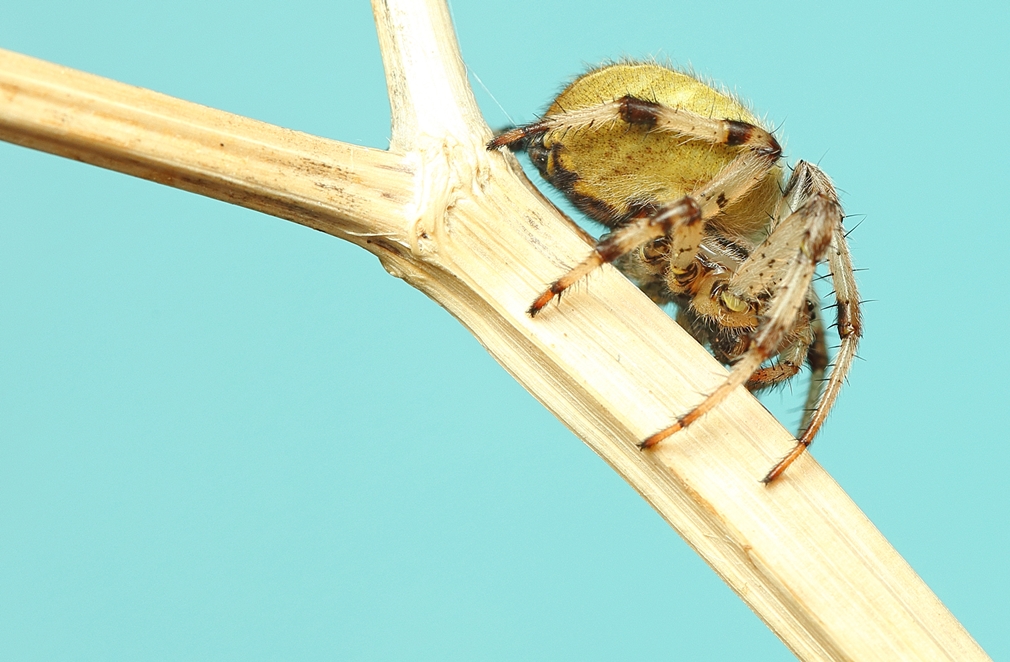


However, the males, which are quite a bit smaller, are just as impressive looking I think...


And now we arrive at that 'not too sure' moment. This next image could be another male 4-spot, but might also be a male garden spider?


I had to get the next one verified by the 'British Spider Identification' group. I had initially thought it might be a Marbled Orb-weaver, but have now had it confirmed as the very similar Bordered Orb-weaver (Neoscona adianta). 


Steven Falk on his excellent Flickr profile for this spider has this to say: This is a localised southern-biased species with the bulk off its population concentrated along the southern coast, the Home Counties, sandy areas of East Anglia, the New Forest and Dorset heaths. Favoured habitats include heathland, saltmarsh edge, fens and tall grassland.

It took a while for it to register in my rapidly ageing brain, but it eventually dawned on me that I had found this species 4 years ago, in exactly the same area; albeit a very different looking specimen...


Quite a nice example of how tricky identification can be though.


Two years after that spider find, I wrote a piece for a local magazine about the spread of an introduced spider that was first recorded in Rye in the 1920's.

I wrote that the first sighting of the species close to my home town, was probably in Ashford Kent in 1997 but that the population was exploding right across the country, and that 'You probably won't have met one of these spiders yet, but the chances are that sooner or later you will'. 

Well, a couple of weeks ago I was alerted to the presence of this species in Marden Kent by Lou Carpenter of Marden Wildlife, and so I went to see if I could find one for myself: what am I talking about? The fabulous Wasp spider (Argiope bruennichi)


Sure enough, I managed to locate one, although on that day I only captured one shot with the DSLR before it had a hissy-fit and shut down; the other image is from my phone.

However, that aside, it was encouragement enough to have a thorough search of an area right behind my house that I have suspected for a long time would be ideal habitat. That area just happens to be the same one in which I found the Orb-weavers. Would I be able to find one though? Erm...


I sure did: not only did I find this fabulous female, but I was lucky enough to spot a few more as well...


By the time I was heading for home, the tally was eight! I didn't find any males, but that's not unusual. Of course, it's in the nature of any budding naturalist that however good a day they might have had, and I'd just had a great one, well, great morning anyway, they always want more, think they could have done just that little bit better?

And so having called it a day with my spider hunting, I was mooching along towards home and thinking what would really top my spider finds, would be a wasp spider egg sac: I had been kinda looking out for them earlier, but had given up and concentrated on the spiders themselves. 

And then, right by the exit gate, something caught my eye low down in the grasses, it wasn't an egg sac, but I couldn't resist finding out what it might be, and so out came the camera again and I took this shot...


Once I got down to eye-level, I could see that it was a tiny Tortoise bug nymph. That's not all I saw either, for right behind was...an egg sac!


Wasp spider egg sacs are as you might expect, quite large, and at first glance look a little like a poppy seed pod. Boy was I pleased that I stopped to investigate that other little bug: here is proof, if proof were needed, that the spiders are indeed living and breeding locally.

That's just about it for the spider-special. Thanks to anyone who stayed with me to get this far. With any luck, and a following wind, by posting some pictures on my blog from time to time, familiarity with these intriguing creatures will go some way to assuage your fears? Probably not: but I live in hope!


Monday, August 20, 2018

You might die laughing...


"Where do I begin? To tell the story of..." (or) "Let's start at the very beginning a very good place to start..."


Yay! Two song lyrics and I haven't even got going in Ernest (as the cupcake said to the pansy). Did I really type that? Sometimes I have no control over my finger (you don't think I can use more than one to bring this to you?) and I have no chance of reaching 50 wpm. Hell, I don't even know what it stands for (as the cupcake said to the...Oops! Better get on with the plot...

The INDEPENDENT
What? The newspaper established in 1986 with a slightly liberal, left of centre bias. Here's what I found on a website called something like 'Media Fact-checker'-They often publish factual information that utilizes loaded words (wording that attempts to influence an audience by using appeal to emotion or stereotypes) to favor liberal causes.  These sources are generally trustworthy for information, but may require further investigation.

Factual Reporting: HIGH

Maybe so, but do they really need to use tabloid headliners like this?


Grrrr, it gets my goat, really it does! And I need my goat, who else will listen to me ranting about these things with blind indifference? And after all, she is my nanny. Would you like, at this point to see a picture that I took of a horsefly? Of course you would, why am I even bothering to ask, you crave one right? Well to misquote Buddy Holly, no need to 'crave-on'...


'. 
'Cool Daddy, cool' 

I hope you are keeping count of these lyrics; I found those last ones somewhere only we know. About the horseflies then, as per usual, the headlines don't reflect the facts, which are revealed...eventually:'Risks are greatest for people with a weakened immune system and if the drugs don’t work (Me: Gee thanks, you included a lyric especially for me) then minor cuts could rapidly become serious.'

'The effects of an infected horsefly bite can include a raised and nasty rash, dizziness, shortage of breath, and weak and swollen limbs.'

Yeah, and then you die a long and lingering death, during which, your knee-caps drop off and you swallow your own tongue, which tickles you to death...from the inside! 
Movin' on up...


The little plant bug that you see in this photograph is the latest addition to a long list of invertebrates that I have discovered in my equally little garden. It belongs in the Miridae family, and is called 'Deraeocoris ruber'. It feeds on other small insects and can be found on a range of plants: I regularly see it on nettle. I don't recall the name of the pink and white plant in this photo, but I shall call it Ruby...Ruby, Ruby, Ruby.


Here's something else I found on nettle, not in the garden I hasten to add... 

I failed to find an ID for this one in my moth book, and so I looked out the booklet called 'Insects on nettles'...


Then promptly put it back on the shelf: it was about as much use as an ejector seat in a helicopter! I think it might be one of the Tortrix moths, and possibly the 'Large Fruit-tree Tortrix'. Fame is but a fruit tree? ♫♫♫


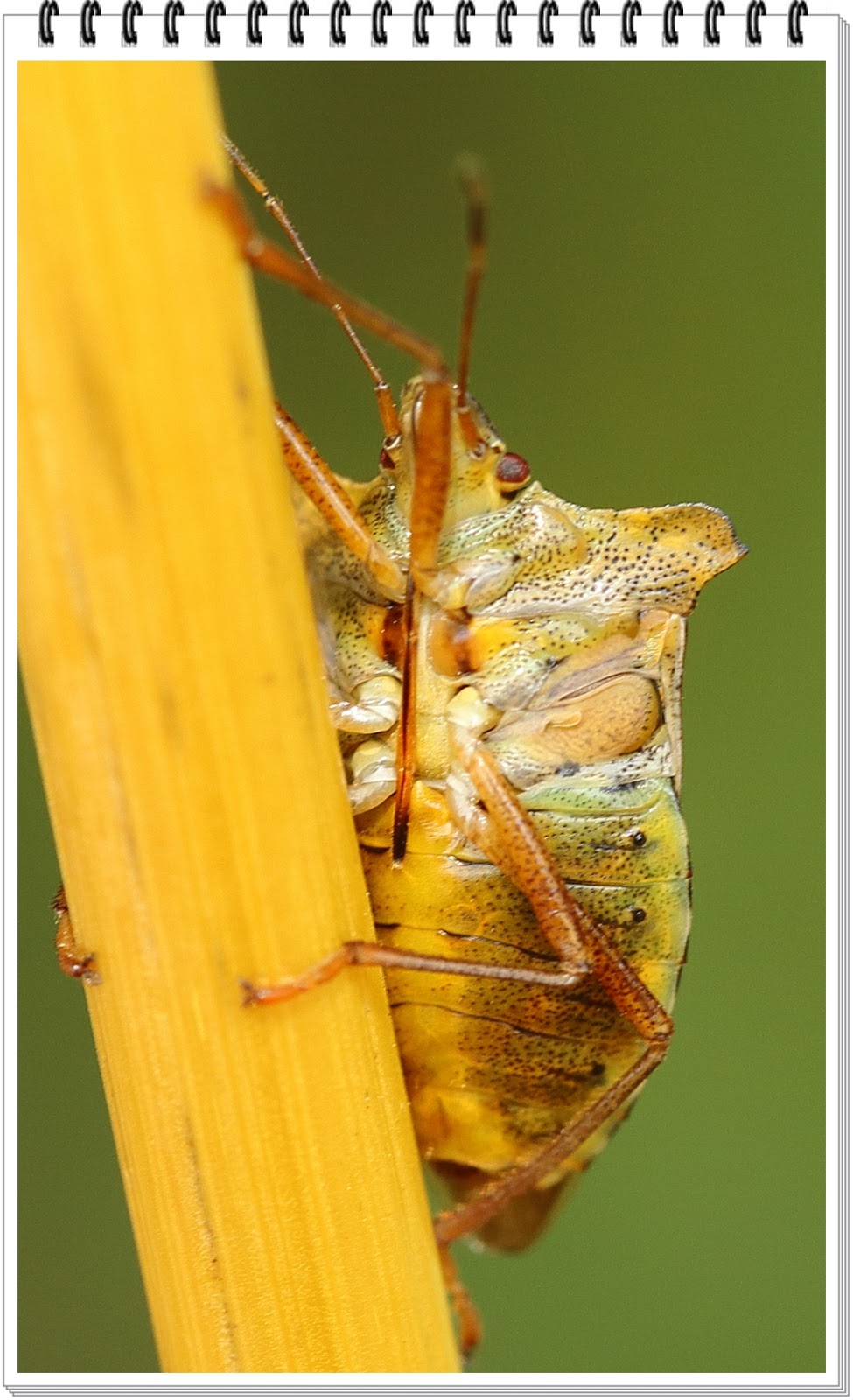
I found a couple of Red-legged Shieldbugs the other day. When I say a couple, they were actually coupled...


What interested me about these was that pale spot which tips the scutellum; apparently, those who know about these things say that it varies in colour, from orange to cream. But looking at these two, I wonder if it could be that males have orange, and females cream? Or whichever way around it works, I am assuming the female is the one on the left here.

A shot from underneath one of those bugs

And by way of a comparison, here's what a Green Shieldbug undercarriage looks like...


Palomena prasina - A Green Shieldbug

Yes, they can look very pink at times.


I always check any beech trees that I come across (that's beech, not beach, baby, beach baby) because I live in hope... that's it really; I live in hope! No, I live in hope of finding a lobster moth larva. Never have, but I have found several other interesting caterpillars, like this one...

A Green Silver Lines caterpillar - Pseudoips prasinana


A blog update wouldn't be a blog update without a spider photo now would it? C'mon, it's not as if they are spiders from Mars!

A spider!
Actually, I can do better regards identity than just 'a spider' because I happen to know this one. Yes, she's a personal friend, you might even say she's my best friend? (Let me know if you tire of these lyric references won't you: won't make a jot of difference of course.) 

Yes, this one is 'Araneus quadratus' - A Four-spotted Orb Weaver spider. How can I be sure? ;-) (Yes...ANOTHER lyric) Because I found one a couple of years ago and was able to identify that one. In fact, let me find the photo and share here, because it's a slightly less menacing photograph than the one above. this one will make you fall in love with spiders...

Araneus quadratus

 Didn't work huh? Oh well, I won't give up on trying to convert you, I won't back down. You have the photo anyway, and every picture tells a story.


The first of two questions: Do you know who this guy is?


Roderick James Nugent "Rory" Stewart, OBE, FRSL FRSGS That's who!

Obviously a very learned man: so why does he feel the need to start every sentence with the word 'so'? Is it because he is the government's prison minister and so sentences are just so for him? 

I only mention it because I heard him being interviewed on Radio 4 this morning and when I was running through my mind what I was going to write next, he came to mind, because I was about to start my next sentence with that very word!

So...

I know there has been a lot of, well let's call it frivolity, peppering this update. But now I want to try and expand your horizons just a soupcon, should your horizon be in need of expansion, which I very much doubt. 

So...

Scroll back up the page a tad, until you come to the photo of that caterpillar with the shieldbug right above. But before you do...because you won't be able to read this next bit from there: what is the connection between those two creatures?

You still here!

Oh! You have looked and now you are back, okay. If you said they are both green, then you are kinda right. Look again at their Latin names and you will see that 'Prasina' forms part of both. 'Prasina' from the Latin: Leek green.


I know, I know, I am like a visiting relative who doesn't know when it's time to leave. I'm outta here:  I'll just slip out the back, Jack!


Monday, October 21, 2013

Fund raising...

I wouldn't normally do this but I want to hijack my own blog entry for the purposes of blatant  and shameless self promotion!
Before you think I have lost the plot though, can I add that it is all in the cause of raising some much needed funds for medical research.

I have produced some posters to try and raise funds for the Alzheimer's Society. Alzheimer's and Dementia affect a huge proportion of our population and need our support. Recent developments in attempting to halt the degeneration of brain cells are promising, but more research is needed and that requires funding.
If you think you can help, please head over to my FOR SALE PAGE for full details...


On with my late October update to the blog then...

I will start with another photo of a caterpillar that I featured a couple of entries ago, the looper, that I now know to be the larva of an early thorn moth...


Firstly, what a great pose? But anyway, the reason I have added this is because I have been reading a little more about these creatures and it seems that being considered to be the best twig mimic of all, is not the whole story.

No, research now shows that they don't just rely on looking like a twig. Apparently the disguise works best where twigs are common, it seems to fool most birds more often and so during the day they will position themselves where there are lots of natural twigs, even if it means missing out on feeding.
They then move to the leaves under cover of night, where they then feed in relative safety.

It also seems to work best if the position themselves where there aren't too many others caterpillars doing the same thing as the birds do see the larvae but don't seem to find the extra effort involved in determining whether or not it is actually food worthwhile but if there are rich pickings to be had, they will then persevere.


----------------------------------------------------------------------

I was out recently on a rather dull day after rain and the flash was causing me all kinds of problems with water reflection and so decided to opt for natural light on these next pictures...


I think this large wasp is probably an Ichneumon and possibly Coelichneumon sp? There are several similar and so I can't be sure.
Not how most folks imagine a wasp to look but wasp it is.

Another surprise on this dull day was how many crickets were around on the low vegetation. I counted up to twenty of the species pictured here and then gave up, there were lots more, both male and female...


Roesel's Bush Cricket (male)

Incidentally, if you are wondering why Roesel's ? It was named after a German entomologist. I think we in the south east corner of the U.K. were the first to see this species and today the most prolific population is still to be found here, although it has spread north at quite a rate in recent years and can now be found in many other areas.


I also found this cool little leafhopper whilst out wandering the local countryside, I think this might be Idiocerus vittifrons but they are extremely difficult to tell apart...


The same goes regarding being confident over identity of this plant bug as well. I wouldn't want to go further than suggest Lygus species...


Green shieldbugs are still evident as both adults and the occasional nymph, although I have yet to find any in their winter coats (brown.)


---------------------------------------------------------------------------------------


Spiders then! I just love these little jumping spiders, they are such characters and quite feisty. They have great vision with those two large front eyes and if you take a close look at them, you will often see them turning to get a better view of you as you do so...


This one has me stumped for now regards a confirmed identity but it was very small at no more than around 2mm and has those white palps. It is a female but that's all I can say at present.


The spider photo above shows Araneus diadematus, the garden, or cross spider that is most often seen at this time of year but below is a variation, Araneus quadratus. Araneus being Latin for spider and quadratus meaning square, referring to the four prominent spots on the abdomen...


The background can be quite variable in colour ranging from orange-red to light yellow-green. This coloration can change, perhaps responding to humidity levels (greenish if moist, tending towards red if drier). 


Besides the omnipresent spiders, I am still finding tortoise bugs locally...


Of course sometimes when the weather is really bad and there are few bugs to be found anywhere, the unexpected still turns up. That's what happened the other day when it rained hard and I didn't even bother taking the camera when I went out. In fact, I didn't need to this day-the next photo was taken through the patio window...


That's right, a slug! Well on bad weather days you have to take advantage of whatever is offered right?


-----------------------------------------------------------------


Back in the summer (by the way, this is leading into another of those, what's happening here pictures)...I saw something spilling from what I think may have been a fleabane flower, anyhow, a bright yellow daisy-like flower and this is the photograph...


And so this is my question-is this nectar? If so....why did if feel solid/hard to the touch? It was quite hard.

I'll leave you with that thought until the next time....

Thanks in advance to anyone who feels they can help with my fund raising posters.