Showing posts with label Insects. Show all posts

Monday, November 04, 2019

The first new insect type in 100 years...

It's probably about  a month since I was here last. But just because I have been away from the blog does not mean I have been idle. Oh no! Far from it. Where have I been, what have I been doing?

Let's start with where I have been: it used to be bear, now it's golden. Its motto is 'Eureka'. 'General Sherman' is almost certainly its oldest inhabitant  estimated to be 4,650 years old!  A well known valley here set  the hottest temperature ever recorded in the world- 134 degrees Fahrenheit. One visual clue? Okay here it is...

                  
Nope, I don't really understand that graph either; but it is supposed to represent the vowel shifts associated with 'California-English'. And so just in case you missed the not-so-subtle clue there: yes, I have been in California again.
Did I take my macro camera gear with me? You betcha!

Do I have photographs to share? You bet your sweet bippy I do...


Now I am no expert on North American insects but I think this might be Hylephila phyleus - The Fiery Skipper.


Not too sure about this darker one though. I spent way too long trying to research an identity for this little skipper and the closest I could get was Poanes melane - The Umber Skipper: hope that's right.

I do have more skipper photographs, plenty more to be exact as unlike here in the UK, there were still lots around: but let's skip those for now and move on to one of my favourite tiny creatures...


These  jumping spiders are pretty commonplace it seems, but a real challenge to photograph. I kinda wish I had taken the extreme macro lens, but was trying to travel as light as possible.

Then again, I wish I hadn't just invented an excuse as to why these photos aren't sharper. How about if I said that I was enjoying being in America, and in particular the Californian sunshine, so much, that I  was possibly not giving photography my fullest attention? 


Let's move on shall we. I know you don't all appreciate the beauty that I see in spiders. I cannot claim that I found this next creature myself, because, well, I didn't. But...I did manage to sneak a couple of pictures of what turned out to be a pretty impressive shieldbug, or stinkbug as they like to call them ...


Brochymena arborea, otherwise known as the Rough Stink Bug would be my guess for this one. Rough stink bugs are very well camouflaged and closely resemble the colour and texture of the tree bark on which they live. And in case you are looking at my photo and thinking to yourself 'It doesn't look well camouflaged to me', this one was underneath the bark, the other side was very similar in appearance to the bug.

There are a couple of other Bronchymena species that it might be, but I plumped for this one after much consideration. Frankly I was starting to get bug-eyed and losing the will to live anyway, so settled on it being Bronchy-thingy-wotsit...whatever I said at the start of this ramble.


Well if attempting to identify the last critter tried my patience, then this one, at least for a while, completely banjaxed it! At first sight I thought it might be Plectoptera (Stonefly) but that didn't seem to fit perfectly. Snakefly? Nope. Flying ant? Nope. Have a look at my photograph, see what you think...


While you are contemplating that image, did I mention that there was an earthquake during the second week of my visit? Yes, 4.5 or 4.7 depending on which report you read. It was surreal: it was about 10.30 at night and I was already in bed. You don't expect to be lying in bed and then the earth suddenly moves do you! Not in my bed you don't.
                                                     ðŸ˜‚


Anyhow, back to the story; after doin' me 'ead in trying to  find out just what kind of creature this was, I had a lightbulb moment. Doesn't happen very often, but somewhere in the back of my mind I thought I recalled reading something on the BBC website that might be pertinent, and sure enough, a quick Google revealed this...


Well butter my butt and call me a biscuit! A webspinner eh, and we now have them here in parts of the UK. But what is a webspinner? Here's the official word:

The order Embioptera, commonly known as webspinners or footspinners, are a small group of mostly tropical and subtropical insects, classified under the subclass Pterygota. The order has also been called Embiodea or Embiidina. Webspinners have up to 2.5cm long brown bodies and are the only insects that produce a silk webbing from their front legs, living in tunnels constructed from it to protect themselves from the elements and predators.

And so this actually turned out to be quite an intriguing find for me.


The story even made the Telegraph newspaper who ran this headline:


Britain gets first new insect type in 100 years, as webspinner from the Tropics found to have migrated to Surrey.

Too much excitement is bad for your ulcer, and so let's calm things down a little here; there was one particular insect that I had on my wish list for this visit, not going to reveal it just yet, but here's an anagram to tide you over...'tis a man'. C'mon, I may as well have told you outright huh?


This photograph (above) is 'Asclepias speciosa' the Showy Milkweed. It belongs to the Acanthus family of plants and seems to be well suited to the Californian growing conditions. It has these rather large (about 3 inches or so) fruit pods and attracts many insects, including aphids by the thousand, and a superb looking bug called a Large Milkweed Bug (Oncopeltus fasciatus). 


The large amount of aphids is of no consequence to the milkweed bugs as far as being a source of food. Milkweed bugs are herbivores and consume milkweed seeds. Compared to here in the Uk it seemed very late for nymphs to be still around, but not in California: in favourable conditions reproduction occurs all year round. 

An adult male and lower photo shows two nymphs.

Many fruit pods were alive with both adults and juveniles.
Apparently studies have show that northern populations of these bugs will migrate, whereas southern ones remain sedentary.


Well this blog update that began as a leisurely stroll through Californian wildlife, has already become something of a behemoth. I guess I should get to my exciting 'tis a man' finds; or MANTIS as I like to call them. Yes, I am sayin mantis rather than 'a mantis' for a very good reason.

Yes, the one thing I was hoping to find this visit was a mantis: timing seemed good and so I was hopeful that by the end of my stay  I'd be able to cross it off my bucket list.

Wednesday October 9th was my first day out with the camera searching for these amazing insects. Did I find one? No I did not.

What I did find though was FIVE! Yes...F-I-V-E !!

Well...paint me green and call me a cucumber!

I took squillions of photos, but somehow managed to keep the total to just six for this update - although I may get tempted to add more to future updates.


I was SO excited to see these that I almost had an accident! On the very first day as well: in their natural environment too. Fabulous insects full of intrigue and wonder for this English country boy. 

Now you are not going to ask me to identify these to species level are you? Oh, you are... bugger...erm... Arizona Mantis (Stagmomantis limbata) was one possibility, with European mantis (Mantis religiosa) being another. Or even possibly California Mantis (Stagmomantis californica)  for the green ones. Perhaps the darker/slimmer one might be something like Japanese (Tenodera aridifolia) or Chinese (Tenodera sinensis) Mantis?


What I do know is that they are stunning insects for me and after finding and photographing them, I was on a high for the rest of that day. I had several more encounters over the next days and weeks which I may get to share sometime soon.


Alright, time to call an end to all this indulgence for now. A couple of final thoughts to share: I discovered that I do not like dill pickles! Euwwww! I don't even like the look of corn dogs, let alone the thought of eating all that batter. As for the corn cob pipe, which looks like this...


No thanks friend. 

What did I enjoy? Well I now have a penchant for brownies and the root beer I tried was pleasant enough. 

Thanks for wading through this rather long update: I am most grateful to you -


A very quick postscript?

Okay, I will be concise: when I got to San Francisco airport to board a plane home, I was amazed, and more than a little excited, to find that INSECTS were on display throughout the part of the airport I was in...


Shame nobody spell-checked the text!


Tuesday, February 12, 2019

A different but very important update subject...

A note from the author of this update: 

Regular readers will know that these updates are usually fairly lightweight affairs that contain a certain amount of what I like to think of as humour. Usually they are sprinkled with my own photographs as well.

This one off is different. I felt there was no room for levity and accordingly, apologise for this (brief) change of direction. It is very important to me though, and whilst I can only hope that you might have enough time and patience to make it to the end of this writing, I thank you in advance for letting me vent!


Headlines like this that have been appearing right across the media in the past few days have been the inspiration for writing this blog update:


World's insects could be wiped out 'within a century' as scientists warn they are dying out eight times faster than mammals

  • Insects are dying out eight-times faster than mammals, birds and reptiles
  • Study suggests that insects could become extinct in 100 years at this rate 
  • The decline, described as a worldwide crisis, is blamed on intensive agriculture 
  • Scientist say we have entered the first mass extinction since the dinosaurs. 


INSECTS
Are we about to destroy 480 million years of insect evolution and symbiosis?


At any given time, it is estimated that there are ten Quintilian (10,000,000,000,000,000,000) individual insects alive. That's about 200 million insects for every human on the planet, depending on which estimate you use. And yet man is not only capable of eradicating every last one, but has already begun travelling that road.

Even scarier is the fact that we have not even been able to describe all of the insect species on earth yet: in fact, it is estimated that there are many more undiscovered species than we currently recognise.

How many warnings do we need that it would mean catastrophe for not only the insect population if we fail to act, but the human race itself would be doomed. I have reports dating back 30 years that address this issue, yet STILL it falls on deaf ears.

Now given that most folk have an inbuilt dread of insects and would possibly welcome a world without them; let’s just get this argument out of the way once and for all shall we.

Those of us who belong in the Entomophobia camp, usually seem to hold the following views: if insects disappeared, there would be no more mosquito bites and far more significantly, the scourge of insect-spread diseases, like malaria and dengue fever, which infect millions and kill hundreds of thousands of people a year would be over. Farmers would also no longer need to use insecticides — more than 500 million pounds of the chemicals are used annually just in the United States alone.

For starters approximately 80% of the world’s plants rely on pollination to reproduce: the vast majority of pollination is carried out by insects. Therefore, most of the plants on earth would soon disappear, we cannot possibly pollinate such vast numbers by hand. So what, I hear you say? Here’s what…between 50 and 90 percent of the human diet by both volume and calories, depending on the country, comes directly from flowering plants.


Secondly, if the insects are all gone, a lot of mammals and birds will also die out.  Insects are the primary food source for birds, amphibians, fish and reptiles. Even those animals that don’t eat insects will have no fruit or foliage to eat. Ghoulishly, all the resulting dead trees and animal carcasses — and human bodies — would linger around far longer, decomposing much slower than they would in a world abuzz with insects.

That would necessitate at the very least new ways of dealing with the dead, and at worst, new diseases appearing as a result.


Thirdly, no more honey or silk. Both are produced by insects of course. Insects are the main drivers of many of our ecosystems on land and in freshwater. The cycling of nutrients such as carbon and nitrogen through the ecosystems would come to an abrupt end.

Without insects, the environment would simply fall apart.

So what are the causes of this catastrophe? The biggest threats are that of intensive agriculture and pollution in the forms of pesticides and fertilisers.

A lot of it is also to do with uprooting hedgerows and producing huge monocultures which don't leave space for anything else to thrive. Global warming is another factor, despite what Mr Trumpton says!

So what is to be done? Reversing the land use from so much intensive farming and urban sprawl. Planting wild flower meadows: outrageously in my opinion, some farmers are being paid by the government to do this already. When they should be caring for our planet as a matter of course.

Schooling! Inspiring the next generation and imbuing them with a sense of understanding of just how important the insects are. There is a huge bias towards vertebrates, and even just the ‘pretty ones’ amongst them. TV programmes like Springwatch are guilty of paying less attention to the invertebrates than they should. We are told they have a ready audience of millions of nature-loving people, so instead of wasting air time by chortling over ‘in’ jokes and inventing silly names for animals, why not educate us about THE most populous species on earth?

Replace pesticides with more sustainable crop-growing practices.

I have only scratched the surface of this enormous subject, and will by default have omitted some important factors. However, what I do know is that I love nature and the natural world, and that includes the insects. They were here long before us and will probably be here long after we have gone, unless! We carry on in our stupid, blind way and kill them off for good. In my own small way I have witnessed an alarming decrease in insect species right here in the South of England. Many species I would see in large number each year, have seemingly disappeared. 

Call me odd, call me a weirdo, mock me, laugh at me if you want, but PLEASE......believe me, this is not scaremongering  or fake news. It will come to pass unless we change our ways.

I don't expect you to love invertebrates as I do but we can all do something to help. Make your garden wildlife friendly, put up bug hotels. Pressure your MP to get changes in the law regards habitat loss and pesticides. Educate the children that insects are not to be feared: of the huge numbers of insects, only a tiny amount, one percent, are harmful to humans. Most insects are harmless or actually beneficial.


We must start listening and act now.


Saturday, May 25, 2013

Butterflies and The Bard.....

Just back from a week in Oxfordshire and whilst there I managed to find time to cross the border into Warwickshire and pay a visit to the Butterfly Farm at Stratford-upon-Avon.


Billed as 'The UK's largest tropical butterfly paradise' and located on the south bank of the river Avon,opposite the Royal Shakespeare Theatre, I had read about it and was keen to take a look for myself.

Even after preparing my camera for the humid conditions by sealing inside a plastic bag, it was still around 20 minutes before it had settled enough to allow me to take any pictures:Very hot and humid inside there. 

However, once I'd sorted that, there were subjects a'plenty to photograph and aside from the constant,but expected interruptions caused by the numerous parties of schoolchildren being ushered around, at what seemed to be every 15 minutes,I was in butterfly heaven.


I didn't find photographing some of these insects at all easy using just natural light indoors but even though it would have been possible, I really didn't feel I wanted to add flash.


It was also a little challenging to get anything other than distracting backgrounds. There was lots of rich vegetation and not much space between planting. I suppose I had around 90 minutes at the farm and could easily have spent all day getting the shots I wanted but there were other things to do that day and anyhow, I was already starting to flag in the heat.


I have to add that having said how I struggled with getting the photos I wanted, I met a Frenchwoman with a little 'Ixus' camera that she described as 'cheap but very good' and was impressed by both how close it allowed her to focus (I think from memory she said something like, less than 25mm) and then how great her photos looked onscreen.


Tree Nymph Butterfly

I wish I could provide identities for all of these wonderful insects but I am unable to do that without extensive research and try as I might, I could find no relative information at the farm. 


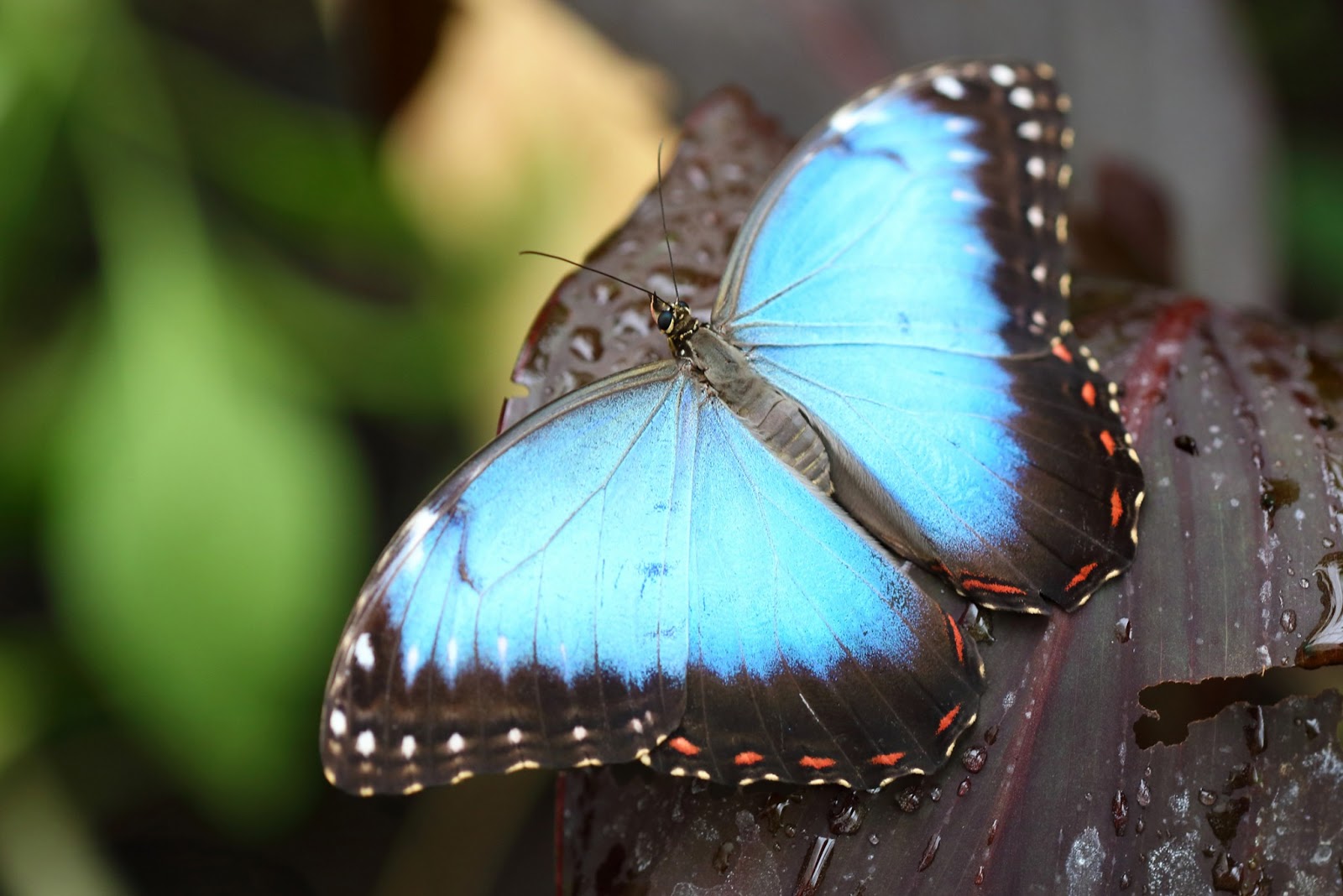
Blue Morpho Butterfly


This selection illustrated here is but a tiny proportion of the total I could have photographed and as well as the insects there were plenty of caterpillars too...


Then I found some eggs to add to my haul. I think these may well be moth rather than butterfly...


Actually,looking at them again here,I'm not even sure they are viable. They do seem to be a bit messy.

In the caterpillar room, by the way that's not where I found mine, those were on the foliage inside the main dome with the butterflies, I had a go at photographing some pupae. These were all either behind glass or netting...


Again,I'm almost ashamed to admit it but I have no idea which insect these pupae represent but some of the most spectacular ones I have ever seen were these golden ones...


And so a visit to the butterfly farm was a terrific way to spend some time and I will certainly be returning sometime soon. There is also an 'Insect City' with stick insects, beetles, leaf-cutting ants, as well as millipedes,snails and crabs in the mini-beast section that I didn't even manage time to visit this time.

I was however struck by the amount of butterflies,in fact,almost all that I photographed, that showed signs of damaged/tatty wings. I thought about it a lot and decided to e.mail the farm for an explanation;asking if this is common in the wild or something related to how they are kept indoors. I have as yet not had a reply but will publish it here should I get an answer from them.

Until the next time then...


More information on the butterfly farm....HERE


Saturday, May 05, 2012

I don't mind the wet weather, it's fine by me...

It's still a case of trying to dodge the rain to photograph and record invertebrates for now, as the sunshine of a warm March declined into one of the wettest April months on record.
 May has begun in similar fashion: but on one of the few sunny mornings we've had I ventured out to check local ponds for damselflies and was pleased to find several had emerged at each of the ponds.


A Large Red Damselfly

Different weather conditions suits different creatures of course and I've noticed this year that whereas previous years have seen the tops of nettles becoming home to weevils, they seem to be full of earwigs now. Something to do with the dampness no doubt.


CLICK ANY PHOTO FOR A LARGER VIEW


This earwig, pictured above wasn't actually on nettle but unusually on a grass stem, overhanging the pond where I found the damselfly. It must have been there all night as it was soaked.

I took another shot from a different angle that had bluebells in the background and I quite like the effect.....


The other observation I've made is that some critters just don't seem to mind, or perhaps they're not even aware of, the bad weather. If you're brave enough to venture out with the camera, or perhaps in my case, stupid enough! There's always something to be found and photographed.It may not be what you were looking for-most times it isn't, but I can usually find something.


This attractive little beetle was sitting a'top a large grass seed-head and was making no attempt to shelter from the rain.
'Malachius bipustulatus' is the scientific name for this one, I can never remember that though (as with most of these complicated names) and so I prefer it's common name of Malachite Beetle.

Easily recognised by the twin red spots at it's rear and reasonably easy to see, even though it's only around 5-6mm by virtue of the fact it has the bright, metallic green elytra.

Malachite Beetle face-on close up


The other creature that loves all this wet weather of course is the humble snail. I've not seen any figures yet that say this is going to be a good year for them but if the numbers I've been seeing are anything to go by, they probably are.


The first shot here is a natural light photo, hence the paler, more subdued colours. As you can see in the photograph below the addition of flash, especially on a dull day, can result in a more saturated image. I possibly overdid the flash a tad here too as it's close to being blown. I wanted to share this shot though and frankly, couldn't be arsed to 'PS' the image!

Just hangin'

Returning to Coleoptera (Beetles) for a second. On yet another foray into what was once a woodland walk, but now resembles a paddy-field, I got my first sighting of a big red beetle that usually turns up in May each year. This is the Cardinal Beetle (Pyrochroa serraticornis) that at about 15mm plus, is treble the size of the malachite beetle.


Sometimes called a red-headed cardinal beetle, for obvious reasons. There is also another very similar beetle that has a black head. I don't think I need to tell you what that one gets called?


A dorsal view of the cardinal beetle

On one of the numerous days when outside photography was not an option, I decided to do some work on tidying the garden shed (again) and when moving things around, out from behind a length of wood crawled this vine weevil.


As I'm constantly being told, vine weevils are very destructive in the garden and to be avoided at all costs.
Even so, I couldn't bring myself to destroy such a wonderful looking creature and my view is that there's a place for everything in this world and that includes vine weevils.

I just hope that it's happy in its new home.......next door's garden!


I'll leave you with that thought-until the next time.....