Showing posts with label Leptoglossus occidentalis. Show all posts

Sunday, February 24, 2019

Wide eyed and legless...

This was how we saw out January here in darkest Kent...


With daytime temperatures like this...


But the weather in this part of the world has been exceptional for a while now, and on yet another fine February day that evoked Robert Browning poetry, I ventured out with the macro lens to see what I could find...


Dunno, but here's another one...


Actually I do know. At least, I have some idea. These are Bagworm moth larvae of the Psychidae family.

The  larvae of  Psychidae construct cases out of silk and environmental materials such as sand, soil, lichen, or plant materials. These cases are attached to rocks, trees or fences while resting or during their pupa stage, but are otherwise mobile.

A bagworm begins to build its case as soon as it hatches. Once the case is built, only adult males ever leave the case, never to return, when they take flight to find a mate.

In the larval stage, bagworms extend their head and thorax from their mobile case to devour the leaves of host plants.

And yes...there is a caterpillar inside of those strange constructions; here's another, larger one that I found...


Just to prove that it was moving around; I tried to get a little video, but this was at about x3 mag using the MP-E 65mm macro lens and natural light. Holding it steady and getting the camera to focus was not easy. In fact, almost impossible.


Warning: This video may not appear in emailed versions of my blog...

(Apologies for the 'up next' notification at end of video. The option to remove this has been removed by YouTube recently.)


Shall we have another from the...

Okily, dokily!


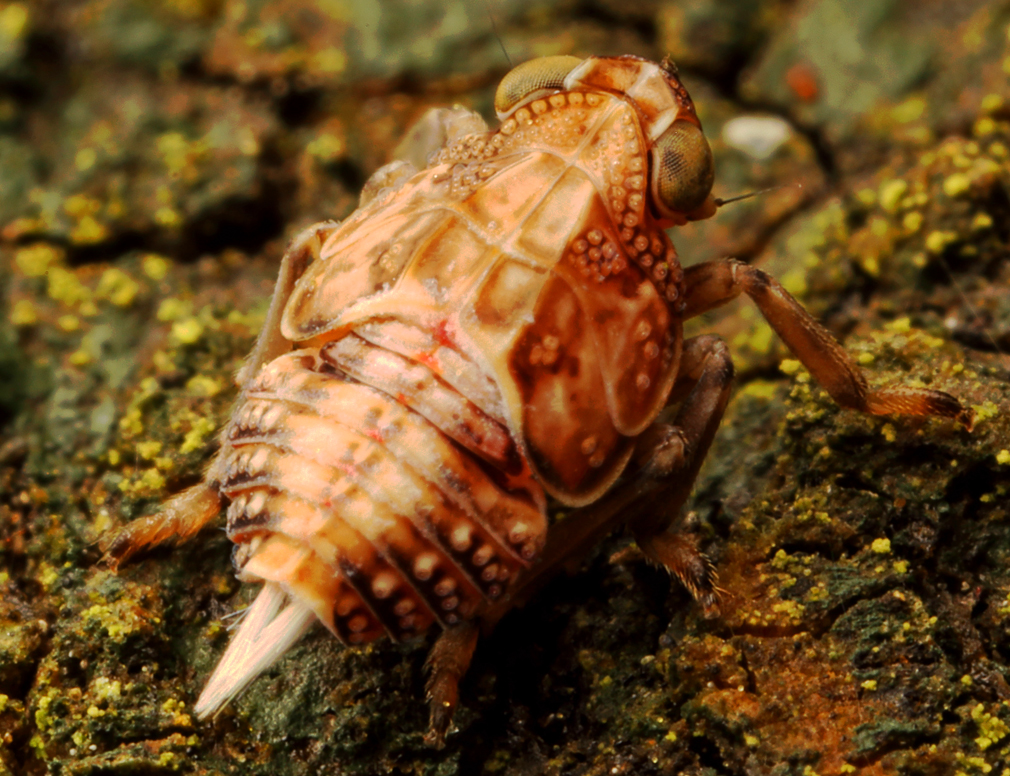
Issus coleoptratus is a species of planthopper belonging to the family Issidae.

This is an early/mid instar, which means it has a lot of growing to do yet. The adult hopper will have a totally different appearance...

Adult Issus coleoptratus hopper


My mantra on these bug walks is 'One good find', I always tell myself that if I have one good find, I can regard it as a successful day. And this next photograph demonstrates just that: my one good find. Although to be fair, I was rather pleased with all of my finds, anyhow, here it is...


This one is Leptolossus occidentalis, a Western Conifer Seed Bug. A large, impressive squashbug. In fact so large that I struggled to fit it all in the viewfinder. It is not a native bug and was first detected in the UK in 2007. I think they must be well established here in Kent now. This is the third location I have found them at.

The long legs with twin claws

In for a penny, in for a pound!
More weirdos...


I think this is an inebriated Soldier Fly larva. If not intoxicated, definitely legless. 

And this final weirdo has me foxed: I have no clue as to what it is...


Possibly another fly larva but i'm not even convinced that is correct.


I will take my leave of you with this walking hard hat...


Sunday, November 23, 2014

An international flavour to this update...

It's around three weeks since I last updated the blog and so what has been happening during that time?

Well the main event for me was the sudden appearance of a large migrant bug in my bathroom window. It's one that I have found once before, but that was out in the field and a few miles from home and so this was a bit of a surprise, They must be spreading faster and further than I'd appreciated...


A Western Conifer Seed Bug (Leptoglossus occidentalis)

A Western Conifer Seed Bug (Leptoglossus occidentalis)

This is a large squash bug that is similar to our own Dock Bug but more elongate in shape and around 20mm rather than the 15mm of Coreus marginatus. Here's a piece about the distribution of this interloper, with due credit to Britishbugs.org.uk/ : 

Geographical Distribution
Leptoglossus occidentalis was originally restricted to western parts of the United
States, Canada and Mexico, but in recent decades it has spread eastward and can
now be found over almost the whole of North America. It was accidentally
introduced into Europe in 1999, to northern Italy, and has since spread rapidly, being
recorded from Switzerland in 2002, Spain and Slovenia in 2003, Croatia and
Hungary in 2004, Austria in 2005, Germany, France, Serbia and the Czech Republic
in 2006, Belgium, Britain and Slovakia in 2007, and from Montenegro and Poland in
2008. In the UK, the majority of records have been of adults observed at light traps
along the south coast of England, clearly indicating a large migration across the

English Channel.


Here's a photo showing the very distinctive expansion of the hind tibiae...


I think this one must have been attracted to the light and then came in through an open window. They are known to enter buildings in search of a hibernation spot. Which brings me to this little video; it doesn't show any interesting behaviour, but it was taken after I released it into the garden. It was quite a windy day by the way...


Three days have elapsed since I placed the bug on this plant, I have kept an eagle eye on it each day and it is still in exactly the same spot; well, on the same plant anyhow. It has just concealed itself underneath one of the leaves and that has me wondering if the garden was the best choice to release it, when maybe I ought to have kept it inside somewhere for the winter?


I read recently of a couple of people who have kept these in a dry but cool place and that they can live on just water and reserves through the winter months- maybe I'll consider that, if it remains in place much longer?


A Canadian friend recently sent me a photograph of what she suspected was 'spider related' and asked if I could confirm. She lives in Burlington-Ontario Canada...

The Canadian mystery object
 I was able to tell her that it does indeed look like a spider egg sac and possibly an Orb Weaver (maybe the Cross Orb Weaver-Aranueus diadematus.) Coincidentally, I found a very similar one a couple of days ago under a log...


Here's a little added information I cribbed from the internet, as I know Cathy will be looking forward to having up to 800 spiderlings come next spring...

Male spiders reach adulthood ahead of females and may pair up with immature females, waiting for them to become sexually mature. Females spin egg sacs in late summer or autumn that are about 20mm in diameter and comprised of golden silk. They are constructed (seemingly “plastered”) in a protected place somewhat away from the web, sometimes attached to the eaves of buildings or inside rolled-up leaves or other foliage. Female dies shortly after laying her eggs. Each egg sac can contain anywhere from 100 to 800 yellowish eggs. Typically, only one egg sac is made per female. Spiderlings emerge from the sac the following spring and remain clumped together for a day or two, after which they disperse.

One of my own reference photos of the 'cute' spiderlings


Whilst we are visiting the Northern Hemisphere, I don't think by the way there's any foundation to the story I read about Canada being a migratory country that 'we pick up and move to wherever the weather is nicest' but anyhow, I have a good friend who lives in California, who this year was lucky enough to be able to visit the monarch butterfly migration in Natural Bridges, Santa Cruz.

They have very kindly given me permission to share a few photographs on my blog, for which I am very grateful...


Monarch butterflies return to the Californian coast in September/October each year in search of the milder temperatures. Most will have journeyed some 1,500 miles from places like Washington, Arizona and New Mexico and will remain through 'til March...


The monarch migration from their summer breeding ground takes four generations, meaning that the ones arriving this year are the great-great grandchildren of the ones from last year.


It has been known for this beautiful butterfly to turn up in the UK but with total sightings at less than 500 since the 1800s I won't be holding my breath to see one anytime soon; I just wish I'd been there myself to witness what must have been a spectacular event.

Lastly I wanted to include a shot of the fantastic larvae, oh and thank 'TT' for allowing me to include these pictures...


Something that I came across completely by accident, when I was photographing other things, was this robin doing what I can only describe as grunting. It's only a very short clip and a bit shaky too...I will explain after you watch the video...


In all honesty, the reason this isn't great is that I have to admit, I was out with the macro rig when I saw this robin and so, keeping the macro and flash in one hand, I got the trusty point and shoot in the other, zoomed in and just shot what I thought was a photo, without checking the settings. It transpired that the camera was set on video mode...Ooops!

I haven't seen a robin do this before but I suppose it must be territorial? Either that or it's got a cough...


The unseasonably mild weather has continued here in Kent and that has allowed the garden wildlife to remain active to a point. I spotted this damsel bug on the butterfly bush (Buddleia) when I was checking for aphids, of which there are huge numbers right now...


A phone grab of the aphids

On the same plant I also found this threesome...

2 x Moth larvae and a Green Tortoise Beetle


And under a fallen leaf I found this soldier beetle larva. The larva are soil dwelling and are predatory...

Cantharis larva


Cantharis larva
This last image will probably give you a better idea of the size of this larva...


And although I can't be certain exactly which species this is, the adult beetle will look something like this...


In my experience it won't be an adult long before it's doing this either!


That about wraps up yet another update, I'll leave you with this shot of the little lane I walk most days...


Until the next time...