Showing posts with label Tortoise Beetle. Show all posts

Sunday, November 23, 2014

An international flavour to this update...

It's around three weeks since I last updated the blog and so what has been happening during that time?

Well the main event for me was the sudden appearance of a large migrant bug in my bathroom window. It's one that I have found once before, but that was out in the field and a few miles from home and so this was a bit of a surprise, They must be spreading faster and further than I'd appreciated...


A Western Conifer Seed Bug (Leptoglossus occidentalis)

A Western Conifer Seed Bug (Leptoglossus occidentalis)

This is a large squash bug that is similar to our own Dock Bug but more elongate in shape and around 20mm rather than the 15mm of Coreus marginatus. Here's a piece about the distribution of this interloper, with due credit to Britishbugs.org.uk/ : 

Geographical Distribution
Leptoglossus occidentalis was originally restricted to western parts of the United
States, Canada and Mexico, but in recent decades it has spread eastward and can
now be found over almost the whole of North America. It was accidentally
introduced into Europe in 1999, to northern Italy, and has since spread rapidly, being
recorded from Switzerland in 2002, Spain and Slovenia in 2003, Croatia and
Hungary in 2004, Austria in 2005, Germany, France, Serbia and the Czech Republic
in 2006, Belgium, Britain and Slovakia in 2007, and from Montenegro and Poland in
2008. In the UK, the majority of records have been of adults observed at light traps
along the south coast of England, clearly indicating a large migration across the

English Channel.


Here's a photo showing the very distinctive expansion of the hind tibiae...


I think this one must have been attracted to the light and then came in through an open window. They are known to enter buildings in search of a hibernation spot. Which brings me to this little video; it doesn't show any interesting behaviour, but it was taken after I released it into the garden. It was quite a windy day by the way...


Three days have elapsed since I placed the bug on this plant, I have kept an eagle eye on it each day and it is still in exactly the same spot; well, on the same plant anyhow. It has just concealed itself underneath one of the leaves and that has me wondering if the garden was the best choice to release it, when maybe I ought to have kept it inside somewhere for the winter?


I read recently of a couple of people who have kept these in a dry but cool place and that they can live on just water and reserves through the winter months- maybe I'll consider that, if it remains in place much longer?


A Canadian friend recently sent me a photograph of what she suspected was 'spider related' and asked if I could confirm. She lives in Burlington-Ontario Canada...

The Canadian mystery object
 I was able to tell her that it does indeed look like a spider egg sac and possibly an Orb Weaver (maybe the Cross Orb Weaver-Aranueus diadematus.) Coincidentally, I found a very similar one a couple of days ago under a log...


Here's a little added information I cribbed from the internet, as I know Cathy will be looking forward to having up to 800 spiderlings come next spring...

Male spiders reach adulthood ahead of females and may pair up with immature females, waiting for them to become sexually mature. Females spin egg sacs in late summer or autumn that are about 20mm in diameter and comprised of golden silk. They are constructed (seemingly “plastered”) in a protected place somewhat away from the web, sometimes attached to the eaves of buildings or inside rolled-up leaves or other foliage. Female dies shortly after laying her eggs. Each egg sac can contain anywhere from 100 to 800 yellowish eggs. Typically, only one egg sac is made per female. Spiderlings emerge from the sac the following spring and remain clumped together for a day or two, after which they disperse.

One of my own reference photos of the 'cute' spiderlings


Whilst we are visiting the Northern Hemisphere, I don't think by the way there's any foundation to the story I read about Canada being a migratory country that 'we pick up and move to wherever the weather is nicest' but anyhow, I have a good friend who lives in California, who this year was lucky enough to be able to visit the monarch butterfly migration in Natural Bridges, Santa Cruz.

They have very kindly given me permission to share a few photographs on my blog, for which I am very grateful...


Monarch butterflies return to the Californian coast in September/October each year in search of the milder temperatures. Most will have journeyed some 1,500 miles from places like Washington, Arizona and New Mexico and will remain through 'til March...


The monarch migration from their summer breeding ground takes four generations, meaning that the ones arriving this year are the great-great grandchildren of the ones from last year.


It has been known for this beautiful butterfly to turn up in the UK but with total sightings at less than 500 since the 1800s I won't be holding my breath to see one anytime soon; I just wish I'd been there myself to witness what must have been a spectacular event.

Lastly I wanted to include a shot of the fantastic larvae, oh and thank 'TT' for allowing me to include these pictures...


Something that I came across completely by accident, when I was photographing other things, was this robin doing what I can only describe as grunting. It's only a very short clip and a bit shaky too...I will explain after you watch the video...


In all honesty, the reason this isn't great is that I have to admit, I was out with the macro rig when I saw this robin and so, keeping the macro and flash in one hand, I got the trusty point and shoot in the other, zoomed in and just shot what I thought was a photo, without checking the settings. It transpired that the camera was set on video mode...Ooops!

I haven't seen a robin do this before but I suppose it must be territorial? Either that or it's got a cough...


The unseasonably mild weather has continued here in Kent and that has allowed the garden wildlife to remain active to a point. I spotted this damsel bug on the butterfly bush (Buddleia) when I was checking for aphids, of which there are huge numbers right now...


A phone grab of the aphids

On the same plant I also found this threesome...

2 x Moth larvae and a Green Tortoise Beetle


And under a fallen leaf I found this soldier beetle larva. The larva are soil dwelling and are predatory...

Cantharis larva


Cantharis larva
This last image will probably give you a better idea of the size of this larva...


And although I can't be certain exactly which species this is, the adult beetle will look something like this...


In my experience it won't be an adult long before it's doing this either!


That about wraps up yet another update, I'll leave you with this shot of the little lane I walk most days...


Until the next time...

Wednesday, June 26, 2013

Strangely strange....

Some blog posts will suit certain folks...and others not. I would suggest that if you have a fear of spiders,or even, photos of spiders, then this one may be a 'not' for you! You have been warned.....

Having said all that, these,to my mind anyhow,are the cuties of the spider world and one of my favourite species...I speak of the Jumping Spiders.

I was lucky enough to find a pair of what I think may be Evarcha species? (don't hold me to that) and the........mating... was quite......energetic...


Well,that's something you won't see everyday...and here's another...

This is the 'birth' of tiny hoverfly larvae...


Click on any photo for a larger image


The eggs that these emerged from are only a couple of millimetres in length and so you can see how small the larvae themselves are.

I also came across another larva, this one was green...


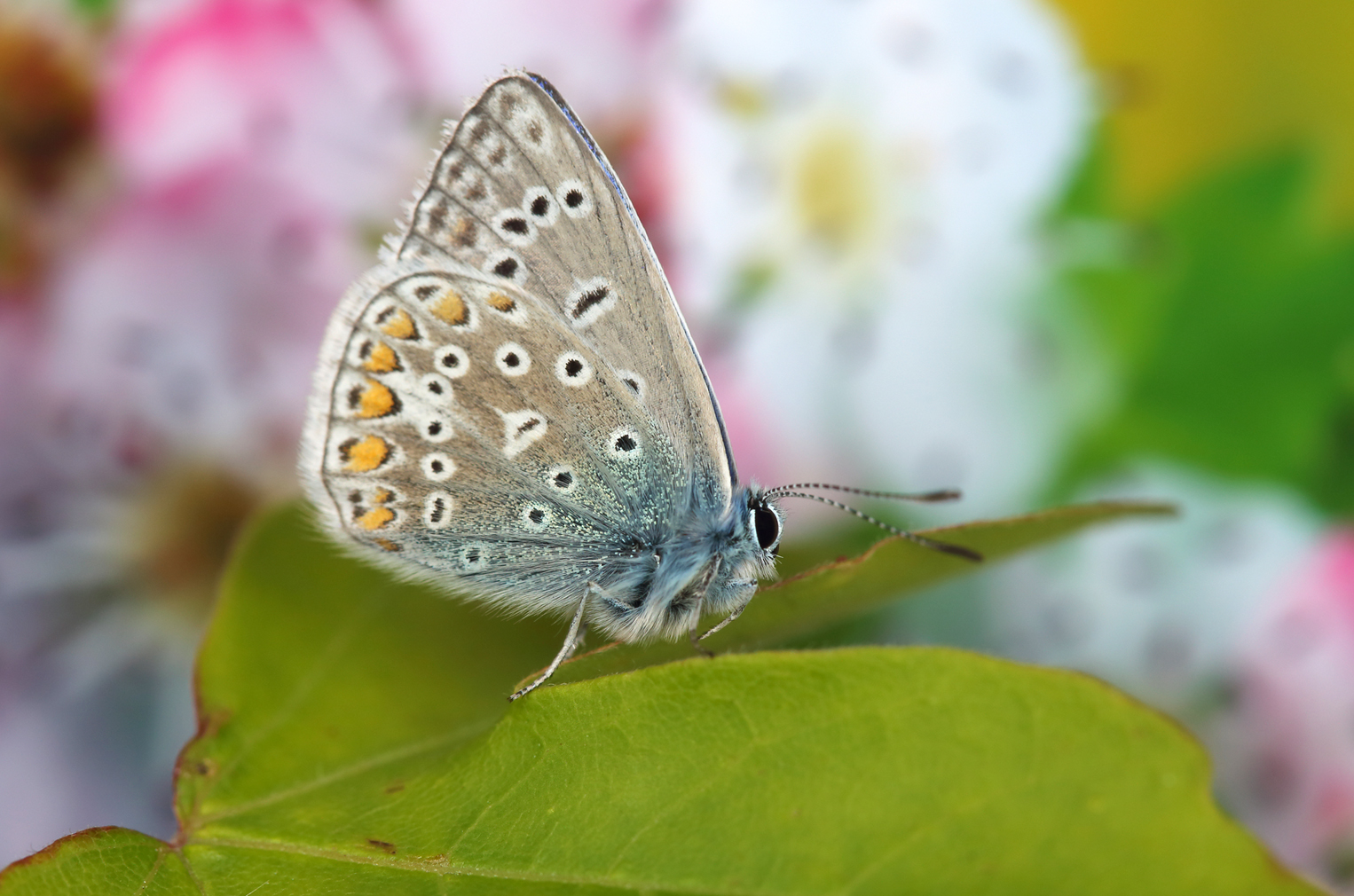
And then, a couple of firsts for 2013 to follow. My first Common Blue Butterfly and also a Tortoise Bug...


And so to the 'stranger than strange' section for this update...

I love seeking out the odd or unusual in the natural world and here are a couple of offerings that illustrate this beautifully?


I think this one pictured above is the larva of the cereal leaf beetle. I have found these before and although this one differs a tad in colour/pattern, I reckon it must be the same species.

Second one is...well..is, more of a mystery at this stage. The only thing I can say at this stage is that, I have found something very similar before and although I was unable to come up with an identity, somebody was kind enough to offer a possible i.d. but...I can no longer find either the photo, or the identity...


More? Okay then...try this minute.....thing!


This one was just about 2mm I guess. May even be a connection to the one above? So many questions, and so little time...

Erm..as I began with spiders I think it's only fair to make sure that my arachnid warning was worthwhile and so I'll add this crab spider as well.


This was a bit of an experiment-one of those days when I left the macro lens at home in favour of an old 35mm film lens that I used with extension tubes. I was quite impressed with the detail and given it was just natural light, a reasonable result?

As for the condition of my little pinky? What can I say? The horrors of macro photography...if you look really closely you can see the top edge of my finger is missing a slice! That happened when I removed it whilst attempting to cut hardboard with a Stanley knife! It was a long time ago...I'm better now!

Eeeeek! This is all getting a little weird...I'll wind things up for this entry with something a bit nicer...


This colourful caterpillar is the larva of a micro moth-Depressaria daucella I think? If it isn't...then I am not to blame as I pinched the identity from somewhere else as I originally thought it was a sawfly larva....anyhow, that's it for now, toodle-pip!


Addition: 27/06/13

I don't normally so this but I'm adding a photo to clarify a point about the mystery bug....This is the one that was moving Maria...might help?


Thursday, June 07, 2012

Cuckoo spit and fly **** (apologies, couldn't resist)


I wanted to begin this blog entry with the photograph you see below to prove a point more than anything else.
I added the picture to my  flickr photostream recently and was disappointed with how the image looked. I have read complaints of how some images once loaded to flickr look over-sharpened and that's what happened to mine. I've compared the two, side by side and the photo reproduced here is much nicer and truer to the original.

Besides all that, I thought perhaps the folks that don't get to see my flickr photos might enjoy seeing this strange beast?

A Horned Tree Hopper
Having got that off my chest, I'll get down to the business of updating you on what's been happening of late.

This year, as last, we have had Blue Tits nesting in the garden, Also replicating last year, when the time came to fledge, one little runt got left behind.


As you can see from the photo, this tiny thing was way behind the others and didn't even have it's flight feathers.
Last year we managed to get the casualty to the local wildlife rescue home-this time we had a problem though, we wouldn't be able to get to the home (around a 16 mile drive) on the same day.

What to do? This little one looked to be quite a bit less developed than last year's too. We phoned the home and explained and they suggested we try and keep it overnight, and then take it to them the following day.

As for food-we were to feed it on scrambled egg, made with water and feed every half and hour until about 9pm, then begin again at first light.


We hurriedly made-up some food and did manage to persuade it to eat a little, but it needed to be convinced, it wasn't asking as perhaps you'd have expected.
Before its next feed was due we began to worry about its condition-it seemed to be fading away and so resolved to change our plans and make the journey to the wildlife rescue centre after all.

Sadly nature took its course even before we'd readied ourselves for the journey and the little bird passed away. We were so upset but being realistic, it probably didn't have much of a chance.


On a brighter note, there's a happy ending to the next story...

At one of our local ponds I spotted a cat that I've seen hanging around previously (in fact I feel this same cat may have been responsible for the demise of the ducklings from a few weeks ago?) and it was pawing at the ground. As I got closer I thought it might have a small frog or toad.
Once the cat had beaten a hasty retreat, I could see that it was in fact a dragonfly nymph that must have climbed from the water very recently, as it was still quite wet.


A Dragonfly nymph
I wasn't sure if the cat had injured the nymph but resolved to find a quiet spot to re-locate it and hope all would be well-I'd check an hour later.

On my return I found the cat had also made a return visit and there out in the open, upside down, was the nymph.


This time I took it home. We have an old water-filled,butler's sink it the garden and I put the nymph on one of the reeds at its edge.
I wasn't at all convinced that it would survive the cat-battering but at least it would be safe for now.

I kept a watch on it for any signs of the adult dragonfly emerging. I've seen and photographed damselflys emerging and they have done so very shortly after leaving the water-perhaps dragonflies are different in this respect because a full 4 hours passed with nothing to see.

Maybe it was not going to happen and the cat had interrupted the process?
I'd have like to photograph the emergence but we had to go out, and would'nt be back for around 3 hours.

On our return, I was a little shocked to see that it had indeed emerged and was starting to dry its wings and expand the abdomen prior to being able to fly.


It didn't seem to be damaged in any way and continued to get ready to enjoy it's brief, hectic life. By dusk it was just about ready for lift-off. By now though the temperature had dropped and it decided to spend its first night with us.

The following morning it was looking great and I knew that it would be leaving as soon as the sun had warmed it. 


That was exactly what happened as this beautiful, male, Broad Bodied Chaser took to the skies.
A great relief to me and I still marvel at how something as dull and frankly, unattractive as the nymph, can morph into this spectacular insect.


----------------------------------------------------

We once lived in a hundred year old, ham-stone built cottage in Somerset, these days however we have a more modern house that boasts the kind of garden most newer properties seem to be afflicted with! A very small-compact-bijou, call it what you will area that limits the possibilities for wildlife.
We've been doing our utmost each year to improve things and encourage nature and at this time of year, we're starting to get more and more creatures either take up residence, or pass through.


Philaenus spumaris-The Common Froghopper may not 'float your boat' but for me, it represents a really nice sight. These little hoppers are now appearing in ever increasing numbers in the garden and with the adults being so variable, with many varied colour forms, they do make interesting subjects to observe.

Add to which, these juveniles or 'nymphs' are responsible for what we all used to call 'cuckoo spit' as kids.


I also found a green tortoise beetle in the garden for the first time this year.
Although this is a somewhat unconventional view of the little critter-it did make me smile and although I did manage shots showing the other side, decided I preferred this one on this occasion.


Lastly for this update I wanted to share this next bit of insect behaviour with you-I'm not sure if it is a reflection on my blog in general but here goes.....

It's a fly taking a dump! Te,he!


By the way, if you're thinking this looks more like a bee than a fly? It is in fact one of the bee-mimicking hoverflies.

Until the next time then...

Friday, December 23, 2011

The Beetles...

Every once in a while something unexpected turns up and makes my day.
Such was the case today when I discovered a small beetle that even though I have been photographing beetles since around 2008 I have never seen before.


Here's the information:


Scientific name: Cassida nobilis
              Order: Coleoptera
             Family: Chrysomelidae


Cassida nobilis is around 5mm long, it's body is broad, somewhat flattened and oval. It hides both it's head and legs, sitting close to the plant surface and the large, flat neck shield and elytra make the beetle difficult to detect when at rest.


Cassida nobilis (Gold-striped Tortoise Beetle)
I've been unable to establish exactly how many species of Tortoise Beetle are present in the U.K. but I'm sure it's at least six-possibly seven and could be more.

I have found a couple of others and look how different C.nobilis looks to C.viridis...

Cassida viridis (The Green Tortoise Beetle)
And then C.rubiginosa that appears similar to viridis at first glance...

Cassida rubiginosa (The Thistle Tortoise Beetle)
C.nobilis is listed as widespread but very local in England and seems to be more common at the coast.


The beetle is listed as a Notable B. species, meaning that it is a nationally scarce insect.

C.nobilis


I was really pleased to find this one. Not only because it's another to add to my list of finds but more importantly, it means we have some scarce beetles living right on our doorstep.

I think it's a stunning little creature and probably the most impressive of the tortoise beetles that I've found to date; even though it's the smallest with the others being between 7-10mm.

Although this beetle also has the name of gold-striped tortoise beetle, in actual fact the stripes on this example appeared to me to be more mint-green, moving towards yellow in different lighting conditions. But then, I suppose 'gold' has oft been used with a little bit of artistic licence to represent yellow.

I would have loved the opportunity to take some natural light shots of this one but a dull and overcast late December day, with rain threatening isn't really conducive to macro photography; however, I did take just one, not fantastic because of the problems that I've referred to but here it is anyway...

Natural light shot of C. nobilis
All of these photographs were taken using a Canon 100mm macro lens with a Raynox M-250 attached.

Tortoise Beetle larvae in general are strange creatures that carry the excrement they produce on their backs.....

A tortoise beetle larva
That is Cassida nobilis-The Gold-striped Tortoise Beetle then. A fabulous find that I wanted to share.

Until the next time then...