Showing posts with label Metamorphosis. Show all posts

Sunday, June 30, 2013

Caterpillar sheds its skin to find a butterfly within...

A couple of weeks ago whilst out walking in the sunshine,I came across a stand of nettles at the edge of a footpath and spotted some small tortoiseshell butterfly caterpillars grouped together, as they do when they are recently emerged.

CLICK ON ANY IMAGE FOR A LARGER VIEW


I was intrigued as I watched them doing something that seems to be a kind of collective defense mechanism, to warn of potential predators-that is, this 'twitching' movement...


The usual reminder here that you will not see these videos in an e.mailed version of the blog-you will need to visit direct.


Anyhow,I decided that as there were quite a few, I'd take home a small amount to observe and try to photograph through to the butterflies emerging.

By day 7 of watching the caterpillars feeding on fresh nettle that I provided each day, they began to step up their intake...and output come to that, as they began to consume as much as possible before pupation.

Overnight on the seventh and early on the 8th day, they all became golden pupae...


They really are one of nature's many wonders...
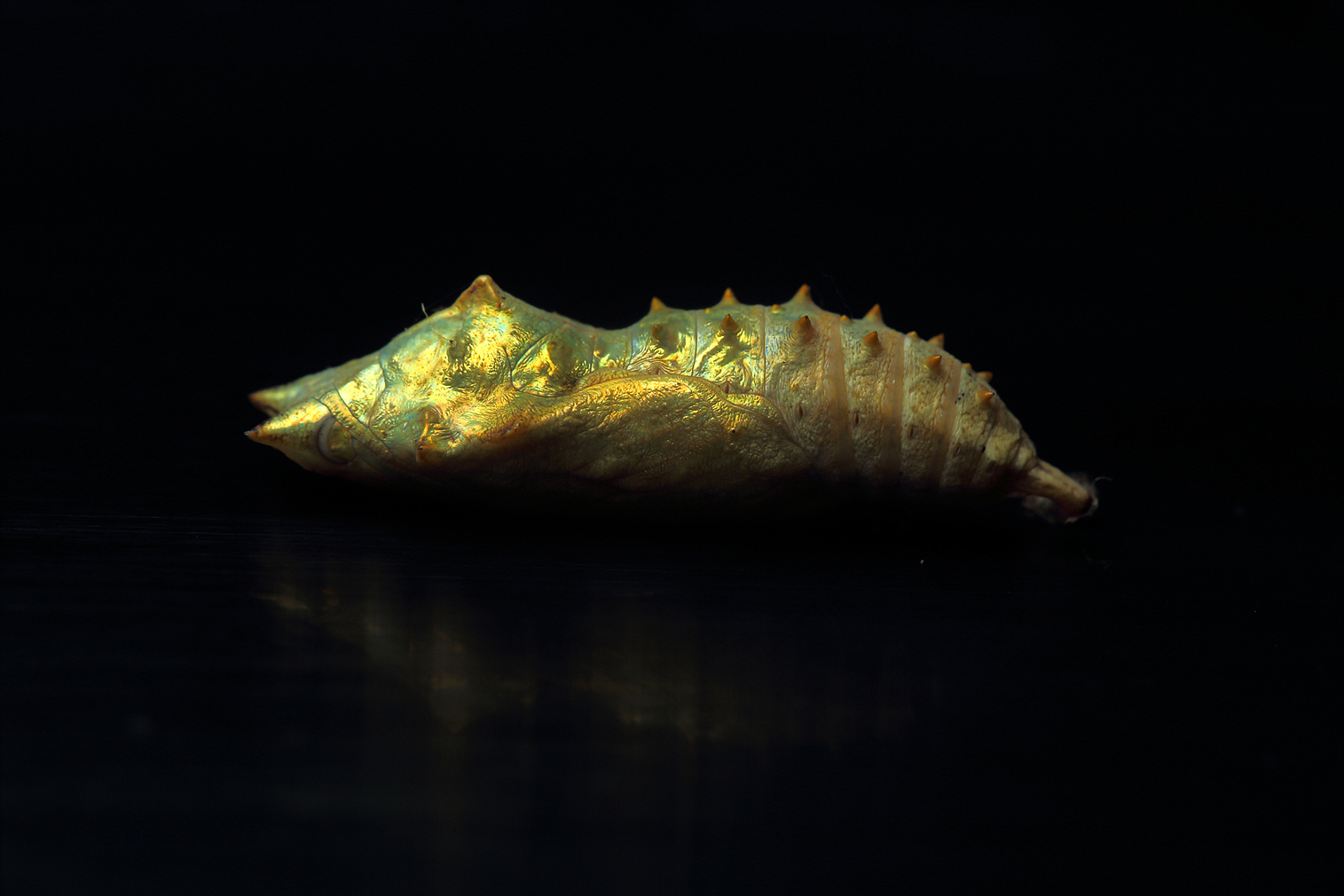


And so the constant replacing of food plant and cleaning out of the daily 'frass' had come to an end and now they were to remain motionless until the next stage of metamorphosis was done. Well, no actually! I had read that even at this stage it was possible for movement to be observed and had even seen the occasional twitch myself.

I wasn't prepared for what I witnessed next though....I have never seen this amount of movement before...


This is only a short clip from the video I took, the whole thing is over 10 minutes long and even then, there were other similar bouts during the same day and into the next.

As the time for the butterflies to emerge grew ever closer, the change in colour of the pupae became very noticeable and even the wing colour could be seen...


I set up the camera to try and catch one emerging and began a vigil to ensure I was ready. Several cups of coffee and toilet breaks later, followed by a period of about one hour's uninterrupted close quarter study and my patience was rewarded...


Once again,the video above is only a clip from the original to allow it to load on the blog in a reasonable amount of time. What a magical thing to be able to see at close range though...a real privilege.

There followed a period of twisting and pumping by the butterfly to inflate its wings fully that took quite a while, but eventually it began to resemble the insect we all know...


Eventually it began to exercise its wings in preparation for a maiden flight and I then placed it in the sun to warm itself fully. I took the following photograph, moments before that happened and it disappeared from sight...


I can report that not only did all of the caterpillars I brought home become beautiful small tortoiseshell butterflies, but having released them in a secluded local spot, I have since seen at least one happily sunning itself at the same location.

That's all for this time, until the next update, thanks for your interest,see you again very soon...

Sunday, September 30, 2012

Caterpillars preparing for winter...

As things start to wind down for winter, any of the species that hope to survive the season are now making final preparations. I have been watching a reasonably large collection of Buff-Tip Moth caterpillars over the past few weeks as they furiously feed up before pupating...


They live gregariously until the final instar and will often twist around each other on a single twig, as in the photo above. Fully grown they can reach 60mm in length and look very impressive, as does the damage they can inflict on the host plant-in this case oak.

When they undergo a moult, they seem to be able to do so in the same position and more-or-less at the same time...

The remains of a mass-moult
The black spots on a bright yellow or orange background make this caterpillar very conspicuous and also of course, warn of its poisonous nature.


If that wasn't enough to deter any unsuspecting predator, it also has an unpleasant smell. The mature caterpillar has this striking yellow inverted 'Y' on its head.


Through last week the feeding became a lot more frenetic as the time neared for pupation. I've noticed when observing other species that just before pupation takes place, the feeding will become very intense. I also witnessed  how the group was dispersing, and saw several individuals strip an oak branch of its leaves in no time and would then be left dangling from what remains...


Although these caterpillars can be around until into October  this particular bunch have in fact now all pupated. This involved leaving the host plant/tree and once they reached the ground, bury themselves in the earth, just below the surface where they will spend the winter before emerging as the adult moths next springtime.

This is one of the last photographs I took before they all disappeared below ground...


This photo below demonstrates how the process begins, it was taken a few days after the caterpillars left the tree...


The whole transformation into a pupa seems to take quite a while in this species, especially compared to butterflies, which I've watched pupate in less than half an hour.

From looking as though they have died in the early stages, the next photograph shows how fantastic they look at the second stage...


Then finally, as the whole process is completed, they attain the darker colours that will help to camouflage them throughout the winter months should they be unearthed, or come to the surface for any reason...


I look forward to being able to bring you shots of the adult moths next year.


Until the next time...


Thursday, September 29, 2011

Do Butterflies remember being Caterpillars?

Commitments and circumstances have conspired to keep me away from 'blogging' for, well too long really. But, as John Lennon famously said "Life's what happens whilst you're busy making other plans" I may have paraphrased him there but it was something very similar anyhow.

I mentioned in an earlier posting that I had some comma butterfly larvae that I was rearing and that I would do an update on their progress. This blog entry will attempt to fill you in on everything that's happened in the past few weeks concerning the little beasties.

It was late August when I acquired the larvae (Caterpillars) and at that stage, I would guess they were probably only first or second instars and no more than a few millimetres in length.

I collected lots of Hop, one of their favourite food-plants and they seemed happy enough and soon grew to a respectable size and with each moult, became more elaborately coloured.

Click on any photo for a larger view


By the time September arrived, they were pretty much fully grown at about 35mm.

I had noticed that although these were all from the same batch of eggs, they progressed at very different rates and some seemed almost ready to pupate at the same time as others were not even to the stage of a final moult. When I say, final moult, I am discounting the fact that the act of pupation is in itself a 'moult' and therefore should really be considered as the last one.

The first signs of imminent pupation in the larger caterpillars was when I observed a real increase in food intake. They seemed to be getting through the hops at an alarming rate and even worse, the evidence was there for all to see (and me to clear up) from the other end of the larva!

On September 7th, the first one left the area where it had been feeding for the past weeks and climbed to a stem some way above the leaves and attached itself by the 'Cremaster' (a cluster of minute hooks) in the classic, head-down position.


It remained in this position, motionless, apart from the odd twitch for sometime. On the following day at around 2pm it began to twitch again and the pupation proper had begun. I suppose it was around 26 hours from the first signs to the completion of the process.


This is around 10x faster than actual speed.


The body that's revealed when the caterpillar sheds it's skin for the last time, is the pupa or chrysalis. It no longer feeds of course but will still twitch in response to threats but is otherwise 'sessile'.
At first it's soft and skin-like but soon hardens and it's this shell that protects the butterfly whilst it transforms.

This stage lasts around 2 weeks for the comma butterfly but can vary greatly for other species. The pupa is light in colour at first...


        ... but darkens over time until it looks like this 


I won't go into the whole business of just what happens in complete metamorphosis because I touched on it in an earlier posting, but the complete transformation is known as 'Holometabolism' and I've heard it described as a kind of re-cycling! It's not the worst analogy I've heard. If you drop a plastic bottle into a re-cycling bin, it gets melted down and reformed as an entirely different shape.That's close to what's happening here.

The next stage to look out for as an indicator of the final steps towards emergence is a change in colour from the dark. almost black that they've acquired, to something that at last seems to reveal the amazing process that been happening, unseen for the past 2 weeks or so; the very clear sighting of the colours of the adult comma butterfly wings that are now showing through the walls of the pupa.
Confirmation that the journey is almost complete. This is what it's all been building to, the final countdown has begun! Nature is about to dumbfound me yet again.

The little video that follows, although isn't the best quality or colour, and does have some very 'rural' editing (I don't have great software for editing movies is my excuse), but is never the less the result of many hours spent caring for and observing these insects and what it shows is something that few have been privileged to witness.

Complete metamorphosis is nature at it's wide-eyed,gob-smacking, amazing best! Not very literary, I agree but sometimes less is more?

And so it was that 17 days after the first larva became a pupa/chrysalis and just 7 days following the final larva's pupation, I was lucky enough to be there and watch in awe as a beautiful comma butterfly made it's entrance...


I wish that I could find a way to share this as the HD-Movie that it was videoed in but I've had to reduce both size and quality to get it to display here. I intend to work on this for future videos and if anyone knows of a way to display them at a larger size/quality, I'd be happy to hear from you.

I was on a high for sometime having watched this action and leaving aside the complete joy at witnessing it, I have learned so much at the same time.

It had no idea for instance that the pupal shell is forced open by the butterfly using its feet. The wings were wrapped around the insect, again, I had no inclining that was the case.
What struck me above all else though, was the proboscis; it seemed  to be 'unfurled' and stretched the length of the body. Only when the butterfly had struggled free of the shell did it then recoil like a spring.

Some recent studies have shown it may be possible that butterflies can remember some of their lives as caterpillars.

When caterpillars were conditioned to avoid specific smells (did you know caterpillars could smell?) they seemed to remember to keep away from those scents as adults.


Meconium

During the emergence of the butterfly from the pupa, there is a substance secreted that looks for all the world as if it is blood. It isn't and there's no cause for alarm.


  • In biology, meconium describes the metabolic waste product from the pupal stage of an insect that is expelled through the anal opening of the adult upon eclosion from the pupa. 


  • Adult Butterflies are not able to fly until their wings gain blood circulation and completely unfold; this usually takes 1-3 hours depending on the type of butterfly and of course, at this stage they are very vulnerable.

    I took lots of photographs of the adult butterflies before releasing them in local woods. It was great to feel that I was doing something to help protect and conserve the population, especially in light of the fact that this year was particularly poor locally for commas. The weather has been superb for late insects and I'm sure they'll feed-up on whatever they can find before hibernating through the winter to emerge as breeding insects next spring.

    I'll add some more pictures in my next posting, but for now here's one of the adult that I followed right through from caterpillar to adult butterfly.

    Until the next time then...

    Comma Butterfly (Polygonia c-album)