Showing posts with label Larvae. Show all posts

Friday, October 27, 2017

"Seriously, we’re all going to die: Insect populations are at apocalyptic levels"


You may have read in the news of a catastrophic decline in insects based on research conducted by scientists from Radboud University in the Netherlands and the Entomological Society Krefeld in Germany. It has been all across most news platforms for the past few days and makes for worrying reading. 

The number of flying insects has declined by more than three-fourths since 1989, threatening food supplies

This is the conclusion of a study published on Wednesday in the peer-reviewed scientific journal PLOS One:

"Our analysis estimates a seasonal decline of 76 percent, and mid-summer decline of 82 percent in flying insect biomass over the 27 years of study, we show that this decline is apparent regardless of habitat type, while changes in weather, land use, and habitat characteristics cannot explain this overall decline."

The study added, "Loss of insect diversity and abundance is expected to provoke cascading effects on food webs and to jeopardize ecosystem services."

The plight of honeybees has been well documented and it is now widely believed that a type of pesticide known as 'neonicotinoids' are responsible for the precipitous decline in honeybee populations.

Coincidentally, I have been reading Rachel Carson's 'Silent Spring' which deals with an ever-growing threat posed by insecticides and pesticides. She points out in quite graphic form how there is a global threat from the misuse and over-use of these chemicals, together with intensive farming methods. The really sad thing is that her book was published 55 years ago, and we seem to have learned nothing!

Or maybe we have, but just don't care, because nature comes second to the pursuit of the dollar!


Even that back-stabbing numpty Michael Gove had this to say on the subject: The Environment Secretary said "heavy farm machinery and overuse of chemicals was boosting short-term productivity but would render large tracts of soil infertile within a generation."


A reminder from LWEC (Living With Environmental Change) about why pollinating insects are vital to our ecology:


Why are insect pollinators important?

Bees, flies, wasps, beetles, butterflies and moths are part of a nation’s biodiversity and natural capital. They have intrinsic value and provide environmental and economic benefits because:


 — Pollinators improve or stabilize the yield of three-quarters of all crop types globally; these pollinated crops represent around one third of global crop production by volume.

 — Many fruit, vegetable, oil, seed and nut crops that provide vital nutrients for human diets worldwide, including more than 90% of our vitamin C, are pollinated by insects.

— The cultivated area of pollinator-dependent crops has risen, raising worldwide demand for insect pollination services three-fold since the 1960s. Globally the crop production attributable to insect pollination was valued at US $215 billion in 2005.

 — Honeybees, but also bumblebees and solitary bees, are managed and traded commercially for their pollination service. Wild pollinators are at least as important as managed pollinators in providing these benefits.


That opening to this update was a bit heavy eh? In fact it was heavier than regret! And so in true BBC 'One Show' fashion, let's move on to something  a bit more ...


My last update was all about caterpillars, which by the way are doing fine, there are just 2 left eating now, the others have all pupated. It is strange though how they all came from the same batch of eggs and yet the final two are about three weeks behind the others. Anyway, I will continue the theme with some more caterpillars in this update. 


Here's what the excellent UK Moths website has to say about the Convolvulus Hawk-moth:

A large species, with a wingspan of over 10cm, this is a migrant in Britain, appearing sometimes in fairly good numbers.
It most often occurs in late summer and autumn, usually with influxes of other migrant species, when it turns up in light traps and feeding at garden flowers, especially those of the tobacco plant (Nicotiana)

Although larvae are sometimes found in Britain, usually on bindweed (Convolvulus), it does not regularly breed.

I was very lucky to get some early (probably 2nd) instar larvae to rear. They came to me looking a little like Twiggy on a diet (ask yer gran who Twiggy is, and I don't mean Ramirez!) Oh! Hang on...here you are look, this Twiggy...


You get the picture now? Well, if not, here it is...


Quite an aerial though eh?

What to feed them on then? The clue is in the name of 'Convolvulus'. But what exactly is convolvulus? It's this...


The gardeners enemy: good old-fashioned bindweed. Should be easy enough to find plenty of bindweed? Maybe so, although it is getting quite late in our year to find any that is still growing and green. Then there is the little matter of me looking like a right plonker gathering the one weed that everybody else seems to hate. No matter, most folk around here think I am retarded anyway! Being spotted laying in wet grass, or photographing what looked like (and was) a cow pat...that kind of thing, hasn't helped my cause. 

And so it was that I went out and scored my bag of weed to feed to the hungry caterpillars. They appreciated my offering and probably gave my efforts short shrift as they devoured it. It wasn't long before they began to moult and look like this...


It is a good thing that these are hungry little blighters, because, once cut, bindweed soon wilts like a flower without sun, or a woman without love. By the time of the next moult, they were looking different again...


Oh yes! They were now entering their 'new-wave' period: they even acquired 'Adam Ant' face stripes. Some of them moved on further, to what I am going to call the 'Buster Bloodvessel' period. You know the one - the chubby chappy from Bad Manners... 


I don't usually add YouTube videos in the midst of an update for fear you might not return to the remainder of my writing, however, you are reading this right, so you must still be here. Why is there nothing as silly as this in today's music, who dumbed it down?

Where were we? Oh yes, they were starting to get a bit portly themselves...


It was at about this time that the difference between the fastest growing larvae and the slowest became quite apparent. In fact, prior to the smaller ones moulting again, the large green ones had already dug into the soil to pupate. Right before this happened, I measure one: it was 75mm long...


When they did eventually moult, something amazing happened: they changed from green to almost black...

Just completing a moult

Free from the moult

A few hours later and they looked like this (apologies, I have run out of music genre analogies)...


And finally this...


And that just about brings us up to date. There are two of these blackish caterpillars still eating, but I am expecting them to pupate at any time. Will I get any adult moths emerge come spring? Certainly hope to. 


Friday, October 13, 2017

Moon or Luna?


As much as I am enjoying sitting here listening to a bit of Bob Dylan on the iPod, sooner or later, one of us must know (a little clue to the song there) that it's time to knuckle down and write up another blog entry. Just before we get to the subject matter of this update, a question: what do you think is the significance of this next photo?

Well according to the BBC, who recently broadcast a programme about marbles in which presenters showed how a marble was held by the crooked index finger and flicked by the thumb, "this is where the phrase 'knuckle down' came from". 

Let's get to it then: let's talk about caterpillars...
Actually, these are not strictly caterpillars, but larvae: still, carry on John, nobody will have noticed. 

I recently obtained some early instar Actias selene (Indian Moon-moth) larvae. These would be fantastic to observe I thought, and as they seem to like a wide variety of food-plants, many of which I could obtain easily, would be a safe bet. I had a care-sheet from the Amateur Entomologists Society that stated the preferred food-plants:

The caterpillars will feed on a variety of plants, including:-
  • Walnut
  • Apple
  • Hawthorn
  • Cherry
  • Cherry Plum
  • Willow
  • Hibiscus
  • Rhododendron (Rhodendron ponticum)
  • Holm or evergreen oak (Quercus ilex)
On arrival I treated them all to a mix of walnut, apple, cherry, willow and rhododendron, and waited to see which they preferred. None of them was the answer! I added hawthorn and a couple of the larvae seemed to take to it but weren't eating very much and soon began wandering off in search of something better.

This is how most looked when they arrived...


The following day I was starting to think I had made a mistake taking these on as they were definitely not feeding. Then I did a bit of detective work and found that they will also use liquidamber, or sweet gum. 

Where could I acquire sweet gum though? Any ideas? Nor me! Hang on though...isn't eucalyptus a gum tree? That was rhetorical of course, because we  already know the answer . Just need to find some now. Hmmm... might be a problem. 

I pounded the streets, but that did no good and so I repaired them and moved on. I racked my brain...but even putting it on the rack had no effect, I couldn't recall where, or indeed, if, I had seen any locally. I decided the only thing to do was to have a drive around looking for some. My salvation came in St. Michael's near Tenterden, when I spotted this tree outside a house, beside the local garage...


I rang the doorbell. "Hi" said the guy who answered, only half interested as he browsed his phone. "This is gonna sound like a strange request" I said. "try me" he replied, still not looking up from his phone. "Could I possibly steal a few sprigs of your eucalyptus tree?" Finally! his interest had piqued. With a half-smile, he said "Take the whole tree if ya like". Thanking him, I felt I owed an explanation: although, he didn't seem at all interested in knowing my reasons. I mumbled something about caterpillars as he turned and shut the door and I cut myself some eucalyptus.

Success! In fact, a great success. All but a couple were eating like there was no tomorrow and the remainder soon joined in.

It was September 16th when I acquired the caterpillars and by the end of the 17th some were already moulting...


By the 19th of September, many had moulted and were now shades of green...


Time to separate them into individual containers, as I had read that they can be cannibalistic once they start to mature. They were all looking much healthier now and growing fast. All except for the little runt that is. He was still way behind the others and looked like this...


In fact, this is how it stayed right through until September 26th. It was eating, but not a lot. His/her plight was not helped when on the 19th, it somehow managed to circumnavigate the obstacles I placed at the top of the water jar that contained the food plant, and fell right into the water. I have no idea how long it was there before I rescued it, but I dried it as best I could and assumed that it  had possibly drowned as there was no sign of life. 

However, the next time I checked, it was feeding. A miracle. It did eventually moult and became green like all the others, even though it was now a couple of moults behind the rest, who were quite variable in size and colour but doing much better than the runt...


Freshly moulted 29th Sept.

Freshly moulted 29th Sept.


The largest ones were now really impressive beasts. Those feet are brilliant and once fixed to a leaf or stem, there is no moving them. I had also read that they could be aggressive, gnashing their mandibles and swiveling their heads round if threatened, but I had no problems and didn't find any displaying those traits.

October 7th saw my first completed cocoon...


Today (Oct 13th) most have now pupated and I have just three with a bit more growing to do. Now I have to wait and see if any adult moths emerge in around a month's time, or whether they will overwinter and eclose come spring 2018.


Wednesday, July 12, 2017

"The most dangerous caterpillar species in Britain!"


Yes, it was Saturday December 18th 2010 when I wrote the following words in my first ever blog post: "In the beginning: I'm making a start on this new blog today. It's cold and snowy in Kent, with little to offer in the way of interesting, outdoor macro subjects to photograph".

And today July 12th 2017 I am here writing my 200th update. According to statistics, most people quit blogging within the first three months (you spend time working on something without a reward, the harder it is to continue doing it). For me the truth is that I love doing these updates and would probably continue even if they weren't being read. Thankfully, due to some loyal followers, my little blog continues to be accessed in at least a dozen countries, with UK, USA, Netherlands, China and Belgium being the top 5 regards amount of views. 

A sample of just some of the bugs and insects that I have featured here over the past seven years...


What have I got that is special for this update? How about...

 "The most dangerous caterpillar species in Britain!"

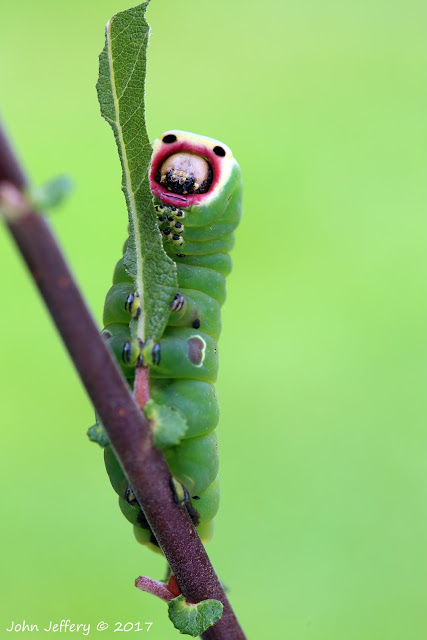
That is how I have seen the caterpillar of the puss moth (Cerura vinula) described. The puss moth is quite an easy moth to identify and inhabits wooded, or lightly wooded areas where there is plenty of willow or poplar. Here's a recently emerged adult moth that I photographed in 2015...


But it's the larvae that interest me most. As with all larvae, they are predated by many other creatures. In order to protect themselves, they have the ability to spray formic acid at their attacker! 

A Puss Moth Larva - Cerura vinula


Formic acid is interesting in itself and gets its name from the Latin name for ant "Formica". There is a little video of wood ants spraying the acid, it's on YouTube if you feel like having a look. Formic acid is actually found in the bites and stings of many insects, including bees and ants. It is also a contributing factor when you get stung by nettles. It's used by farmers to preserve animal feed, bee-keepers use it as pesticide against the deadly Varroa mite and if all that leaves you wanting more, then I can tell you that it is used in the treatment of warts and as a toilet bowl cleaner.


I'm starting to feel a tad guilty now, because the other day I had to rescue yet another bee from the bird bath. I really don't know why, or how they get into the water, but once in, they seldom get out...


This one however lived to see another day and once dry, flew off seemingly unharmed by its dunking. I think this is probably a wool-carder bee. 

---------
I have been having a few early morning walks whilst this hot weather has been with us. I tried a few evening ones too, but the mosquitoes gave me such a hard time that I soon stopped those. In a local, uncut meadow, I found this large beetle. Unfortunately it was quite low down in the grasses and even so, the light wind was enough to make it almost impossible to get a perfectly focused picture...


This is most likely Nicrophorus investigator. There are other similar beetles but I think judging by its size and the reddish antennae tips (that you cannot see well here because of the movement) it seems to fit. As always, there are mites attached. This is the beetle that uses carrion to house its young.

In the same woods that I found the puss moth larva, I also spotted this fabulous grasshopper nymph. Possibly a field grasshopper but wouldn't put my house on it...that would flatten it for sure!


I was pleased with those two finds but ecstatic over the next: a species of butterfly that I have never seen before, let alone photographed. It was in woods that I know well too and have surveyed for insects in the past. There was another survey in about 2010 I think, and this butterfly was definitely not on their list either. It's the beautiful purple hairstreak...

A Purple Hairstreak - Favonius quercus

The UK Butterflies website says this about it: "It is often difficult to locate, due to its habit of flying in the tree canopy, where it feeds on honeydew. However, the adults are occasionally seen basking at lower levels, on various small trees, shrubs and bracken". It's the side of the wings that you can't see here that have the purple colour, although not as much in the males as females. 

One day whilst out walking without the camera, I managed to capture these 2 pictures of a brimstone butterfly with my phone...


When I found this crab spider, its face was still covered in the remains of its dinner (been there!)


And this is what it had just been dining on...


The crab spider here is Misumena vatia: It's the same spider that in a recent BBC 4 programme about life in our back gardens, Chris Packham
said could change colour to match the background. He didn't mention that it is only the mature females that have this ability; and that the colour changes are restricted to white, yellow and green(ish). 

Well I have lots more that I could share, but I think there is more than enough here for one update, so I shall save it for next time. Instead I will leave you with a few shots of something that has not featured much at all in the updates...until now: it's the humble garden snail...