Showing posts with label Palomena prasina. Show all posts

Tuesday, April 05, 2016

Boing!


My answer is that it depends on my mood. Right now I am a half-full kinda guy because spring makes me feel optimistic and spring 2016 has come to my little corner of the British Isles.


For starters, the bluebell woods are just reaching their full potential and the sight of this carpet of blue is enough to lift anyone's spirits, but if you add in the aroma, then you really do feel a harmony with nature that is very powerful.


When the buds on the cherry tree burst open to reveal some of the flowers, white and fresh as morning snow, I knew it would be just a matter of time before the honey bees arrived in large numbers to harvest the pollen. Now, just a day later the tree is alive with 'the voice of the garden' as somebody once described it, i.e. the hum of hundreds of bees. Magic!

Oh yes! The butterflies are coming out of hibernation too, but more of that later. The female worker bees have also found once again that the willow provides ample sustenance for the colony...


And then I came across this bee in the water. I don't know if it got there by mistake or had been attacked by something. It seemed very lethargic and quite unable to release itself from the surface tension. I did wonder for a second if it had a parasite of some kind attached, but on closer inspection saw that it was a teeny springtail. Did it arrive with the hitch-hiker, or did it climb aboard once the bee was in the pond?


It's only a natural light shot and so there isn't the same amount of detail as in a macro photo lit by flash.
I did rescue this bee by offering a stick for it to climb on to, which it did. I left it in the sunshine, drying out. Whilst I was beside the water, I saw this froggie just chillin'...
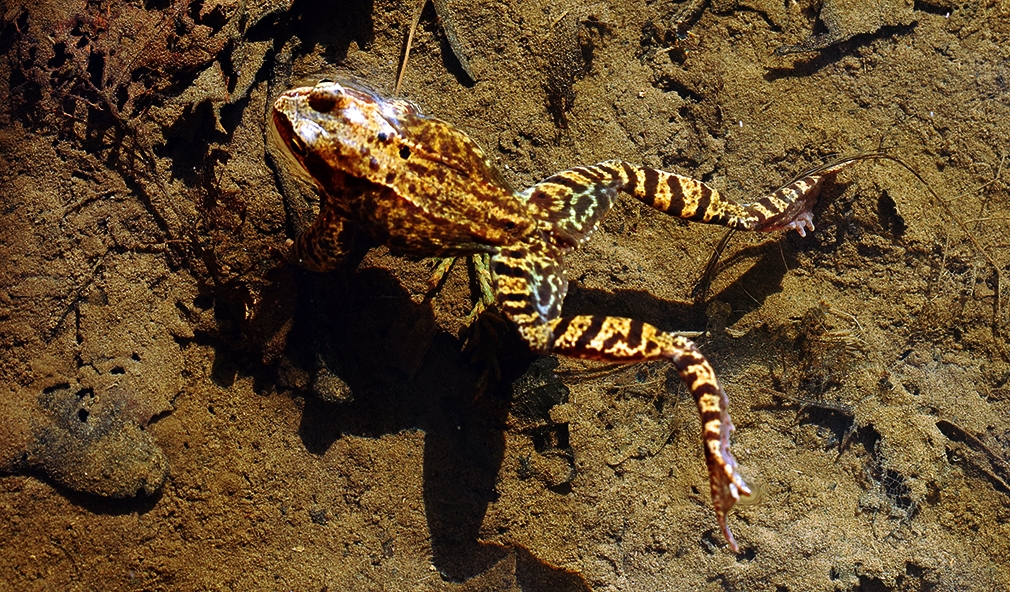

Or possibly sunbathing?


Under a nearby oak tree, I found a number of these bees. I imagine they are some kind of mason bee? Beyond that I am sorry to say I have no clue. I find bees exceptionally hard to differentiate. They probably have the same problem with humans?


Some of them seemed to be digging into the clay soil, presumably to nest? Again I could be wrong about that. I really need to gen-up on bees per se.


Changing the subject yet again, I discovered a couple of nice fungi recently...
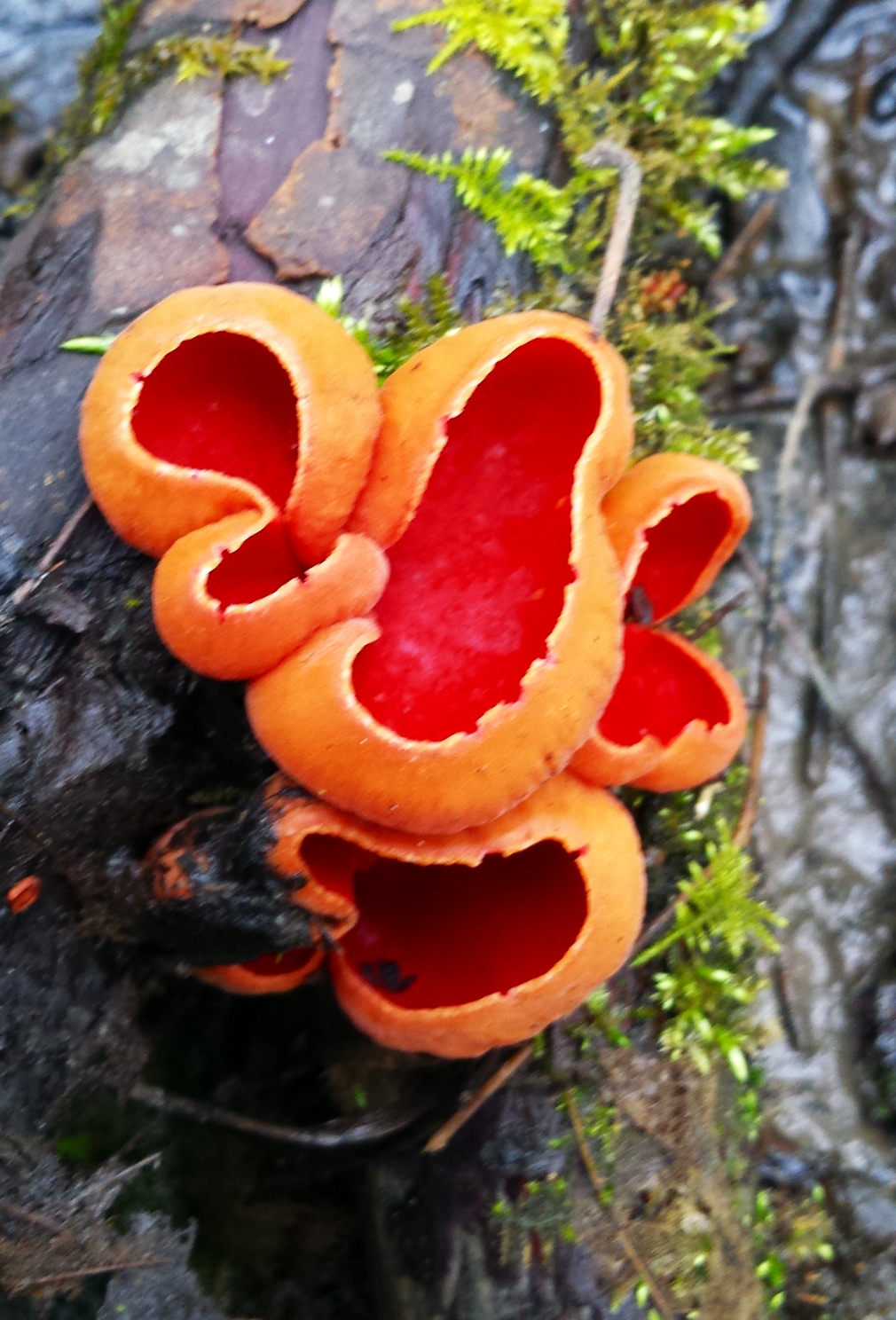

Again, this is only a phone picci and so not great, but still, I think this is Sarcoscypha austriaca- or Scarlet Elfcup? It could also be S.coccinea as they are practically identical. The habitat seems a perfect fit; that being, on dead twigs in a damp, shady place.


Another shot, with the DSLR this time.

This was the other fungi I found...


I am no expert, or even amateur regarding fungi but I wonder if this might be Piptoporus betulinus? Commonly known as the birch polypore, or razor strop. As you may have guessed from the second part of the scientific name, it grows almost exclusively on birch.


A few of the critters I have uncovered now. Starting with this fab beetle...


It's one of the Carabidae beetles but there are around 350 species in the UK. I bet you are now thinking that I am just dodging having to identify this striking beetle? Well, actually no, I shall stick out my neck and plump for Poecilus cupreus. That may be a tad presumptuous as there are a few other Poecilus beetles that it could equally be. Then again, it might not even be Poecilus? I really think it is though! There...that should do it!


And another ground beetle...

Badister bullatus-A Ground Beetle
Quite a common but colourful ground beetle, often found in moss, as this one was. Something to do with the old saying about it not being the Beatles that gather no moss, but the Rolling Stones no doubt?

(Do I need to explain that this is a joke? Probably would be my guess)


Then came my first shieldbug of 2016, a turtle bug...

Shortly after, another shieldbug...

Palomena prasina- A Green Shieldbug


 A juvenile centipede was next...


A daffodil provided me with my first true bug of the year ...

Probably Lygus species.
And another first for 2016, a Grassbug...


The Butterflies? Ah yes...the butterflies...


Nothing that was in a good place to get a decent photograph but at this stage I am just happy to see them re-appearing. There's plenty of time for arty-farty shots.


And that's about it. I know this update has been about what I have seen. Just a selection of recent finds, rather than any in depth analysis, but I wanted to share and also demonstrate  just how fast things are moving now. I am also about to overhaul the blog and perhaps re-style it and so this will probably be the last update in this current format.


One last picture, a hoverfly sitting on a daffodil...


Postscript: If anyone finds my missing avatar photo from the comments on the right of this blog update, could they please hand it in to teacher. Thank-you.


Saturday, September 05, 2015

When is a worm not a worm?

Well I have surprised myself on at least two counts here; firstly, despite the rainy weather (Man, August was poor for sunshine) I have gotten out and about a few times with the camera. Secondly, here I am back with another update....already! I say already because these updates are normally, notoriously sparse. Let's start with that rain then shall we...


I have noticed lots and lots of green shieldbug instars in the garden and what's more, they don't seem to mind the inclement weather at all. Many of them were sitting in the rain quite happily (not sure how you judge happiness in a shieldbug, but still...) 


I'm not convinced this bee was quite so at home in the wet weather...
The following morning, it was raining again and the bee was still hanging around the same part of the garden...


At least this woundwort shieldbug was making some effort to take shelter...


In the old orchard behind the house, this southern hawker dragonfly was finding it difficult to get airborne in damp and cold(ish) conditions...


I did find another one on a nicer day as well...


On a (slightly) better day, I noticed this little speckled bush cricket. This is a male and males call to attract females by rubbing their wings together, but their 'song' is a high-pitched chirp that is barely audible to human ears. The fact that the wings are reduced to these little flaps means that they are in fact flightless...


Oooh! Before I move on, I have just remembered a trip to Alexandra Park in Hastings a while ago, where I saw this young heron...


I have to report that the sorry saga of my moth trap woes continues. This has been another troublesome year for me. Early season I just wasn't catching any moths and then for whatever reason, the bulbs kept blowing. Having sorted that problem at last (I hope) and then completing a couple of small alterations to the trap, it has now rained every night since it has been back in service and so apart from about an hour one evening, I haven't yet been able to use it properly. Here's one of the moths I did get on that last short outing though and I will of course update the moth trap diary here just as soon as I have something to add to it..

Celypha lacunana
I think the identity is correct on that little moth but as always do tell if you know better...


Since my last update I have found time to re-visit the nature reserve at Cinderhill, close to Tonbridge in Kent. Once again I had some nice finds. Starting with this tussock moth caterpillar...


And a slow worm, slow-worm or slowworm...

A Slow-worm (Anguis fragilis)
Despite their name and appearance, slow-worms are neither worms nor snakes, but are in fact lizards - they're given away by their ability to shed their tails and blink their eyelids.


Chrysotoxum festivum-A Hoverfly
There are several similar species of the hoverfly pictured above.but given the markings and habitat I am hoping I have chosen the correct one.


There were lots of common lizards sunning themselves on the tree stumps...


Once again I found some gorse shieldbugs on broom, this one is just getting its winter coat...


Finally one of my favourite and often seen hoppers...


Issus coleoptratus

Well that is all for now, except that...I have more and so I may even break the habit of a lifetime and post yet another update in the next few days...

Until the next time...


Friday, July 19, 2013

Waspish behaviour and bad eggs...

When I found a clutch of bug eggs a while ago,I thought that I might be able watch them emerge and then observe some of their behaviour in an effort to learn more about them. I didn't realise at the time that the greyish appearance was to be a clue as to just how wrong I was....


What actually emerged a few days later,was this tiny parasitic wasp. In fact, each little egg had the very same occupant. I know that Trissolcus basalis is a parasite of the green shield-bug, but they are so small that I couldn't say with any confidence if that's what we are looking at here.

I decided that a concentrated search for another batch would be in order...


Sometimes...just sometimes, things go as planned. A couple of days later I found this batch of eggs on oak. This time they looked much more promising.

I didn't have long to wait before the tiny bug nymphs began to emerge en-masse...

Click on any photo for a larger view

I also didn't have long to wait to learn something new about the critters...


All 26(?) of them changed from green to brown in a very short space of time. How strange when they would become green once again at the very next stage of development?

Incidentally,isn't it wonderful how symmetric the egg laying is here...rows of 3 then 4 then 5 then 6 then 5 then 4....

They were ready to moult in no time at all and I was lucky enough to be there when a couple did just that...


An amazing thing to witness. Firstly look how large it has already become compared to the exuvia (external skeleton) it is leaving behind. Then see how the insect that is emerging is so pale and almost translucent.

I wanted to show you the large image above because it's such a spectacular thing to see. Here's a set of shots now that give you more of an idea of the emergence process...


Eventually..it breaks free of the old 'skin' completely...


And a shot of it sitting,no doubt exhausted by the effort,beside the Exuvia ...


Does it sound too crass to say that it is quite moving watching something so tiny go through this process that allows it to grow ever larger? It seems a real struggle for the bug and yet-it has no choice,it must undergo this change repeatedly, until it becomes a fully winged adult.

To give you some idea of scale, here's a picture of a freshly moulted one on a corner of an oak leaf... do leaves have corners?


After keeping these just long enough to observe the first moult and then make sure they were all in good health for a few days, I released them and they seem to be doing just fine in my garden.

I'll be back soon with yet another observance first for me that I want to share.

Until the next time then...

Oh! Just before I go...the latest photograph of the poplar hawk moth caterpillar....


What a treat eh?