Showing posts with label Slow worm. Show all posts

Saturday, March 17, 2018

Another cold weekend, little wonder the tits are blue...

I had hoped to be able to begin this update by conveying that we have turned a metaphorical (or perhaps, more aptly, meteorological) corner. However here in sunny Kent this morning, the skies have become ashen and snow is once again in the forecast. Not to worry; I have given myself a good, stiff talking to and promised that it won't last more than a nano-second or two. 
Let's concentrate instead on the past few days, which have been most encouraging. 

As with many of my finds, and indeed photo opportunities at this time of year, they come when out walking the dog. In fact this first find came when dog-walking somebody else's doggies: Benny, the German Shepherd, and Dotty the Jack Russell...


Walking around yet another plot of land that will soon become a building site, I spotted a square of roofing felt which I carefully lifted to reveal these little beauties...


These are quite young, female slow worms. As I am sure you know, slow worms are not snakes but legless lizards: they have the  ability to shed their tails and blink with their eyelids. These were probably still in hibernation mode and so I quickly replaced the felt, which I assume had been placed there for exactly this reason.

After last year's debacle with a neighbour's cat destroying the blue-tit nest in the garden, I have taken some measures to try and protect the nest-box this time around...


OK, so it looks a bit messy, but if it works I shall be more than happy to put up with how it looks until nesting season is done for another year. It doesn't seem to have phased the birds at all because they have already been checking out the box again...


On the front wall of the house I saw my first Salticid of the year. A little jumping spider that was sitting in the sunshine. I don't like to photograph bugs and insects in direct sunlight and so I was attempting to provide some shade with one hand, whilst taking the photo using the macro in the other, hence the shallow depth of field...


In my little work studio that is situated at the bottom of the garden, I had a visit from a rather dopey wasp. I say it was dopey: mainly because it was quite docile and also when I asked it who is the current reigning monarch, it had no answer!


In previous years Comfort's Wood (a real favourite bug-hunting area) has by mid March seen both primrose and wood anemone in flower, as well as the odd violet and green bluebell shoots. That's green shoots by the way, not green bluebells. I have often seen bee-flies in the woods too. However, this year, on a recent visit, all I could spot were the primroses...


10:05am Saturday March 17
Image result for it's snowing again

It's okay though, are we down about the weather? Noooo.... as Dame Vera Lynn sang back in 1939: 'Keep smiling through,Just like you always do,
Till the blue skies drive the dark clouds far away'. 


This next discovery should be enough to put a smile on anyone's face. I had seen this animal a few times on my early morning dog walks, but it took a few tries to get even a half-decent shot, as no sooner had I spotted it, than the dog did too...
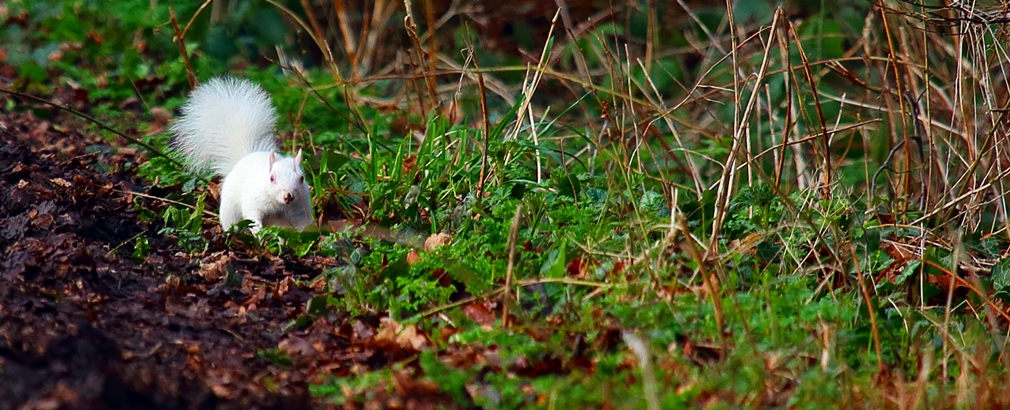

Yes, it's an albino squirrel. According to the BBC the odds of a squirrel being born white is thought to be about one in 100,000.  Only a few white squirrels are albinos, recognizable by pink or blue eyes and the absence of pigmentation anywhere on the body. The gene for such an absence of the pigment, melanin, is recessive, so each parent must carry it to produce an albino squirrel. Albino squirrels have vision problems and are at a disadvantage in the wild. Many white squirrels  are genetic colour variants of the grey species, as are the less common black squirrel.

I have seen albino squirrels before, here in Kent, but not for a while. This was the last time I photographed one, it was 2016...


I think I may have saved my best find until last? Well, for me it has to be a favourite. I love the longhorn beetles and finding one out and about in March was a real treat for me. This is 'Rhagium mordax' and is a species of the Lepturinae subfamily in the long-horned beetle family. The adults favour open-structured flowers, particularly hawthorn and umbellifers where they feed on nectar and pollen. I have already seen some thorn in flower this year, but thought it was blackthorn, rather than hawthorn...


And that is a wrap as they say. Yes, another update comes to a close. Thank-you for reading this far and for your continued support: I very much appreciate you being there.

I am entering my seventh year of writing for 'The Wealden' and my latest little article can be found HERE as well as on the dedicated page accessible from the button at the top of the homepage, where you will also find every other article since 2012


Wednesday, August 30, 2017

Burning up at the bioblitz...


It's Wednesday August 23rd and looking like a lovely, late summer day. Today there is a 'Bioblitz' in a local village:coordinated by the Medway Valley Countryside Project, who's stated aims are:
  • Create, Sustain and Enhance Kent’s Landscape & its wildlife
  • Develop, Manage and Support community-based environmental initiatives
  • Develop, and Promote life long outdoor learning
  • Encourage and Enhance greater access in the outdoors and the corresponding health benefits.
I thought a visit would be apposite...

It was a great way of engaging the children (of whom there were many) and the guided walks seemed popular. I decided against them though, and instead had a short walk of my own to see what I could find. Half a dozen of my finds are shown below. Nothing out of the ordinary, but there were quite a few more that I didn't photograph, and it all added to their overall tally.


I have had several early morning walks with the camera recently. Mostly for the purpose of getting some long-exposure tripod shots: I think it would be fair to say that the results have been, variable and on Monday August 28th all I managed was the following shot of a crop field, and that was taken with my phone...


Just two days later, the same destination of Frittenden, saw the highest temperatures in the whole of the UK for that day: 29.3 deg or 84+ if you prefer Fahrenheit. Here is one of the photographs from an early morning session that I can share...

A Grass Moth

And a tiny Green Shieldbug nymph too...


The Comma butterfly is a real success story, in that it seems to have been able to reverse its decline and is now wide-spread once again. Named of course for the white comma shape on the underside of its hindwings. The jagged edges of the forewings are the reason behind the other common name of 'Angelwings'. 

A Comma Butterfly - Polygonia c-album

Having found the adult butterfly, I was pleased when I spotted a caterpillar; however, once again, as with the puss moth larva I found a while ago, all was not well. On close inspection, I could see an unwanted visitor...


It was this tiny parasitic wasp, which I managed to remove. Yes, I was interfering with nature in some small way, but I wanted to see if I would be in time to save the caterpillar and allow it to form a chrysalis. As you can see in the next photo, it did go on to suspend itself from a nettle soon after. The inset picture is a closeup of the wasp...


It wasn't too much later that it had indeed become a chrysalis, and so if my hunch is right, I may yet get to see the adult butterfly emerging.


All of which brings me back to my last update about the puss moth parasitic larvae. Having seen most become pupae, one remained fairly active and amazingly, seemed to survive without a food source for another 15 days. After which it gradually became increasingly yellow in colour...


It's still around but not looking good now!


I can also now confirm the identity of the 'dancing chrysalis' featured in my last update. It eclosed last week to reveal a fabulous herald moth...


I haven't featured spiders for a while, and as you all love them so much and September (spider month) is just around the corner, I thought I would add a couple of pics of a teeny, juvenile, fence-post jumper. A first for me; not seen anything other than adults until now...


I guess I shouldn't really leave you with images of spiders...nightmares and all that! Here then is something much prettier, they are (empty) lacewing eggs and these are another 'first' for me. Despite searching each year, I have never been lucky until now..


Saturday, September 05, 2015

When is a worm not a worm?

Well I have surprised myself on at least two counts here; firstly, despite the rainy weather (Man, August was poor for sunshine) I have gotten out and about a few times with the camera. Secondly, here I am back with another update....already! I say already because these updates are normally, notoriously sparse. Let's start with that rain then shall we...


I have noticed lots and lots of green shieldbug instars in the garden and what's more, they don't seem to mind the inclement weather at all. Many of them were sitting in the rain quite happily (not sure how you judge happiness in a shieldbug, but still...) 


I'm not convinced this bee was quite so at home in the wet weather...
The following morning, it was raining again and the bee was still hanging around the same part of the garden...


At least this woundwort shieldbug was making some effort to take shelter...


In the old orchard behind the house, this southern hawker dragonfly was finding it difficult to get airborne in damp and cold(ish) conditions...


I did find another one on a nicer day as well...


On a (slightly) better day, I noticed this little speckled bush cricket. This is a male and males call to attract females by rubbing their wings together, but their 'song' is a high-pitched chirp that is barely audible to human ears. The fact that the wings are reduced to these little flaps means that they are in fact flightless...


Oooh! Before I move on, I have just remembered a trip to Alexandra Park in Hastings a while ago, where I saw this young heron...


I have to report that the sorry saga of my moth trap woes continues. This has been another troublesome year for me. Early season I just wasn't catching any moths and then for whatever reason, the bulbs kept blowing. Having sorted that problem at last (I hope) and then completing a couple of small alterations to the trap, it has now rained every night since it has been back in service and so apart from about an hour one evening, I haven't yet been able to use it properly. Here's one of the moths I did get on that last short outing though and I will of course update the moth trap diary here just as soon as I have something to add to it..

Celypha lacunana
I think the identity is correct on that little moth but as always do tell if you know better...


Since my last update I have found time to re-visit the nature reserve at Cinderhill, close to Tonbridge in Kent. Once again I had some nice finds. Starting with this tussock moth caterpillar...


And a slow worm, slow-worm or slowworm...

A Slow-worm (Anguis fragilis)
Despite their name and appearance, slow-worms are neither worms nor snakes, but are in fact lizards - they're given away by their ability to shed their tails and blink their eyelids.


Chrysotoxum festivum-A Hoverfly
There are several similar species of the hoverfly pictured above.but given the markings and habitat I am hoping I have chosen the correct one.


There were lots of common lizards sunning themselves on the tree stumps...


Once again I found some gorse shieldbugs on broom, this one is just getting its winter coat...


Finally one of my favourite and often seen hoppers...


Issus coleoptratus

Well that is all for now, except that...I have more and so I may even break the habit of a lifetime and post yet another update in the next few days...

Until the next time...