I like to get news headlines on my phone to try and keep up with what's happening in the world. I also get a few notifications from websites of interest. I've discovered though that it's probably not a great idea to just read the headline and nothing else. Here's an example that arrived a few days ago...

Could easily be misconstrued don't you think? When I clicked on that line of text however, all became clear...

Some newspaper headlines do make me chuckle on the other hand...

Enough of this malarkey,


What's this then JJ?
Another of your tenuous clues to summat or other?
Nope! One hundred and seventy is actually the number of moths I found in my moth trap one morning recently. Well, very close to 170. Hard to say exactly because I had a few escapees as always. I didn't know that the trap contained quite as many insects; this is what I saw when I peered in to it...

I wanted to have a go at photographing every moth: just phone grabs mostly, but how to go about it without having some escape each time I opened the trap to remove one? This was the solution I came up with...

Yes, I got out the old festival, pop-up tent and set about emptying the trap inside so that any escapees would be easy to re-capture. If you know of a better way (and I am sure there are plenty) to empty a trap, I would love to hear from you.
Here are the photos that I did manage. They won't win any photography competitions but I did spend way too long doing this. about four and a half hours actually, and by the end, just wanted my life back!

I haven't got around to identifying all of them yet. I doubt I ever will, moths are tricky at the best of times. I have managed a few though:
38 x Grass moths
6 x Common Footman
1 x Buff Footman
1 x Leopard moth
1 x Dark Arches
2 x Buff Tip
1 x Elephant Hawk moth
1 x Buff Arches
1 x Small Magpie
2 x Clouded Border
1 x Rosy Footman
1 x Lead-coloured Drab
1 x Spectacle
2 x Riband Wave
1 x Plain Wave
5 x Small Scallop
2 x Heart & Dart
2 x Gold Fringe
Still with me? Oh I am pleased: I nearly dozed off myself writing those out. How about some better photographs of the stars of this particular night. In fact, let's begin with what must surely be the star...

 Meet if you will Deilephila elpenor, the Elephant Hawk-moth...

He looks kinda angry in this picture huh? I say 'he', I think it is male; females are a little less bright (no jokes please).
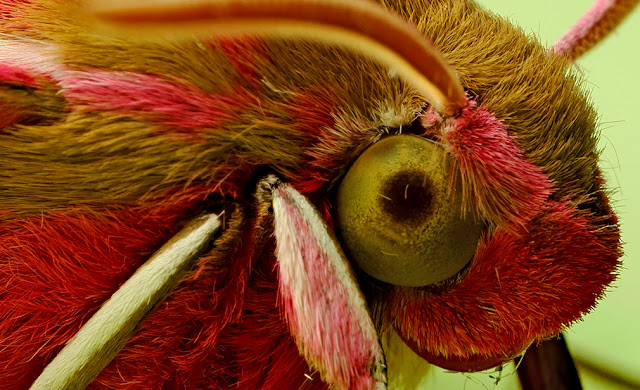


He looks kinda angry in this picture huh? I say 'he', I think it is male; females are a little less bright (no jokes please).
This species is nocturnal and of course feeds at night. That means choosing flowers that open or produce some nectar at night. The Elephant Hawk-moth has incredibly sensitive eyes that allow it to have night vision. In fact it was one of the first species in which nocturnal colour vision was recorded.

How can I follow that? Well, can't top it for colour and beauty, but what about the antennae on this next guy!


This one is Lymantria monacha, Black Arches.
In this species the males are actually smaller than the females, but have these large, feathery antennae. Notice the tell-tale splash of pink above the eye. There is usually pink somewhere, more often on the abdomen. Of course we cannot see the abdomen in this photo and so there may well be pink present.
Anything else JJ?
'Mais bien sur mon ami'
(I think that means, mines been sore Monday Amy!)

'Phalera bucephala' or the Buff-tip Moth.
The Buff-tip camouflage technique, is to resemble a broken twig of the silver birch tree.
Do you have a buff-tip missus? Ooops! Sorry, sometimes I have delusions of grandeur and just for a second or two, think I am Donald J. Trump. Let's get back to the job in hand? No...I am not still being Trump!

We have had some really interesting moths already, I hope you agree: but this next one must have one of the coolest names. This is 'Miltochrista miniata' more commonly known as the Rosy Footman...


One more? Certainly...

This is rather a brightly coloured specimen, but I think it is 'Agapeta hamana'.
It may look large in my photo but is actually only about 20mm long. It doesn't seem to have a common name; so I'll give it one...Wayne!
 |
| Hello, I'm Wayne... One more and then we can all go home and have tea...  |
The aptly named Leopard Moth - Zeuzera pyrina
There were also a couple of non-moth critters in the trap...
Notice how all of these insects are covered in moth scales: moths tend to loose scales readily.
And finally, this amazingly small beetle. About the size of an average Springtail, so no more than 2mm at a guess.

This little beetle belongs to the Aderidae family. There are only three species in the UK apparently: I believe this to be 'Aderus populneus'.

 |
| Probably Rhagonycha fulva - A soldier Beetle |
 |
| An Ichneumon Parasitic Wasp |
Notice how all of these insects are covered in moth scales: moths tend to loose scales readily.
 |
| An Orange Ladybird (16-Spot) - Halyzia 16-guttata |
And finally, this amazingly small beetle. About the size of an average Springtail, so no more than 2mm at a guess.

This little beetle belongs to the Aderidae family. There are only three species in the UK apparently: I believe this to be 'Aderus populneus'.

There is actually a lot more I could add to this blog but I don't want to impose on your time too much, so will save for the next one.