Showing posts with label Halyzia 16-guttata. Show all posts

Wednesday, July 17, 2019

Elephants and Leopards in my tent...

I like to get news headlines on my phone to try and keep up with what's happening in the world. I also get a few notifications from websites of interest. I've discovered though that it's probably not a great idea to just read the headline and nothing else. Here's an example that arrived a few days ago...


Could easily be misconstrued don't you think? When I clicked on that line of text however, all became clear...


Some newspaper headlines do make me chuckle on the other hand...


Enough of this malarkey,


What's this then JJ?
 Another of your tenuous clues to summat or other? 

Nope! One hundred and seventy is actually the number of moths I found in my moth trap one morning recently. Well, very close to 170. Hard to say exactly because I had a few escapees as always. I didn't know that the trap contained quite as many insects; this is what I saw when I peered in to it...


I wanted to have a go at photographing every moth: just phone grabs mostly, but how to go about it without having some escape each time I opened the trap to remove one? This was the solution I came up with...


Yes, I got out the old festival, pop-up tent and set about emptying the trap inside so that any escapees would be easy to re-capture. If you know of a better way (and I am sure there are plenty) to empty a trap, I would love to hear from you.

Here are the photos that I did manage. They won't win any photography competitions but I did spend way too long doing this. about four and a half hours actually, and by the end, just wanted my life back!


I haven't got around to identifying all of them yet. I doubt I ever will, moths are tricky at the best of times. I have managed a few though:

38 x Grass moths
6 x Common Footman
1 x Buff Footman
1 x Leopard moth
1 x Dark Arches
2 x Buff Tip
1 x Elephant Hawk moth
1 x Buff Arches
1 x Small Magpie
2 x Clouded Border
1 x Rosy Footman
1 x Lead-coloured Drab
1 x Spectacle
2 x Riband Wave
1 x Plain Wave
5 x Small Scallop
2 x Heart & Dart
2 x Gold Fringe


Still with me? Oh I am pleased: I nearly dozed off myself writing those out. How about some better photographs of the stars of this particular night. In fact, let's begin with what must surely be the star...


Meet if you will Deilephila elpenor, the Elephant Hawk-moth...


He looks kinda angry in this picture huh? I say 'he', I think it is male; females are a little less bright (no jokes please).
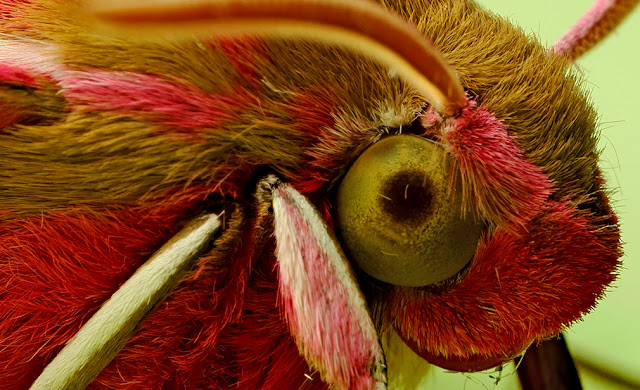
This species is nocturnal and of course feeds at night. That means choosing flowers that open or produce some nectar at night. The Elephant Hawk-moth has incredibly sensitive eyes that allow it to have night vision. In fact it was one of the first species in which nocturnal colour vision was recorded.


How can I follow that? Well, can't top it for colour and beauty, but what about the antennae on this next guy!


This one is Lymantria monacha, Black Arches.


In this species the males are actually smaller than the females, but have these large, feathery antennae. Notice the tell-tale splash of pink above the eye. There is usually pink somewhere, more often on the abdomen. Of course we cannot see the abdomen in this photo and so there may well be pink present.

Anything else JJ?

'Mais bien sur mon ami'

(I think that means, mines been sore Monday Amy!)


'Phalera bucephala' or the Buff-tip Moth.


The Buff-tip camouflage technique, is to resemble a broken twig of the silver birch tree.

Do you have a buff-tip missus? Ooops! Sorry, sometimes I have delusions of grandeur and just for a second or two, think I am Donald J. Trump. Let's get back to the job in hand? No...I am not still being Trump!


We have had some really interesting moths already, I hope you agree: but this next one must have one of the coolest names. This is 'Miltochrista miniata' more commonly known as the Rosy Footman...


One more? Certainly...


This is rather a brightly coloured specimen, but I think it is 'Agapeta hamana'.
It may look large in my photo but is actually only about 20mm long. It doesn't seem to have a common name; so I'll give it one...Wayne!

Hello, I'm Wayne...


One more and then we can all go home and have tea...

The aptly named Leopard Moth - Zeuzera pyrina


There were also a couple of non-moth critters in the trap...


Probably Rhagonycha fulva - A soldier Beetle


An Ichneumon Parasitic Wasp

Notice how all of these insects are covered in moth scales: moths tend to loose scales readily.


An Orange Ladybird (16-Spot) - Halyzia 16-guttata

And finally, this amazingly small beetle. About the size of an average Springtail, so no more than 2mm at a guess.


This little beetle belongs to the Aderidae family. There are only three species in the UK apparently: I believe this to be 'Aderus populneus'.


There is actually a lot more I could add to this blog but I don't want to impose on your time too much, so will save for the next one.


Monday, April 27, 2015

I've been searching in Comfort's Wood for Hazel...


Time to welcome back the leaf-roller weevils to our local woodland. As soon as the hazel leaves begin to appear, I start looking out for these fantastic creatures. With its brick red elytra you would think it would be easy to spot. But being only 6-8mm in length, when it is not moving, it can look just like a part of the tree or at least, a new bud. 

Apoderus coryli (A Hazel leaf-roller weevil)

Apoderus coryli (A Hazel leaf-roller weevil)

Apoderus coryli (A Hazel leaf-roller weevil)


Another bright little thing I found recently was this 22-spot ladybird. Probably the brightest of our yellow ladybirds and added to that, how many other native ladybirds have a 28 letter name? This one is even smaller than the weevil at about 3-4.5mm which is tiny compared to say, the common 7-spot at 5-8mm. Unusually, this one feeds on mildew rather than munching on aphids.

Psyllobora virgintiduopunctata (A 22-spot Ladybird)
Compare it with this next ladybird to get an idea of just how yellow the 22-spot is. But then you might expect it to be yellower than the one below as that one is actually called and orange ladybird, despite it having a yellow head and legs.

Halyzia 16-guttata (An Orange Ladybird)


Issus coleoptratus! There...I can even write that without having to refer to my reference books. Why can I remember the scientific name of this hopper? Because it occurs quite often locally and I have found it regularly over the years. I think this is at the mid-instar stage, so it'll have a bit of growing to do yet. There is only one other similar species, I.muscaeformis, but it is much rarer and not one that I have ever found...or.....have I? Maybe I wouldn't be able to tell the difference if I did spot one?

Issus coleoptratus (A Planthopper)

Issus coleoptratus (A Planthopper)


Whilst on the subject of small creatures, this spider is only about 5mm. This is a female. The males look totally different and don't have the pale legs & brightly coloured palps.

Heliophanus flavipes (A Jumping Spider)

Heliophanus flavipes (A Jumping Spider)

Returning to ladybirds for a moment; what do these next two have in common do you think? Well, although sadly the second one was in a bad way for some reason, they are both 10-spot ladybirds. Variations of the same species, and yet neither have 10 spots, confusing isn't it?


Hmmm..how can I link into the next photo? Oh! I know, ladybirds are sometimes called ladybugs and I have just started to see some real bugs. True bugs that is. C'mon...I tried...I had a go? Ahem...(presses on regardless)...this is the common flower bug. That is its name, it isn't necessarily a bug that frequents common flowers, although, it sometimes does. Ever feel as though your digging yourself into a hole? Here's the photograph... 

Anthocoris nemorum (A Common Flower Bug)
Just to confuse things further, this was not on a flower of any kind but a nettle. Now you're going to tell me that a nettle is a flower I suppose? Let's move on to a moth then...


This longhorn moth is just starting to appear in the wonderfully named Comfort's Wood close to where I live and there are usually good numbers in springtime. It's a male and I think is Adela reaumurella, but it might be A.rufimitrella as it's tricky to be certain from a photo. You can see how long the antennae are in the males, I couldn't even get it all in the frame here.


In the same woods I found a large white butterfly feeding on the wild flowers.I know these have featured in my recent updates too but it's always worth sharing photos of spring butterflies in my opinion...


Pieris brassicae A Large White Butterfly)

Pieris brassicae A Large White Butterfly)

I also had a chance to photograph one in the garden, early one morning...


Well that's about it for another update, I think this one is somewhere around update number 157 and I should be back with another fairly soon.

Until the next time...


Wednesday, January 21, 2015

An Orange ladybird has 12-16 spots...whilst a 16-spot ladybird has 13-18 spots, does that make any sense?


Having recently introduced some random logs to the garden, in order to both provide a low feeding perch for the birds and to encourage more bugs, they have already started to pay dividends...


This rather large ground beetle was scurrying around one morning and with patience, I managed a few shots. As usual with these Carabid beetles, I can't be certain of an ID...


An Orange Ladybird (Halyzia 16-guttata)
Also known as Halyzia sedecimguttata. This ladybird was tucked away on one of the evergreen shrubs in the garden. The species usually sports 16 white spots, although it can be as few as 12 and is one of the ladybirds that gets attracted to the light of my moth trap in summer.


We've had some hard frosts and even a little snow of late and so the bug finds have been few, but I did get out one morning to take some pictures of the ice etc..


It seems that I really need to add a small tree of some description to the back garden, if I want to get as many species of wild birds visiting as possible. Most aren't keen on feeding in the open. Until that happens, I've placed a couple of feeders in the tree beside our front drive and in no time at all, have had good numbers of visitors that include these amazing Goldfinches...

 The usual reminder here that these videos won't appear in the e-mail version of this update-you will need to view online.


Amongst the ground feeding birds was this lovely Dunnock...


They are quite well camouflaged once they get into the leaf litter...


The Blue tits and Great tits have also been enjoying the sunflower hearts...


You are supposed to be able to tell in the summer months, how many yellowy-green caterpillars a tit has eaten by the yellowness of the male blue tit's breast.
They were certainly having a good feed of seeds and have been regularly emptying the feeder in less than a day; I even spotted one checking out one of the nest boxes...


Amazingly, there are still aphids in the garden too...


I suppose it is conceivable that this is the very same snail-eating beetle I found in the garden a while back? 


Silpha atrata


Silpha atrata 

Erm...what else have I come across in the garden since my last update? Well there was this rather beautiful moth cocoon...


Again I couldn't say with any certainty which moth this might be but I aim to find out. I have placed it in a small open-top container in a quiet corner, so that I can keep tabs on how it is doing come springtime.


I do know what this one is though; a butterfly pupa this time-the pupa or chrysalis of an Orange-tip butterfly in fact...


You can see in this photograph that the silk girdle has been broken; probably by the strong winds and rough weather we have had. However, the cremaster (that little dome between the stem and the pupa) is still holding the pupa fast against the twig and so I think all is well.


Macro photography offers huge rewards and satisfaction and a real sense of achievement when things are going well, but one of the curses of macro-photography is undoubtedly sensor dust. It is almost an occupational hazard that we all have to confront at some time and that time is now for me...

  
Cleaning your camera's sensor can be an expensive business with most stores charging an average of £50 per clean. For most jobs, these quality swabs are the alternative I choose to use: Costing me around £23 including delivery, they should be enough for 4 sensor cleans. That's my job sorted for this afternoon then...

Until the next time...