Showing posts with label Rove Beetle. Show all posts

Tuesday, March 12, 2019

Unlucky 13? (Count 'em)


A Rove Beetle (Staphylinidae)
ROVE BEETLES


According to the UK Beetle Recording website, there are 1130 species of Rove Beetle (Staphylinidae) here in the British Isles. In fact, the family contains more than one quarter of all British beetle species.

How many of those have I found? Well let's just say that somebody suffering from Amelia could still count them. And I don't mean the captain of the Millenium Falcon , Hands Solo!


Another of my 'Staphy' finds

In case you don't know, and to save you rushing off (and possibly not returning) to look up Amelia. It is a birth defect causing one or more missing limbs. Anyhow, to return to the plot; I guess I must have actually discovered a dozen or so Rove Beetle species over the years and thought I knew the species at least well enough to be able to recognise anything belonging to this family. 

After all, I may not have found too many, but there is a definite similarity to all of them that I (wrongly) assumed would allow me to identify any, at least to species level. However, to quote Scottish singer-songwriter James Aaeron Diamond "I should have known better". Just when you think you have nature sussed, it throws you a curve ball.

Before I get to the 'Full Monty' and reveal all though; here are a couple more of my Staphylinidae finds that illustrate what I mean about the similarities...


The striking Rove Beetle: Paederus littoralis
There are a number of Staphylinidae subfamilies, of which Micropeplinae is one. Within Micropeplinae, there is just one Genus: Micropeplus. Micropeplus contains just five species ( are you following this? I shall be asking questions later). 


What has all this got to do with the price of bread? Use your loaf! We have arrived at the Full Monty; the hats are off  and all will be revealed, so...hang on to your hats...Oh! too late. You see that kinda shark fin shape my red arrow points towards: well in the end it all came down to that being one cool way of identifying my latest Rove Beetle find.

Which by the way, I still have not shared with you, so I had better put that to rights immediately huh? 


Micropeplus staphylinoides

Yes, it was one of those five species that I came across under a fallen branch in local woodland. But as you can see, it is so very different to anything that I have found previously from this family. I was flummoxed I don't mind admitting. The closest I could get was possibly Colydiidae which seemed to fit habitat-wise and had a similar appearance I thought.

Wrong! I was going to need some help with this and so contacted beetle expert Mark Telfer. Mark has his own  website @ http://www.markgtelfer.co.uk/ 
and is a very knowledgeable and helpful guy, who has identified beetles for me before. 

Here's his reply:

I well remember your discovery of Diachromus germanus. Which I did mention in the Status Review of Carabidae. 
These two beetles are rove-beetles (Staphylinidae) of the wonderful and distinctive subfamily Micropeplinae. The species is Micropeplus staphylinoides, with a characteristic shark’s-fin  near the rear of the abdomen. This is not an uncommon species but takes some spotting.

Fantastic! What I love about Mark's approach is that he provides just enough information, without getting into the minutia, which frankly, I would probably struggle to comprehend anyway, being the amateur that I am.

For instance, this is a description from another website:

The middle ridge of the abdomen towards the base of
the second to last tergite (fourth visible tergite
) projects
as a pointed tooth, almost reaching the hind margin of
the segment. Vertex with two
indistinct furrows in the middle and with a rounded
swelling each side. Elytra distinctly narrower than the
pronotum.


Micropeplus staphylinoides it is then. Another newbie for me and the local woods. 


I did find another beetle on one of my walks. This one was on a concrete post and I spotted it whilst photographing a wolf spider. Possibly Panagaeus species (Carabidae) but wouldn't want to go further than that. Edit: This has now been identified as Anthicus antherinus (Thanks to martinf)

The family Carabidae, commonly called ground beetles, is made up of just over 350 species in Britain and Ireland. It is quite varied, with some beautifully marked beetles: Asaphidion curtum being a real favourite of mine..


Asaphidion curtum-A Ground Beetle (Carabidae)


All of the beetles pictured above are previous finds of ground beetles. 


Apion weevil

I seem to be stuck in beetle mode here and so may as well add a couple more finds. There was this Apion, or Seed weevil. And then one day there were lots and lots of these Pea-leaf weevils that you can see in the next photograph. I suspect the Pea weevil is Sitonia species, and probably Sitonia lineatus. They are one of the earliest weevils I find each year and have even found during winter.


Sitonia lineatus?


Oh! This is the Wolf spider that I was photographing when I spotted that first Ground beetle. This spider is Pardosa species. The Lycosidae, or Wolf spiders, are primarily ground-inhabiting and will also forage on low-growing vegetation. All Lycosids are hunters, so they do not trap their prey in a web. They are not easy to photograph because can run very fast.


What about the creature in these photographs (above) then? Again, this is something I have not seen before; unless, they are Thysanoptera (Thrips). I did once find a whole family of both adults and juveniles, and as far as I can remember, which isn't far at all...these look similar. I could check my files I suppose. But, chances are that the original photos were lost when my USB spare drive went down with 30000 photographs on it!


I think that is probably long enough for one update: almost 2 metres already. 


I shall beat a hasty retreat with this  photo of a magnificent looking Collembola...

Neanura muscorum - A Springtail (Collembola)


And remember: “Great is the art of beginning, but greater is the art of ending.”

Wonderin' who sayeth that now? It was this fella...


H.W.L.

Saturday, April 12, 2014

A dozen species on one walk..it must be spring...

Warning! This post contains several short videos and if you only view the e.mail version you will not see them-you need to go online and view the original.


Last October I came across a huge, plump, gravid female vapourer moth in the garden. She produced eggs on a honeysuckle bush leaf. Before autumn arrived and they all fell to the ground, I collected and over-wintered them in a suitable spot.

I made sure they were kept fairly chilled, sprayed them occasionally with tepid water and then waited and hoped that they would survive what turned out to be a reasonably mild winter. 


I've been checking daily for any developments and today when I looked in on them, there were three of the tiniest larvae I have ever seen crawling around. I know that vapourer larvae will feed on most broad-leaved trees and also I remembered finding caterpillars on willow previously and thought that might be a safe bet as a food plant. They now have a nice supply as well as a few rose leaves, another place I have found them in the past-hopefully they will take to one or the other.


I guess the larvae are about 2mm at present and I am keen to see and learn how they develop having only ever found final instar larvae before. It will be great to witness the change in appearance at each moult and I already know the final stage before pupation will look very different to this little hairy beast.


In the garden, the blue tits that I hoped were nest building in one of the boxes have been busy visiting the box and even hopping in and out of it, one has been doing a lot of beak-wiping on the perch too. However, I haven't yet seen it taking in nesting materials, so I am not sure if it's going to happen at this stage.


Could it possibly be that this feline presence is putting them off?


Kent is looking fantastic right now

And in my local woods-'Comfort's wood' things are hotting up nicely. Although most of the trees here are around 20 years old, there is an area of ancient woodland as well and so I can never be sure quite what I might find. I have already turned up several notable species and the commoner invertebrate numbers seem to increase year on year.

Below is a selection of photographs taken on a recent walk around the woods. These were all taken on one visit...


I was pleased to find the tiny leafhopper (1st photo line 3) which I think is Javasella pellucida. 

There are plenty of butterflies around too...


And a couple of contrasting views of a hazel leaf-roller weevil I spotted on a different day...


I guess about 100 old fashioned yards from the house, there is a small stream and here I saw another interesting creature that I have neither seen before, or have much knowledge of...


And a short video of this creature...


You're going to know what this is (if you don't already) and I can only suggest that I think it must be a freshwater leech. It isn't like any I have seen before but can't think what else it could be.

This is more like the leeches I am used to seeing-these were in my little pond in the garden...


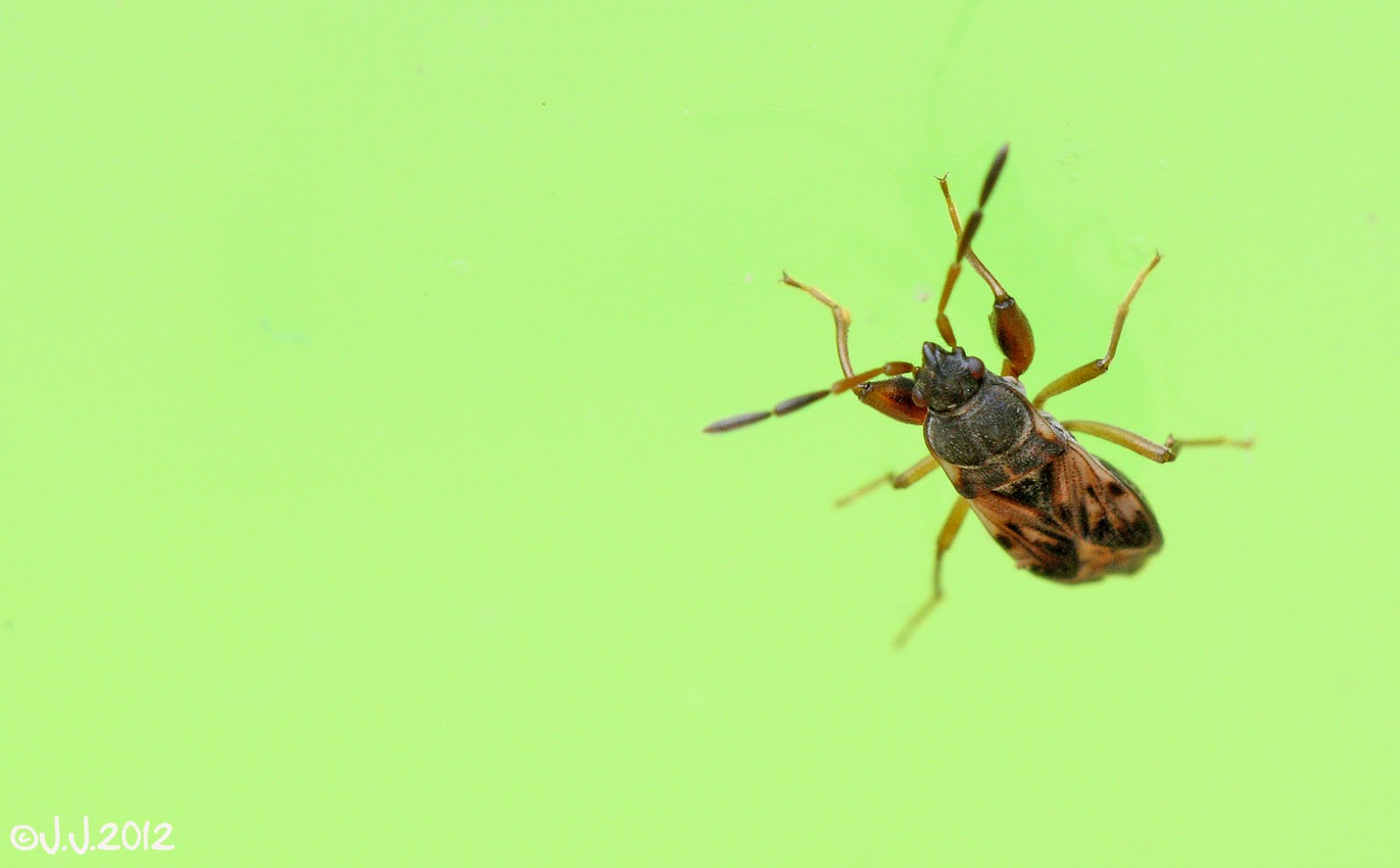
Well that just about wraps up another update-my final offering is this tiny rove beetle that I photographed on grass a few days ago...


Until the next time...

Wednesday, March 07, 2012

A few faux friends...

It's been a while since I could get out and take a few photos of the local wildlife and nature etc.. but finally the weather relented and time allowed a few hours wandering around the Kent countryside.

First up is this Rove Beetle photo from a couple of days ago.


CLICK ON PHOTO TO VIEW LARGE
Paederus littoralis

This little beetle is only about 7 or 8mm long and is flightless.It belongs to the family 'Staphylinidae' There are nearly 1,000 species here in the U.K. some of which have a resemblance to earwigs.
This particular photograph was taken using natural light and is a stack of a few images. This one I rescued from a cattle trough that it had fallen into, it was not at all well following it's ordeal and probably the only reason that I managed a few shots before it scurried off. It did recover though and was soon on it's way. Below is an image from a week or so ago that shows a whole beetle and was taken using flash.


March in the U.K. is right at the tail end of winter, but not exactly spring yet and although bugs and insects are starting to appear numbers are small as are species. However, you only need to turn over a few stones, or fallen branches, or even pick up a handful of leaf-litter and chances are there will be something of interest.


A Click Beetle

This fantastic little click beetle was found in exactly that way, I picked up a large stone to see what if anything was lurking underneath, when this dropped off. The colourful thing it's perched on here is just a small bit of card that I used to pick it up with to get a photograph; before replacing it under the stone to sleep out the remaining days until the temperature rises enough for it to get out and about.

These are always nice to find and their 'coats' always remind me of a pasta that's been squeezed in that area just behind the head/thorax. Just me then?


Moving on.....

A Ground Bug-Scolopostethus sp.

This tiny ground bug belongs to the family 'Lygaeidae' and is only around 4mm in size. These are notoriously difficult to i.d. with any certainty from a photograph but I think I have this one right, at least down to species level.
Once again, this little bug was revealed to me when I turned over a piece of fallen bark and although it was good to see a true-bug after a long winter, it's true colours are only revealed by photographing it with the macro lens; it would just be too small for the human eye to pick up all the detail. Well, my human eye anyhow.


A False-Ladybird Larva

Some days can be particularly frustrating when out bug-hunting and those days have been to the fore over the past few weeks:to be fair, I'd expect little else through the winter months. But this day was turning into one of those rewarding ones when it all seems worthwhile and the finds were starting to get very interesting.

I decided on checking out an area beside a local crop field where I knew there was a fallen tree and that meant a good opportunity to search under the now lifting bark for further invertebrates.

Thinking I might just spot some interesting collembola species I began to search. Nothing of interest, just the usual suspects. I'd almost resigned myself to it being a lost cause when I found another of these fascinating beetle larva.
I found these for the first time only a few weeks ago but this time I had the idea of taking a couple home (I eventually located around a dozen or more) to see if I could observe them pupating and then emerging as adult beetles later in the year.

And so now I have a nice container that replicates their natural surroundings as closely as possible and I'm hoping that I'll be able to watch their progress and learn a lot in the process.


A False Scorpion

Under the very same piece of bark where I found the ground bug was this fantastic creature: a pseudoscorpion. As I think I've stated before on this blog, these are so called because of their resemblance to scorpions. They actually have no sting and as for size, the largest are only 8mm with this one being a mere 3mm, smaller than the ground bug.

They may pose no danger to us but if you're an insect then beware;these tigers of the undergrowth can produce a venom that is extremely toxic and is more than capable of felling prey several times their own size.

These pseudo or false scorpions are actually arachnids. There is an interesting piece with further information about them here.

I ought to point out that the i.d. I am providing on these insects is purely based on my research and sometimes the help of like-minded friends. I am not an entomologist, just an interested amateur photographer and so if any prove to be incorrect, I apologise and would welcome corrections.


Litargus connexus 

The two photos above of a 'Hairy Fungus Beetle' are an example of my inability to put an identity to some of my finds and having to resort to requesting help from others with better knowledge of such things.

I'd not even got to species level with this one when I began to suspect that I might need help. I decided that my best plan of attack would be to enlist the help of someone that had helped me numerous times in the past and so I fired off an email with pictures of the beast to Tim Ransom and in no time at all back came the answer in full. Even better, the added information that this little beetle had last been recorded in my area in 1991 and so it turns out to be a nice find.


Carabidae-Leistus species (possibly L.spinibarbis?)


This striking blue beetle of the Carabidae family had me hurriedly adjusting my flash settings on the camera to try and obviate the reflections from the metallic elytra as best I could.

These fast running beetles are essentially carnivorous, feeding on a variety of other invertebrates.Many of them have this bright, metallic look and can be Bronze, Green, Violet and even in the case of the strange Tiger Beetle, spotted!


Phragmatobia fuliginosa

My last find of the day was this Ruby Tiger Moth larva. These are known to feed on herbaceous plants but I think this one was still in it's dormant phase.

They do morph into a spectacular moth that can be seen flying  from April to June and then again from August to September, although I understand there is just one generation in the north of the country.


A Ruby Tiger Moth

That, ladies and gentlemen, concludes this edition of my little nature/photography blog. I hope you'll be able to join me again soon for the next? Many thanks to everyone that has signed up for notifications of new blog entries and my friends around the world that I know read these missives also. Special thanks to my friend Tim Ransom for his invaluable help with i.d. on some of these entries.

Until the next time then...