Showing posts with label Hazel Leaf-roller Weevil. Show all posts

Saturday, April 12, 2014

A dozen species on one walk..it must be spring...

Warning! This post contains several short videos and if you only view the e.mail version you will not see them-you need to go online and view the original.


Last October I came across a huge, plump, gravid female vapourer moth in the garden. She produced eggs on a honeysuckle bush leaf. Before autumn arrived and they all fell to the ground, I collected and over-wintered them in a suitable spot.

I made sure they were kept fairly chilled, sprayed them occasionally with tepid water and then waited and hoped that they would survive what turned out to be a reasonably mild winter. 


I've been checking daily for any developments and today when I looked in on them, there were three of the tiniest larvae I have ever seen crawling around. I know that vapourer larvae will feed on most broad-leaved trees and also I remembered finding caterpillars on willow previously and thought that might be a safe bet as a food plant. They now have a nice supply as well as a few rose leaves, another place I have found them in the past-hopefully they will take to one or the other.


I guess the larvae are about 2mm at present and I am keen to see and learn how they develop having only ever found final instar larvae before. It will be great to witness the change in appearance at each moult and I already know the final stage before pupation will look very different to this little hairy beast.


In the garden, the blue tits that I hoped were nest building in one of the boxes have been busy visiting the box and even hopping in and out of it, one has been doing a lot of beak-wiping on the perch too. However, I haven't yet seen it taking in nesting materials, so I am not sure if it's going to happen at this stage.


Could it possibly be that this feline presence is putting them off?


Kent is looking fantastic right now

And in my local woods-'Comfort's wood' things are hotting up nicely. Although most of the trees here are around 20 years old, there is an area of ancient woodland as well and so I can never be sure quite what I might find. I have already turned up several notable species and the commoner invertebrate numbers seem to increase year on year.

Below is a selection of photographs taken on a recent walk around the woods. These were all taken on one visit...


I was pleased to find the tiny leafhopper (1st photo line 3) which I think is Javasella pellucida. 

There are plenty of butterflies around too...


And a couple of contrasting views of a hazel leaf-roller weevil I spotted on a different day...


I guess about 100 old fashioned yards from the house, there is a small stream and here I saw another interesting creature that I have neither seen before, or have much knowledge of...


And a short video of this creature...


You're going to know what this is (if you don't already) and I can only suggest that I think it must be a freshwater leech. It isn't like any I have seen before but can't think what else it could be.

This is more like the leeches I am used to seeing-these were in my little pond in the garden...


Well that just about wraps up another update-my final offering is this tiny rove beetle that I photographed on grass a few days ago...


Until the next time...

Friday, June 07, 2013

Watch out for the Billy Witches...

I mentioned in my last update to the blog that I was going to try and find a leaf-roller weevil in action. In other words, actually rolling a hazel leaf.

Well...I have to report that I have not yet manged that, but did find a freshly rolled leaf-and so at least I now know that they have started on the process of rolling the hazel leaves that will become home to the next generation of larvae...


My local woodland is now reaping the benefits of the coppicing that took place a couple of years ago, and the rides are full of wild flowers and in particular buttercups...


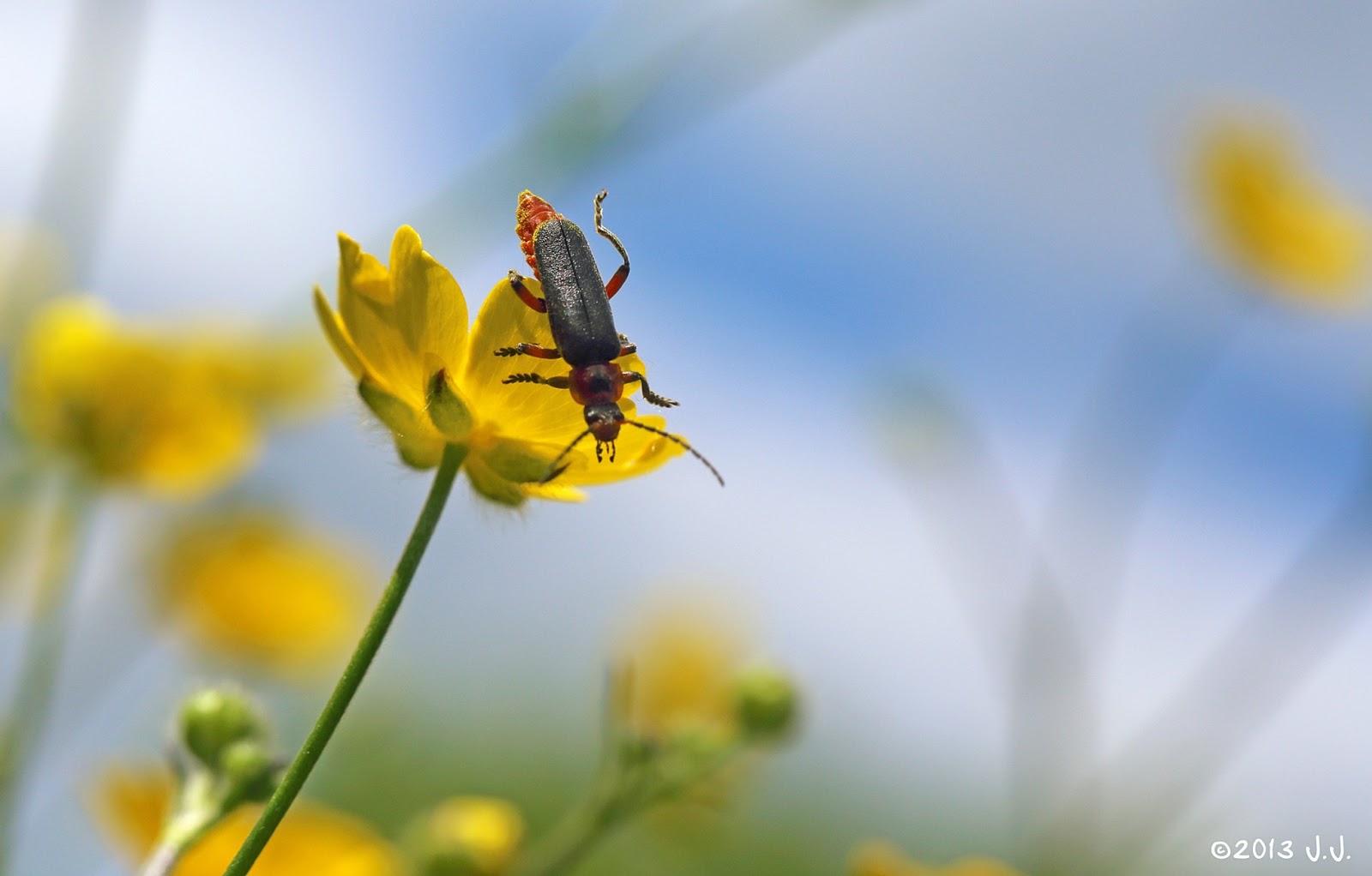
On my last visit,I noticed that these were attracting cantharis beetles. I counted thirty in one area alone...

CLICK ON ANY PHOTO FOR LARGE VIEW ON BLACK


The fabulous wasp beetles were also buzzing around the buttercups as well...


Although these beetles mimic the marking of a wasp, they are completely harmless and are usually happy to pose for photos. Although,I think this one was trying to shake a leg?

If you are one of my readers that dislikes spiders, and I know there are a few...perhaps you might consider skipping the next photo? Although, to my eyes, these are kinda cute!


I think these are probably Araneus species spider-lings  At this stage they bear little resemblance to the adults with this yellow colouring.

Another insect that seems to be around in larger than usual numbers is the snipe fly. These are quite large as flies go and look at first glance, a little like the big robber flies...


Snipe flies of the genus 'Rhagio (which I think this one is) are sometimes called 'down-looker' flies, after their habit of perching head-downward on tree trunks etc.


The news from my garden moth trap is that I seem to be catching fewer than earlier in the year, as far as numbers go. There have been some interesting finds though. I recently had this visitor...

A Common Cockchafer (Melolontha melolontha)
This is the cockchafer or 'May Bug' or even.. Spang Beetle, or 'Billy Witch'.
I think this may be a male? You are supposed to be able to tell male from female by counting the number of 'leaves' on those fantastic looking antennae. Males sport seven,whilst females have six. I am sure that looking closely at the antennae on the right of this picture, I can just about make out seven?

These beetles were abundant once upon a time. That is until the dreaded pesticides were introduced. However, since the new regulations, they are making a comeback.

But the real star of the year so far must surely be this next beauty...

An Eyed Hawk Moth

This took my breath away. What a moth this is. It is a big insect and wings open, measured well in excess of 3" The colouring and markings and texture are superb and when it opens its wings to reveal those eye-spots...Wow!


You might just recall from last year (although, why should you?) that I had some caterpillars of the buff-tip moth that pupated...


I had my doubts as to whether I had managed to keep any of them successfully through the winter months, I kept a close check on them and things didn't look good. Come early spring I felt a few of them for signs of movement but most seemed hard and lifeless.

I had given up hope by late May and decided to clean out the container that housed them. Lucky for me that I did because, on opening the top, right at that very moment, there was a moth emerging for one of the pupae; I grabbed my camera and took some photos...

A Buff-tip Moth just out of its pupa


Once fully recovered from the effort of emerging and having sat for almost 3 hours, just drying out and inflating its wings, the moth looked like this...


Eventually it folded its wings into the recognised resting position, along it's back and the full beauty of this creature and superb camouflage became obvious...


I am so pleased that I managed to keep these and had the privilege of observing the whole life-cycle, other than the egg stage. Since the day this one emerged, I have had a further 4 that I've been able to release.

The only other thing of note, besides the sparse amount of moths in the trap (which by the way I have added to the diary page,but still need to identify most of) is this wasp...


I had three of these one night in the trap. I think they are Ichneumon wasps but wouldn't like to go further than that. They are parasitic wasps and can be tricky to identify fully.

I seem to have lots of new things I could add to the blog,and may even have got a little out of sequence with some finds but, I think that'll do for this time and I'll try and update again soon. I hope once again that you have found something of interest in this latest entry and, as always, thank-you for your interest.

Until the next time then...

Tuesday, October 23, 2012

Autumn takes hold...

Various events have kept me away from photography for a couple of weeks, and when I did manage to have a scout around the local woods and fields, I was struck by just how quickly things have moved towards autumn now.

Butterfly and dragonfly numbers have reduced significantly since I last found time to have a wander but there are still invertebrates to be found...


A shot that illustrates the autumnal feel nicely to begin with. This dock bug was the only one that I came across on this particular day. At this time of year they tend to congregate before hibernating and can be found in quite large numbers, usually on...you've guessed it-dock!


CLICK ANY PHOTO FOR A LARGER VIEW
A Hazel Leaf-roller Weevil (Apoderus coryli)


I wasn't expecting to see this leaf-roller weevil amongst the few hazel leaves left on the trees. These are one of the first species I look for when the new leaves appear in early spring and to see one this late is quite unusual.
Having said that, in mild winters, I have found them in November.


Carabid Beetle (Possibly Leistus)

This great looking metallic beetle was out and about the same day as the weevil and positioned itself at the top of the stem just long enough for a couple of nice clear shots.


A Garden Tiger Moth Larva (Arctia caja)
My next find was this caterpillar. I think this is the garden tiger moth larva. It was quite fast and I did wonder, as it was close to the ground if it was looking for somewhere to pupate.


I found a secluded spot where there was still some scabious in flower and as you'd expect, it was attracting a few insects...


I think this large hoverfly is probably Sericomyia silentis. It seems to be quite distinctive and although if the books are to be believed, this is around May-September, as we've already established, timings are all over the place this year again.
Both it's size and the habitat seem to fit as does the wing veneration from what I can make out.


Another hoverfly found on the same scabious plants was this Helophilus species one. Not exactly sure from this shot if it is H.pendulus or H.hybridus? Actually, scrap that! I think looking at the face, it may well be H.trivittatus? (Where's my pal Tim Ransom when I need him?)


There were also a good number of bees taking advantage of the late flowers too.

When I saw this couple of rhododendron hoppers in cop, pictured below, it crossed my mind that this behaviour is usually to be seen in spring-what then would be the purpose of mating this late in the year? Surely no young would result and so perhaps it was just for pleasure? I know...my brain works in very strange ways sometimes.


Graphocephala fennahi

Of course the changing season has meant that we are now getting much damper conditions and that is just perfect for the fungi.....


I do spend a lot of time contemplating just how amazing and beautiful nature is, of course to portray it in such a one dimensional way is wrong on so many counts:nature is a tough environment where survival of the fittest still rules.
We all probably know that butterflies for instance are short lived, but it's still upsetting to see such a beautiful insect reduced to how I found the one in my next photograph...


This red admiral had lost most of its wings to what I guess must have been bird attacks. A very sad sight, especially bearing in mind that these are one of the species that can overwinter. It was amazingly still alive (just) at this point but there was nothing I could do to help, other than putting it out of its misery-and I couldn't bring myself to do that.

To complete this update I think I'll share a photo of another of nature's inventions that appear in all kinds of forms and manifestations at this time of year-these are the galls that are usually the work of tiny wasps and are to be found on all manner of trees and shrubs. This one I'm calling a marble gall. I have no idea if that is its correct title, it seems to fit though!


I suppose I should add that I found this one on oak. Now you're going to tell me it's actually called an 'oak gall' aren't you?

Until the next time then...


All photos taken using Canon 40d-Canon 100mm Macro and natural light, with the exception of the rhododendron hoppers where I added fill flash.