
Having started the week with white-stuff a'plenty.....


...it was nice to see a thaw revealing some greenery again as the week went on. The snow is great and very pretty but this is 'England's Green and Pleasant Land' and our 'greenness' is what makes Kent special.
By Wednesday, the countryside was looking like this.....

As the thaw took hold things began to melt quite fast-at the bottom of the garden (or 'yard' if you're in the U.S.) there's an old butlers sink that doubles as a little pond. It's not much, but holds just enough water to encourage a few extra bugs and insects into the garden.
I lifted a slab of ice that covered the entire water surface from the sink and I guess was around 40mm thick to discover underneath a few bits of debris that had I suppose been in the water, but had now become stuck to the ice.
Amongst these I was very surprised to find something moving. I grabbed my camera and once I got the macro on this tiny, dark object, I could see that it was a damselfly nymph...
Amongst these I was very surprised to find something moving. I grabbed my camera and once I got the macro on this tiny, dark object, I could see that it was a damselfly nymph...

I hadn't realised that there were damselflies in the pond until now but even more amazing was that this little one survived the ice.
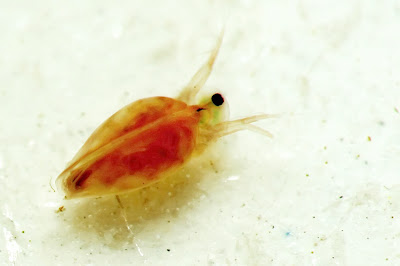
The other thing I spotted was this tiny creature...
My first flying insect of the year appeared on the window one morning after heavy rain. I think it's a midge of some kind?

Having found the damselfly nymph I decided to check out the water barrel in another corner of the garden. This is a good spot for finding springtails and I wondered how they had survived. They ought to have done well as they can cope with very low temperatures.
I was expecting to find the usual globular springtails, but actually only spotted this one which I think is probably Vertagopus arboreus...


Of the few evergreen trees I noticed that there seem to be a large number of Holly that have been affected by the holly leaf miner...


The other thing I spotted was this tiny creature...

I am fairly sure this is a water flea (Daphnia?) I wouldn't want to attempt a closer identity than this because, for instance, if it is Daphnia, this genus alone contains 150 species.
My first flying insect of the year appeared on the window one morning after heavy rain. I think it's a midge of some kind?

I was expecting to find the usual globular springtails, but actually only spotted this one which I think is probably Vertagopus arboreus...
 |
| Vertagopus arboreus? |
Out in the field I have struggled to find much of interest through the recent bad weather but there are signs of spring now and just today I saw a number of green leaf buds on trees.
I was also really pleased when I spotted this wild daffodil close to opening already...

----------------------------------------------------------------
I was also really pleased when I spotted this wild daffodil close to opening already...

It seemed to me that there must be a connection between finding this first daffodil of the year on the very day that would have been the birthday of a good friend I lost a year ago, called 'Daph'.
----------------------------------------------------------------
On one recent outing, I did come across these little eggs...

I thought maybe these were snail eggs at first. I was basing it mainly on their resemblance (although obviously smaller) to my African Land Snails. The other thought was possibly slug? I dismissed that idea because I have found slug eggs before and they have always been transparent.
Having had my curiosity aroused I decided to take a few home to observe. I didn't have long to wait because a few days later I was wishing that I hadn't dismissed slugs so quickly...

O.K. so my initial guess at an identity proved to be wrong but I now think that perhaps slug eggs are transparent until they are close to hatching when the colour of the slug becomes visible. If that's a load of falafel, then I would like to submit to the court that my second guess was right!
Of the few evergreen trees I noticed that there seem to be a large number of Holly that have been affected by the holly leaf miner...
 | ||
The story of the little leaf miner is quite complicated but I've added a small diagram below showing the basics, then I'll add a link to a full explanation at the bottom of this blog post should you want to explore it further.
Ah, you see...I may be getting older but I'm not getting senile yet! If I add the link here, you'll be off to read that instead of completing my blog entry won't you.
In the same woods as I found the holly, I saw this very strange tree. I have added a version of this to my flickr page but it's one that I've added a sort of HDR effect to, this one is the original...

It looks a bit gruesome don't you think? As if it's been mortally wounded.
By way of compensation, I'll end this update with a 'pretty in pink' photo! This is a horned tree hopper that I photographed last summer in amongst the pink willow-herb flowers...

That's it then, until the next update.....


