Showing posts with label Crab spider. Show all posts

Monday, March 20, 2017

No more duck walks, how about a cow instead?

Monday 13th March 2017 and I wake to be greeted by a spring day, with warm sunshine. Time for a walk with the macro. Shall I go walking on sunshine, or perhaps, a walk on the wild side? I could do the walk of life if I knew what life was all about. Should I walk like a man, or walk like an Egyptian? Walk this way, or walk the line? Maybe I'll just go walkin' the dog, or should I walk the dinosaur? I'll try to avoid walking on broken glass, because that's not what these boots were made for...


The first sighting of an insect, was this tiny moth. It was sitting on a fence-post sunning itself. I am afraid that I have no idea of species, actually, I am not even afraid...I just have no idea. Then came this lovely small tortoiseshell butterfly. Once again, it was soaking up the warm sunshine and was favouring any bare patch of clay soil...


My next 'spot' was something of a surprise...


Another fence-post find; this time a woundwort shieldbug. I rarely see these away from their food plant and certainly this will be the earliest in the year I have found any. 

Then...another butterfly: this time a peacock...


Just in case you are phobic, here's a clue to what is coming next in this little blog update...


Got it? How about this second clue...


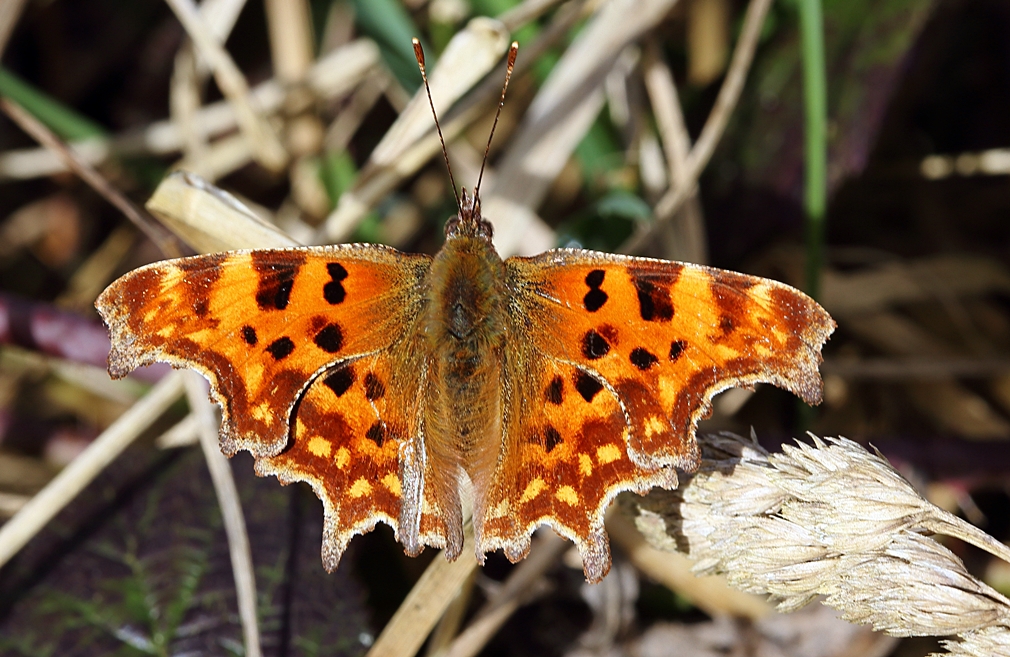
Oh calm yourself! It's only a little female crab spider, she won't harm you. Tell ya what, let's punctuate this update with a comma shall we...


Yes, this comma was the third butterfly species that I was able to photograph on this particular walk. I actually saw brimstone and red admiral as well. Meanwhile, on another fence-post I came across this teeny blue weevil...


And that was just about all I saw on this particular morning; aside from these bonking frogs, or are they toads perhaps?


Saturday, August 24, 2013

Don't waste your walk chatting on the phone...

The countryside isn't an extended office-get off your phone and watch what your dog is doing, stop it from messing on the footpath and from pestering people (me) who want to experience the surroundings in solitude.....

Did I say that out-loud? I was just letting off steam...

I should begin this update with a reflection on my last-you might remember it was partly about some fox moth caterpillars that I had discovered as eggs and had assumed they had reached maturity as larvae...


Well that turned out to be quite wrong as they continued to feed and grow and now have evolved into something quite different...


As well as being hirsute,I have also learnt that this colouration is referred to as rufous, meaning reddish-brown and is actually used as an adjective name for many animals, and in particular birds. It's also where the name of the moth is derived I guess.


A spider....Oh! Spider alert for those who are averse here...a spider that I have been seeing fairly regularly of late is the crab spider Misumena vatia...


These are remarkably able to change colour from white to yellow, although I have read this can take up to 20 days with the reverse only taking 6 days. 

It's thought that this species lives for no more than 2 years and so, let me think...20 days to change, 6 to change back...erm......over 2 years, only 28 times max?


These spiders don't spin a web to catch their prey-rather they use the colour change/camouflage trick and then grab their prey with front legs that have tiny hooks at the tip. Then, instead of wrapping the prey in silk as many spiders do, they will (here comes the gory bit) hold the prey and suck all of its bodily fluids dry.

And so what is the web/silk in my photo above? Well this is a female and I know that they use silk to protect their eggs (yes, these spiders lay eggs) and so I assume that's what's going on here and she is protecting her offspring.

-----------------------------------------------------

Having been lucky enough to see painted lady butterflies this summer,I began searching for evidence of egg laying on thistle. It was always a long shot and I found none, but did discover more moth eggs...


A few days later these extremely small caterpillars began emerging...


Having moulted at least once (not quite sure how many times) they looked like this...


I'm sure you won't be too surprised when I tell you that I have no idea of identity at this stage,
 but will try and keep observing to see if later instars provide better clues.


     I did come across another couple of eggs that I am sure are moth...


They turned this amazing red colour just before hatching...


What emerged however, was not bright red larvae but...well...I have to be honest here and say that I've failed to get any photos that I am happy with as yet-but as soon as I do, I'll post here...


-------------------------------------------------------


A couple of strange ones now-something unexpected that I found on alder and has been puzzling me ever since. This little bug? Parasitised somehow or is it as simple as it hasn't emerged properly? 


All I can really add is that it was still alive at this stage but didn't make the following day. I did see something similar a few years ago, but that involved a fly-I have tried to locate that picture but my filing system is less than perfect and....no chance!


Again, with this next 'thing' I have photographed one before but didn't get a positive i.d. at the time, with most people thinking it was spider related...


It was only around 15mm or so across and woolly looking. It was firmly attached to the underside of the leaf and there was no sign of activity close by. Tell you what...if I find out what this is for sure I'll tell you, as long as you tell me if you already know?

Enough for now, just to add that for anyone who follows my monthly article in print, I promised to provide a full list of butterfly species spotted within half a mile of home this year...

They are, in no particular order, to date:

Brimstone
Common Blue
Speckled Wood
Comma
Peacock
Red Admiral
White Admiral
Large White
Small White
Green-veined White
Gatekeeper
Silver-washed Fritillary
Small Tortoiseshell
Small Copper
Green Hairstreak
Large Skipper
Small Skipper
Orange Tip
Holly Blue
Painted Lady
Ringlet
Clouded Yellow

Until the next time...


Monday, October 29, 2012

Daniel Craig says it all...

Back in June of this year I came across a family of bugs underneath a maple leaf in local woodland...


I thought at the time they were perhaps aphids of some description and one of my flickr contacts Maria (Rockwolf) did what she has done so many times for me now, found a correct identity for the little things. (Thanks again Maria.)

Maple aphids (Periphyllus aceris) Is what they turned out to be. If only I'd considered it was as easy as finding an aphid named after the tree it was found on! Anyhow, that's only half the story.

These little critters have a fascinating and complicated life (honestly!) for instance...

Some are born as 'aptera' individuals. Meaning:Wingless,parthenogenetic,female aphids.Pathenogenetic meaning: Reproduction by development of an un-fertilised egg.This is basically asexual reproduction or to simplify it further-cloning.

Asexual reproduction
Asexual reproduction is the production of offspring by only one parent. No fertilisation of an egg cell or mixing up of the genes takes place, so all the offspring are genetically identical copies of the parent. Greenfly, hydras and strawberry plants can all reproduce asexually as well as sexually.Humans next?

Some are born as 'alates' meaning:Having wings.

If at this point you are still with me, the following photo shows how they now look. This was taken a few days ago...


I now know that the first picture shows what are known as aestivating nymphs. This means that they enter into a kind of hibernation until they resume development in the late summer.

Notice also how most of the heads are pointing towards the centre of the circle in the first photo.

The second photo shows that they have now matured into 'oviparae' (egg laying adults) the oviparae then lay their eggs on the maple twigs and bark and the whole cycle starts afresh.....fascinating! (Perhaps I should have suffixed that with a question mark?) Come to think of it that raises its own question-can a question mark be a suffix?

Let's move on shall we before, as I heard Daniel Craig saying in a radio interview this week,"I'm in danger of disappearing up my own ********"


This photograph of a crab spider isn't the sharpest shot you'll ever see but leaving aside my excuses as to just why it isn't that crisp-I wanted to include it because of what it shows.

If you look closely, you'll see that what appears at first glance to the a parasite attached to the right side as viewed here, is actually a red spider mite.

Now I may be wrong about it being a red spider mite but assuming that I'm not, I was always under the impression that these mites got their name from the fact that they look like spiders and not that they attacked spiders in any way. If that's true, then why was this one all over the little crab spider? Just hitching a lift?


Right...how about a red weevil? "Red weevil? Don't be silly!" 


Apion frumentarium
Or as it's commonly known the Red Rumix Weevil. I think that rumix refers to dock as that's where these are usually to be found. I have photographed these little beetles before but never managed a natural light shot until now.

Everyone has been commenting on how few wasps there have been this year and I had to say that I have also noticed a big reduction in numbers,although I have also noticed an increase in hornets locally.

I did spot this insect recently and I'm guessing this is one of the Ichneumon's?


This next photo is of a bug nymph that I found a while ago now but have been unable to put an i.d. to that I'm happy with...


My initial though for this one was a 'hairy-bug' nymph but that didn't seem to fit when I checked it out. Then I thought perhaps it could be Corizus hyoscyami, a rhopalid bug? The only nymph photos I've seen of these though have little spurs/spikes at the edges of the abdomen.

Here's another view...


I seem to remember that the plant it was on was ragwort but not sure that is relevant.

As always, if you recognise this one, please do let me know.

Last up for now is this robberfly that I photographed in the garden as a bit of an experiment. It was taken using just natural light but is a stack of 20 hand-held images.

Whilst I guess I have to be pleased with the resulting level of detail-for me, I am not sure I like the effect, it seems a bit too sharp to be realistic?


Until the next time then...


Friday, August 24, 2012

From eggs to...well, eggs!

I did promise to keep you updated on the news of my 'gals' (Giant African Land Snails) and I have to report that, despite an anxious wait, like a parent-to-be, not one of the eggs have yet produced baby snails.
It's now just a touch over 3 weeks and so, I suppose there's a little time yet before we can say for sure that they've failed.In fact, one care-sheet I have obtained states anything between 2-6 weeks to hatch. I'll let you know if anything exciting does occur over the next few days.

I did however manage a short little video showing how these creatures move around. Shot through the glass of the tank, it shows one of the snails climbing the side by means of this undulating/rippling movement.
(Apologies for the noisy kids in the background, I forgot to remove the sound before uploading the video)


Click arrow to begin video


Whilst on the subject of molluscs-this year may have been awful for butterflies and some bugs and insects but slugs and snails seem to be the winners regarding conditions needed for reproduction and even survival.

Arion ater/hortensis

Now here's the thing-I thought I knew exactly the species of slug that I found in huge numbers in the garden following recent rain. It's the large red slug-Arion ater isn't it? I checked my reference book and read the following: Large Red Slug- Widespread and common throughout Britain, especially in gardens.Orange-red in colour. Yep! That fits. 

End of story? Oh no! Double check with the Internet now just to be sure...............Erm....err... "Computer says no"

"What?"........  Arion ater: The European Black Slug..."Ugggh!" Two closely-related species are Arion rufus and Arion lusitanicus,and they can only be told apart from A.ater by dissection. "Riiiiiiiight!"  Best read on then and see if there's a logical explanation? There was...

As its common name suggests, it is usually black in colour, although considerable variation does exist, ranging from chestnut brown and orange to pale grey or cream. In general, slugs in northern England and Scotland are jet black, while in the south of England the orange forms appear to be more common - the colour variation is thought to be due to differences in ambient temperatures.

Phew!


A closer look-have you had your tea?

Having cleared that up, I now have to consider that these may well not be ater at all but hortensis? Why so? Because after further research, it does seem to fit the description/photos better.....

------------------------------------------------------------------


As we edge ever closer to September,we are fast approaching what I like to refer to as 'spider-time'. That time of year when spiders not only seem to come into their own, but also, into the house!

Misumena vatia
The one pictured above is unlikely to do so though-Misumena vatia or as it's sometimes referred to 'The Goldenrod Crab Spider' is a flower loving spider with the ability to change colour to some degree, depending on the flower it's sitting on. Although it looks hard as nails in this photo, it's actually not a macho male but a pretty little female. 


Click on any photo for a larger view
House Spider
The house spider (Tegenaria species) on the other hand, would hardly dare to live anywhere else given its name? I think it's probably safe to say that these     spiders are actually living with us all year round. It's just that now they are fully grown making them more obvious ,and now is also mating time- therefore you're more likely to spot one stuck in the bath where it has fallen whilst actively seeking a partner to mate with-well, we've all done that at sometime or other?


Araneus diadematus
And so, if the tegenaria species of spider live in the house, where then do we think the araneus species, or 'Garden Spiders' live? Would you like to phone a friend? Oh, you'd like to use your 50/50? O.K. Computer, take away two of the choices please....."

The thing about being called garden spiders though is that they don't actually know they're supposed to stay in the garden, how could they? They don't read!
And so, the one report I've read of somebody being bitten by one. Yes, that's right...bitten by one, reads: Bite report-on the arm,while in bed.Felt nausea,the arm swelled badly for 3 days.


Yet another sure sign that the year is disappearing fast is the emergence of the dock bug nymphs. I usually manage to spot the early instars and if I'm really lucky a first instar-however, this year, I seem to have missed those but did find what I reckon is probably a 2nd or 3rd instar...

Coreus marginatus-A Dock Bug nymph


I also came across the eggs on one of my recent walks-I think these will be green shield-bug eggs but I'm not sure they are going to emerge now. I have checked them for several days and there has been no change and to me they just don't look right. No doubt I'll be proved wrong but I'll be sure to admit it if I am, so watch this space.

Bug eggs
We seem to have come full circle now, starting with eggs and ending with eggs. That must be as good a place as any to call time on this particular entry.
I have a couple of interesting things lined up for future entries and so I'll do my level best to be back really soon.

Until then next time then...