Showing posts with label Vine Weevil. Show all posts

Saturday, September 07, 2019

He's in the Jailhouse now...


Just sayin'
No, this update is not going to be about Brexit: it's just that I heard the news about Boris whilst writing this.


When people ask me (and they do) what it is about macro-photography in particular that attracts me, one word usually springs to mind. That word is detail. Oh I could flower it up and say that macro-photography allows us entry into an unseen world, it gives us superhuman vision and reveals in spectacular fashion the minutest organisms that the naked eye cannot even see; but underpinning all this, is detail. But this is a photographic blog in essence, and so what better way  to demonstrate it than with a few photos...


The photographs above are just phone grabs it's true: the first being straight from my phone, with the second and bottom ones being progressive crops. Nice enough I guess if you just wanted a snapshot, or were partially interested in the nasturtium flower the bug is sitting on. 

But once I  fired up the macro and put it on the same bug, the details revealed were, well judge for yourselves..

A Bronze Shieldbug-Troilus luridus


And this last one from a little later, when it had moved position...


Look at those armoured shoulders, the projections/spikes that are barely visible in my phone images. I hadn't realised that I have been photographing this species of shieldbug for at least ten years, until I found an image of mine that 'British Bugs' had used back in 2009 of an instar...


This next critter was something of a surprise...

A Great Diving Beetle

This is one of, if not the largest of our UK beetles and is an aquatic beetle. They live in freshwater, either still or slow-moving and are voracious predators. This one is a female: I know that because only females have grooved wing cases. They can, and do fly between bodies of water, but even so, I was surprised to find one on my garden path. 

Just before we leave the garden, a few photos of a pollen-laden bumblebee to share...


What's next? Oh yes, I know


I know, you were expecting a picture of a weasel having seen Boris, right! No, not a weasel, but a weevil. A big vine weevil actually and although I find them in the garden (yes...I DO know they are bad for my garden, just don't care) this one was on the wall inside the house the other day. 

I decided to ignore the BBC Gardening advice of 'remove and destroy any adults', opting for a more humane 'carefully place back in the garden', everything has the right to life! Except perhaps the plants this weevil consumes that is ;-)


When I saw this harvestman I thought to myself, I know what this is, even though I couldn't pronounce the scientific name, I knew it was something like 'Diclodopus ramesses'! Even though this is a pale example (maybe just moulted?) you can see from the body shape, and palps, that it fits for this species: at least you could if I shared the other photo...


Do you see how in this species the palps are forked? (although they look okay to me!)

And so the correct name for this one is 'Dicranopalpus ramosus'. Or is it? Perhaps 'Dicranopalpus ramosus agg'. is more correct since this recent news story appeared:

Harvestmen, close relatives of the spiders, aren't always easy to identify to species level. Dicranopalpus ramosus has always been an exception, easy to identify from the arrangement of the long legs and the forked pedipalps. Until now...
 A new scientific paper proposes that 'Dicranopalpus caudatus' is a valid separate species from 'Dicranopalpus ramosus' rather than just a different name for the same beast. Unfortunately, you can't tell the two species (which occur in the same range) apart without a microscope. 
So it looks as if we may need to start recording Dicranopalpus ramosus as "agg" - an aggregate of more than one common species where it's not possible to dissect every specimen.


I found this neato little moth when I was out walking one day. I have failed to get an ID for it yet, but then my moth skills are sadly lacking: I would do better looking for a politician who tells the truth!


Back to the garden...


Which incidentally is the exact title of a cracking little vinyl album by Dave Cartwright that I bought in...well, never mind when I bought it, it was a long time ago!


We are into September, which is a song by Earth...Oh you know who did that, right? Back to the business in hand: September's arrival means a slowing down of bug activity in the garden, except for butterflies that is. The bush buddleia flowers now and that always attracts butterflies. As well as the red admiral pictured above, I have already seen 5 other species. 

Just today (Sept 7th) I watched a female white butterfly  laying eggs on the nasturtiums, then moving on to the buddleia to feed. The eggs were laid singly and so I assume it was a small white butterfly...


Although, the egg was laid on the upper side of the leaf and that is unusual for a small white.


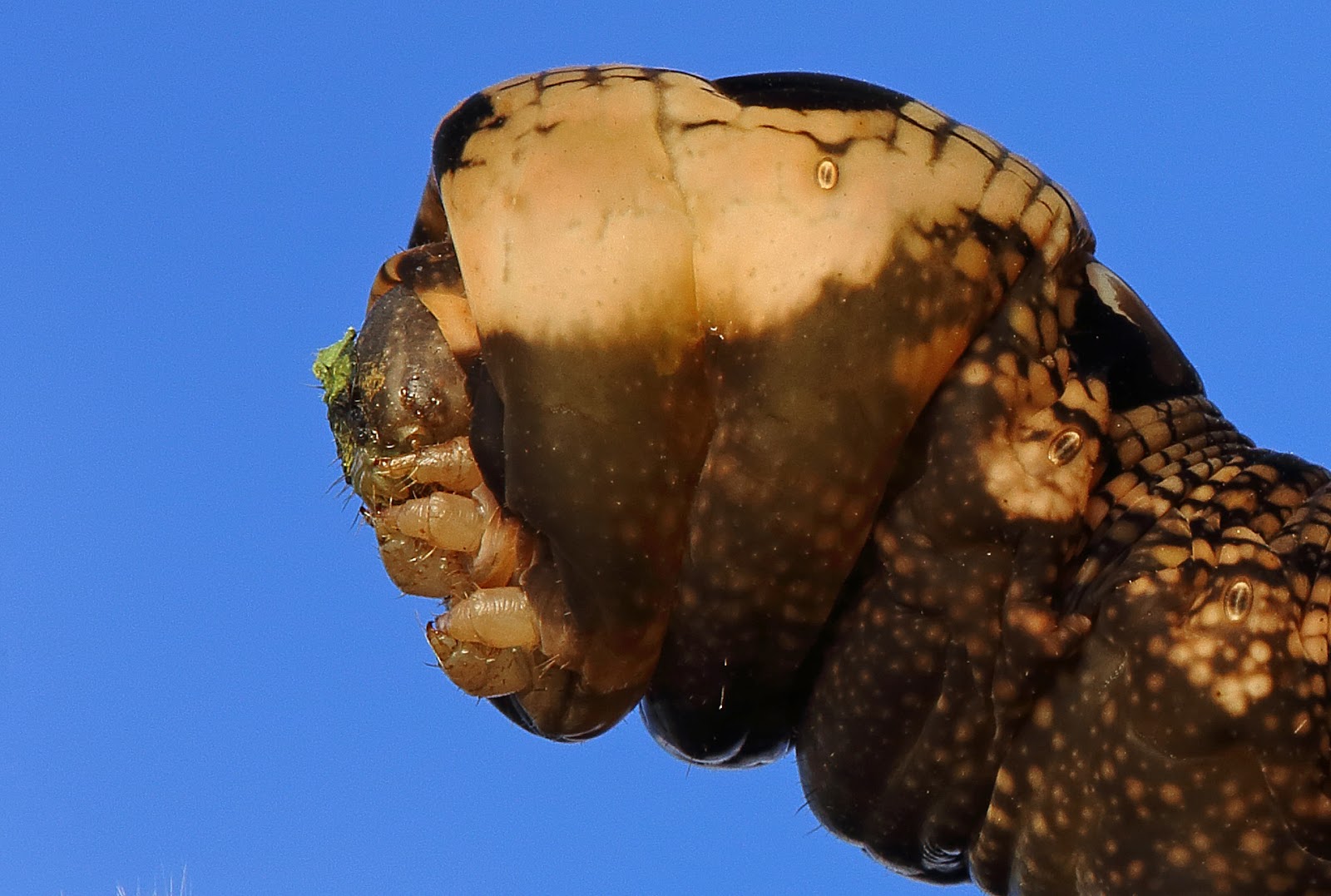
I'll leave you with a monster!

Head shot of an Elephant Hawk-moth caterpillar


Friday, August 31, 2012

Cold comfort...

Comfort's Wood lies half a mile south of our village (or town as the traders prefer it to be known) and is a place I know very well and walk on an almost daily basis.

For this blog entry, I thought I'd share just some of the finds from today's walk.


Please click on any photo for a larger version
Meadow Brown Butterfly
I've already noticed the drop in numbers of Meadow brown butterflies and even though they seem to be one species that cope reasonably well with lower temperatures, if we get many more morning such as we had today, when it seemed unseasonably cold, spotting these will be much harder.


The Common Blue has had a very tough time locally this year and numbers are well down on last season...

Common Blue Butterfly
This female that I found in Comfort's Wood today is only the third individual I've seen all year thus far and that's a real disaster for the species. I'll be watching with interest to see how they recover come next year.

I normally try for a nice clean background for my butterfly shots but I'm quite happy with these showing some of the habitat in this instance. It's a shame though that this female is in such poor condition.


Aphrophora alni (Alder Spittle-bug)
The rosebay willowherb that has lined the woodland rides for a good few weeks is now coming to an end regards flowering, however, it still seems to be called home by a good number of bugs and insects.

The froghopper pictured above was perched on this plant and was doing its best to avoid being photographed by means of the usual trick of disappearing round the other side of the stem each time I was about to shoot.


Black Vine Weevil
The vine weevil in the photo above was something I wasn't expecting to come across today. I have not seen them in these woods before and knowing that they feed at night, didn't expect to bump into one early afternoon.
Once again, this was on rosebay willowherb.
On an artistic note-I was pleased with how this particular shot turned out. It was one of the few I took using flash to increase the light and I always aim to get as natural light as possible when using flash.


A Barkfly
Barkflies (Psocoptera) seem to have undergone an image change, they were once referred to as Bark-louse-or should that be lice? But it was decided that louse had nasty associations with dirt and disease, therefore the barklouse spin-doctors got together and came up with the alternative of fly.

Not often seen because of their small size, there are actually as many as 68 species in the U.K. with  almost every tree in Britain likely to be host to some of these creatures. This one was on oak.


A Grass Moth
I stumbled on this grass moth when I was photographing the vine weevil. I think it will be Agriphila species but unsure beyond that. Possibly A.straminella as I know that one is active during the day;not too sure though as I think that species has blue eyes?


 I also spotted this tiny moth on fleabane-I should know this one as I'm sure I've photographed it before but memory fails me once again.


My final 'spot' on my hour long walk around Comfort's Wood was a Common Darter dragonfly...

Common Darter Dragonfly
By now, the weather had taken a turn for the worse, as seems to happen with regularity this year and it had begun to rain. This one was perched on a small log on one of the footpaths. Determined to get at least one shot, I lowered myself to the ground and ignoring the dampness, set about getting my photo.

The rain didn't seem to be getting and worse and the dragonfly didn't appear at all bothered by me shoving my lens into its face, and so I felt confident enough to take a few extra shots that I could then 'stack' together on the P.C. for a sharper image with a bit more depth of field.


And so, this is the resulting image:it's a stack of 7 frames shot hand-held using natural light. I was quite pleased to be able to get the extra depth of field and clarity but, I'm not sure that I actually like it that much! It seems a bit too sharp somehow for natural light? 

That was Comfort's Wood then, on the last day of summer 2012. Last day? Huh! There didn't seem to be many summer days this year?

Until the next time then...


All shots taken with Canon 40d-Canon 100mm Macro. All natural light photos with the exception of the vine weevil and barkfly where I added diffused flash.