Showing posts with label Birch trees. Show all posts

Saturday, May 01, 2021

Strange flies and unidentified bees...

Can I preface this particular update by saying that there will be no shenanigans: none of the usual banter or crass jokes. No silly inset memes or emojis. Just straight-forward, down home, facts and photos. 

Alright then, let's get into it. How about starting with a fly that looks like it might be modelling itself on Billy Gibbons of rock band ZZ Top. These flies are know as Thick-headed flies, of the family Conopidae: this one might be 'Sicus ferrugineus'. Don't take that as gospel though, there are other similar ones, too similar for any certainty from this boy.


Here's the gruesome bit about these fascinating creatures: Most Thick-headed Flies wait on or near flowers for their selected host species to arrive (most often bees or wasps). On finding the correct host, they take good hold and pierce the body while in flight, quickly depositing an egg inside. 

The egg hatches and the larva feeds off the host's abdominal contents...blah, de blah...there's more, but I'll spare you!

Some Conopids mimic these beasties...


This is 'Eristalis tenax', a Hoverfly. Also known as a common drone fly. If you think this is much more acceptable than the Conopid fly, consider this; the larvae of this insect is called a rat-tailed maggot. On the plus side, you are unlikely to encounter one, as they are aquatic.

Staying with Conopidae for one more picture; this next one is disappointing for two reasons...


Firstly, I messed up my camera settings and blew out the wood anemone petals. Secondly, I was hoping that this was 'Myopa buccata', the intriguingly named  'Variegated Spring Beegrabber'. Our most striking of all Myopa. Said to be fairly frequent, but in 2 decades of bug-hunting I have never before found one. 

This was my only chance at a photo and despite returning for the next couple of days to search for more, I drew a blank.

Time for something prettier...


One of the Japonica shrubs in the garden flowered for the first time this year; I know the flowers are tiny, but quite stunning.

Back to the bugs now...


There's a Spirea bush at the front of my house and right now it is full bloom and attracting many insects. I am not even going to pretend I know which species this bee is, but it does look a bit like 'Lasioglossum' to me, which probably means it'll turn out to be 'Andrena' or something? 

It not only attracted bees, but also this Dock bug...


Meanwhile...


I was so pleased to find this Box bug in my local woods the other day. Having first discovered one there last year, I am hoping that this is proof they are living and breeding there. Especially given that I found not one, but two on the same day...


You might have noticed that neither photo shows the bug actually on Box. British Bugs says that it is now found most frequently on Hawthorn and Buckthorn. All of my finds have been on 'Rosa canina' - Dog-rose.

I'm not seeing as many butterflies as I would like yet, but I did come across this Peacock recently...


Oh yes, I have remembered something I wanted to share. Something that I feel I should have known, but didn't...


I knew that birch trees had catkins: but what I didn't realise is that those are the male flowers and that birch trees also have female flowers that look like this. I ought to have known that fact as I am sure it also applies to hazel trees, and most likely others too.

That's all!


Enjoyed this post? Never miss out on future posts by following me

Thursday, September 24, 2020

Two eyes and an unexpected reply...


As Julie Andrews once warbled: Let's start at the very beginning. A very good place to start. Assuming that is, you have not already guessed what this is from the photograph? 

I was on one of my many trips around local woodland the other day, just looking out for bugs and insects, when I spotted something on a birch leaf...


I thought I might have some idea of what this could be, but I was intrigued and so decided to try and investigate further. I took the leaf home with me and once in my studio, very carefully eased off the top layer, to reveal a pupa/chrysalis inside. It seemed very pale to me, and my guess was that it had only recently formed?


I took a few more images once I had released it from the cocoon so that I could get a clear view. I wouldn't normally recommend doing this, but I was most careful not to injure or upset the pupa in any way, and having done it once before, knew if I was diligent and conscientious,  it would come to no harm.


If you study the bottom one of these photos, there is a big clue as to the identity of what would eventually emerge from the pupa. Don't see it? Okay then, let's divert our attentions to something else for a moment or two, and then I'll explain.

--------------------

You might recall how in my last update I mentioned I had sent an email to Patrick Barkham at The Guardian Newspaper, after reading an article he wrote in which he was 'very unkind' let's say, about a Tachinid fly. Well surprise, surprise, I recieved a reply from him. Here it is...


Hello John,

Thank you for your email and I agree with you. I wrote that piece 11 years ago when I was younger and more foolish and had not yet given deep thought to various environmental crises and our relationship with species.

 I would definitely not use such language today!

V best,
Patrick.

Hoorah! The man has a conscience after all. I wrote back thanking him for his honesty. I also pointed out how even things you wrote 11 years ago can come back and bite you in the bum! 

--------------------

So where were we? Oh yes, the clue. Here, I have highlighted it in the next photo...


It was this image that confirmed, 99% anyway, that my suspicions were correct.

Have you got it now? Try this then...


Oh come on - I can't give you any more clues without telling you what it is! Okay then, I'll reveal all; here's the full monty.

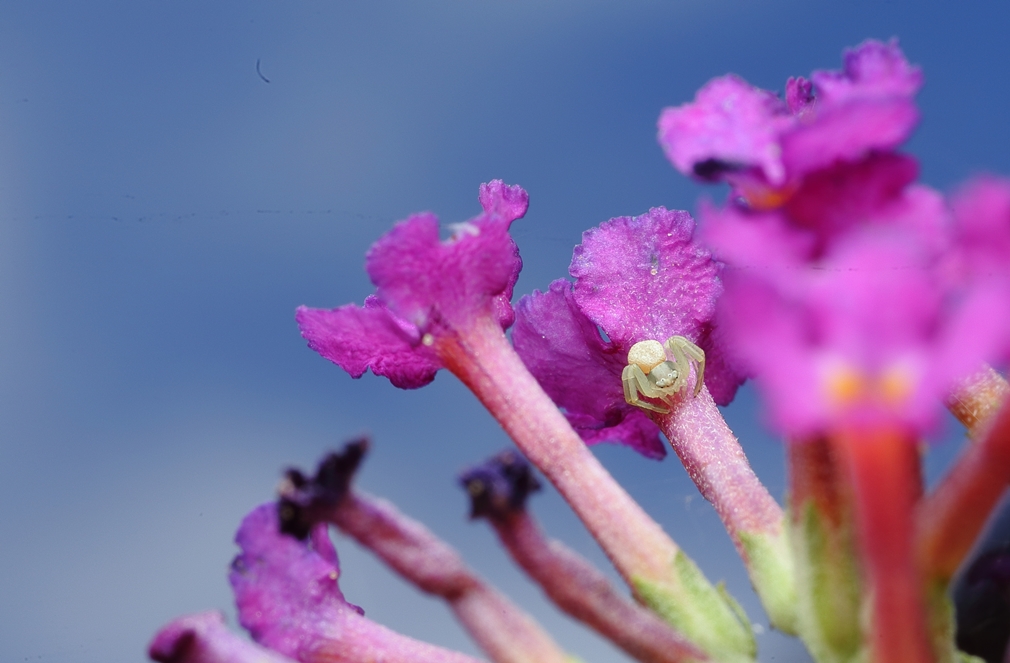
 Erm, no actually. In true full monty style, I'll tease you just a little before the big reveal. How about a couple of recent garden finds; a lovely, minute, Misumena vatia Crab spiderling first...


Followed swiftly by a Brimstone butterfly that was visiting the buddleia...


Oh and, another spiderling that I found in the same woods as the pupa...


Yes: a beautifully pristine, male Vapourer moth. 

That's a wrap I think: or at the very least, something that rhymes with it! Time for my meditation...


Monday, September 03, 2012

How many shieldbugs make an autumn?

September means that even if we don't want to admit that autumn is here, it's certainly on its way. Autumn can be a good time to spot some of our native invertebrates though-dragonfly numbers are peaking and adult shieldbugs can be quite numerous, including Sloe Bugs, Forest Bugs, the tree dwelling 'Troilus luridus' and the ever present Green Shieldbug.

One of the smaller shieldbugs that seem to be quite numerous around early autumn time, is the Birch Shieldbug (Elasmostethus interstinctus) and both the nymphs and adults are quite striking...


Click on any photo for a larger view


I think these two pictures above show what are probably 3rd instar nymphs of the Birch Shieldbug. They were quite small and reasonably fast moving.


A slightly larger nymph

A final instar nymph
All of the nymphs featured here were found in the same spot, a birch tree beside a local pond. Some were underneath the leaves and others quite easy to spot against the darker upper-side of a leaf.

There were also a number of the adult insects on the same tree...

The adult

As you can see, they are very colourful little bugs. These shots have not been enhanced in any way either; it was a dull day and had been raining before I took these photos, hence the sheen some of them have but other than reducing the size to upload to the blog, this is exactly how they looked.

The birch tree in question seemed to have a thriving little shieldbug community as I also found a couple of parent bugs as well...

A Parent Bug

I shouldn't have been surprised I suppose at finding this bug-after all, it is associated with birch as well. Once again these are beautifully coloured bugs and like the green shieldbugs, hibernate through the winter months.

This one may be lucky to make it to winter, as those white spots on it's back are parasites. I've seen this species with the same parasite before and I think they are Tachinid fly parasites:they are laid in this position where it is almost impossible for the bug to remove them.

The parent bug gets its name from the females habit of sitting on her eggs and nymphs to protect them from parasites and I've often wondered if she has become the target rather than her offspring?


Troilus luridus
Troilus luridus is another tree dwelling shieldbug and is quite a bit larger than both the birch and parent bugs. It is also a predatory bug, rather than feeding on plants.


This photo shows a final instar Troilus luridus nymph feeding on a large caterpillar. I watched this take place and the caterpillar had no chance of escape-it was busy feeding when the nymph sidled up to it and inserted its proboscis before the larva could do anything at all;although, even given time, I'm not sure what it could have done?

Those then are some of the recent shieldbugs that I've found whilst out walking locally-in case you are thinking of trying to locate some for yourself, here's a snap of the tree and habitat where I found most of mine...


Until the next time then...

All photos in this blog entry taken with the 100mm macro leans and natural light only-I used my Canon 40d camera.