Showing posts with label Hemiptera. Show all posts

Saturday, September 05, 2015

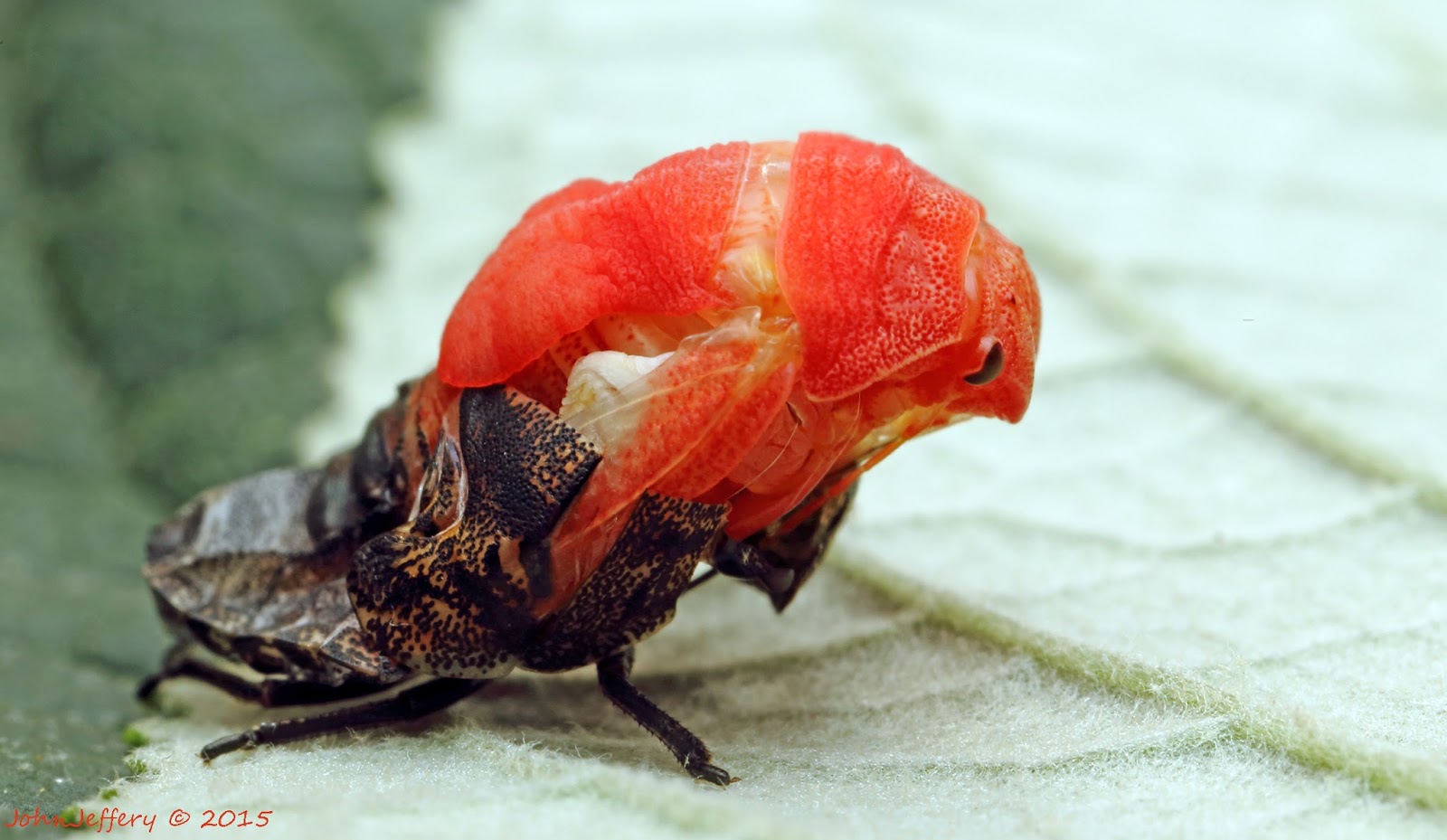
Ecdysis in motion...


I thought you might need this when you realise that I have posted a second blog update so soon after the last one?

What are the exceptional circumstances that warrant such actions? Just that I found this Tortoise Sheildbug final instar nymph and it looked kind of...well, odd to me...


When I say odd, I really mean that the colour seemed very different to other late instar nymphs I have found and so I wondered if it might be close to moulting. Whether the colour was an indication of that or not, I still can't say for sure but I did return to where I found it a couple of hours later and...guess what? I had to hunt around for it and found it eventually underneath a leaf...


11:53 am

11:53am

11:55am

11:56am

11:58am

12:04pm

12:06pm


12:10pm

12:12pm


13:04pm


15:35pm


16:02pm
I decided to let the photographs do the talking for this update. I was lucky with this one that it was so close to home and I could keep popping back to check progress. I have seen this happen a few times now with different species, but it never fails to amaze me just how tricky and dangerous, let alone, exhausting the whole process is.  Hope you enjoyed seeing the pictures.

Until the next time...

Friday, June 26, 2015

In which Giovanni gets all spiky...

Back in March of this year I came across some shieldbug eggs under bark. I didn't know at the time, but they were later identified as Spiked Shieldbug eggs (Picromerus bidens) and it seemed like a wonderful opportunity to further study the life-cycle of these fascinating bugs.


And so I took some home with me and carefully ensured they were given optimum conditions for the bugs to develop and finally emerge. These are the pictures...

Nothing happened until April 15th of this year when the first nymphs arrived...


These are the tiny nymphs that emerged on April 20th 2015


On April 25th four more emerged. These are redder because I managed to catch them soon after emerging...
April 25th nymphs


By April 29th they had darkened

On the same day, some began to moult for the first time...


April 29th first moult

The next picture is from May 4th...


Unfortunately my sometimes haphazard filing system has resulted in a few pictures going AWOL between these dates, which is really annoying for me as they showed how the nymphs had already begun to become predatory. Instead of feeding on plant sap, they were starting to need more substantial food in the shape of caterpillars etc. Even more upsetting, is the fact that you can bet your bottom dollar no sooner have I published this update without them, than they will miraculously re-appear? 


Anyhow, let's move on to the next stage that I do have,the mid-instars...


May 31st mid-instar nymphs

It was at this stage that I struggled to find enough food for them all and so decided to release them all, apart from one individual that I would hang on to to allow me to complete the whole process in pictures, from egg to adult insect. I called him Giovanni! Giovanni is the Italian equivalent of John-Gift from God. I also understand that Giovanni is a leader in something called 'Pokémon' and as he was to become the leader it seemed apt...         

Giovanni in all his glory...

The next picture is from June 1st...


Beginning to show some lovely metallic hues now


June 10th next and these are now late instar nymphs...

June 10th late instar

Starting to show the spiky shoulders that gives this bug it's common name...


June 10th late instar

The final instar nymphs are quite something...

Final instar Spiked Shieldbug Nymph


Final instar Spiked Shieldbug Nymph

Final instar Spiked Shieldbug Nymph

One final moult...


And the cycle is complete...

Giovanni becomes an adult...


In all honesty Giovanni could be female but whatever his sexuality..he/she..is splendiferous!


This picture (above) shows Giovanni whilst he was still a touch teneral in colour as it was taken soon after the moult. I waited a few hours for him to recover and ensure he was fit for release, and then took him to an area where I often find these shieldbugs and watched as Giovanni wandered off in search of a new home...


The end.

Or is it? Not quite because since tying this up, I have had a lie-down, sat in the Hero Yoga Pose for half an hour, given myself an Indian head-massage, completed a course of cognitive therapy, read a couple of pages of 'Mindfulness' - Finding Peace in a Frantic World, given myself a stiff talking to about losing files and set about re-exploring my satellite drive, whilst all the time concentrating on my breathing and guess what? I have located one of the missing pictures that shows how soon these little bugs become predatory...


Well I certainly learned a whole lot by doing this and I guess it's something I may never have seen otherwise.

Until the next time...

Monday, September 03, 2012

How many shieldbugs make an autumn?

September means that even if we don't want to admit that autumn is here, it's certainly on its way. Autumn can be a good time to spot some of our native invertebrates though-dragonfly numbers are peaking and adult shieldbugs can be quite numerous, including Sloe Bugs, Forest Bugs, the tree dwelling 'Troilus luridus' and the ever present Green Shieldbug.

One of the smaller shieldbugs that seem to be quite numerous around early autumn time, is the Birch Shieldbug (Elasmostethus interstinctus) and both the nymphs and adults are quite striking...


Click on any photo for a larger view


I think these two pictures above show what are probably 3rd instar nymphs of the Birch Shieldbug. They were quite small and reasonably fast moving.


A slightly larger nymph

A final instar nymph
All of the nymphs featured here were found in the same spot, a birch tree beside a local pond. Some were underneath the leaves and others quite easy to spot against the darker upper-side of a leaf.

There were also a number of the adult insects on the same tree...

The adult

As you can see, they are very colourful little bugs. These shots have not been enhanced in any way either; it was a dull day and had been raining before I took these photos, hence the sheen some of them have but other than reducing the size to upload to the blog, this is exactly how they looked.

The birch tree in question seemed to have a thriving little shieldbug community as I also found a couple of parent bugs as well...

A Parent Bug

I shouldn't have been surprised I suppose at finding this bug-after all, it is associated with birch as well. Once again these are beautifully coloured bugs and like the green shieldbugs, hibernate through the winter months.

This one may be lucky to make it to winter, as those white spots on it's back are parasites. I've seen this species with the same parasite before and I think they are Tachinid fly parasites:they are laid in this position where it is almost impossible for the bug to remove them.

The parent bug gets its name from the females habit of sitting on her eggs and nymphs to protect them from parasites and I've often wondered if she has become the target rather than her offspring?


Troilus luridus
Troilus luridus is another tree dwelling shieldbug and is quite a bit larger than both the birch and parent bugs. It is also a predatory bug, rather than feeding on plants.


This photo shows a final instar Troilus luridus nymph feeding on a large caterpillar. I watched this take place and the caterpillar had no chance of escape-it was busy feeding when the nymph sidled up to it and inserted its proboscis before the larva could do anything at all;although, even given time, I'm not sure what it could have done?

Those then are some of the recent shieldbugs that I've found whilst out walking locally-in case you are thinking of trying to locate some for yourself, here's a snap of the tree and habitat where I found most of mine...


Until the next time then...

All photos in this blog entry taken with the 100mm macro leans and natural light only-I used my Canon 40d camera.