Showing posts with label Ichneumon wasp. Show all posts

Tuesday, March 10, 2020

Traffic light mite...

If, and I stress if, you are of an age to recall when the wireless was king, you might be able to figure out what my first photograph has in common with an 'adenoidal squeaky-voiced Boy Scout from East Finchley'?

On a rare fine weather day, this was the first thing I saw when I ventured out with the camera...

Calliphora vomitoria

There are lots of unsavoury facts about Bluebottles (or Blow Flies) but here are a few of the more tasteful ones:

The eyes of a bluebottle are made up of 8000 facets

The bluebottle fly can smell things 750 yards away

A bluebottle fly can travel 300 times the length of its body in a single second

The wings of the fly move at a rate of 200 times per second


Alright, alright! Just for you deviants; here is one, well let's call it, indelicate fact: Females deposit their eggs on rotting corpses: this can be a useful forensic tool in establishing the time of death. There...sated? (nice scientific name too huh?)


Once again I am indebted to friend of this blog Maria Justamond. She was able to tell me in double-quick time that the sound clip of birdsong in my last update was in fact this creature...


Yes, a nuthatch: to be precise, the distress call of a nuthatch. Maria also kindly sent me a link to a bird call sharing website and I had hoped to share the call from that here: unfortunately, Blogger is telling me it takes too long to load (that's Blogger for you!)

Ironically I have had a nuthatch visiting the bird feeders in the garden: I have not heard it though, so I guess it hasn't been distressed. In fact the photos above are of 'my' nuthatch. Not great quality I'm afraid because I no longer own a birding lens and they were taken through glass.


As per usual at this time of year, I am wondering what spring will be like: will it be early or late? Well right at the end of February  2018 this is what it looked like here in my part of the world...


But then in 2019 by 7th of March we had spring flowers already blooming in local woods...


I had thought that the milder (if very wet) winter may precipitate an early onset of spring this year. But if the wood anemones are a reliable indicator, then it seems to be already a couple of weeks later. On this very day (March 10 as I write) of last year, I came upon this little spider...

Probably Araniella cucurbitina, sometimes called the "cucumber green spider"

Whilst I am on a spider kick: I was pleased to find this rather rare spider badge the other day...


Would you like to see a nice chunky spider that I found on my last visit to America? No...thought not!


You might recall that back in January I posted this picture of a beetle that seemed to have fungi sprouting from its...erm...back end?


Well look at this hopper nymph I discovered just yesterday in my local woods...


Can you see in the small image, the area I have circled. It looks like something very similar is going on: I wonder just how commonplace this is (and how I could find out).


Meantime:here's an image that I pulled up from a folder dated May 13 2011


I well remember watching this wood ant pulling the moth back to its nest. Okay so wood ants are quite large as ants go, and this wasn't the biggest moth, but even so, it had no way of resisting.

But when is an ant not an ant?


Answer: when it's a wasp!

Yes, this IS a wasp; and just to complete the illusion of it being an ant. it is wingless. Probably a female, wingless Ichneumon wasp (Gelis sp?)


We've tackled when is an ant not an ant; but how about when is a spider not a spider? Well, all spiders are arachnids right. But all arachnids are not spiders:


This creature has eight legs. It is an arachnid. But it's clearly not a spider.

Spiders, Daddy longlegs (Harvestman), False scorpions and ticks are all arachnids. As are Mites. This is a mite: a spider mite to be pedantic. Here are a few snippets of information courtesy of the BBC: They start life with six legs, but develop eight as they mature.  When active, the spider mites are light green with two dark spots on their back, but during their inactive periods they become dark orange or red.


I'll end with a photo of a weevil that was either feigning death, or wanting a tummy tickle - I opted for the latter...


Congratulations if you managed to solve my little poser at the top of this update. In case you did and are now feeling smug: can you now find a connection between this next image and  radio AND  the German aerospace engineer, Wernher Magnus Maximilian Freiherr von Braun? 


Please feel free to comment on my blog. I am always grateful for any feedback, good or bad. Commenting should be fast and easy.

Simply type your comment in the box.
  (If you don't see the comment box: just click on the text that says 'No Comments' or '1 Comment' etc.)

Then choose an identity.

You can use your Google ID if you have one, or just choose: Name/URL and enter your name (URL is not needed). You can also just choose anonymous, if you would rather not be identified.


Tick the 'I'm not a robot' box
(if it is visible)

and then
'Publish your comment'.


That's it. THANK-YOU

Sunday, August 21, 2016

The vexation of a vexillologist...

Isn't it great when you get to learn something new. I recently found out what a vexillologist is!

But I am already getting ahead of myself, let me backtrack a little.

I am always upfront about the fact that I am not an expert on insects and bugs. Far from it, I am merely an amateur with an interest and inquisitive nature. It's true that over time you are able to accumulate (and hopefully store) facts and figures about some of the bugs you might encounter on a regular basis, but even so, there is always more to learn and somebody who already has a superior knowledge.

Having said all that, there is always research and I try to use that tool whenever I find myself lacking, which is usually more often than I would wish.

 Here's an example: the Large White, or Cabbage White Butterfly (Pieris brassicae). It was whilst researching the parasites of  this species that I stumbled upon Dr Tom Williamson and his excellent blog post entitled: Cotesia glomerata: an amazing example of what evolution is capable of. Dr Williamson describes himself amongst other things as an amateur vexillologist.


I had to look it up in the dictionary to satisfy my curiosity. Just in case you don't know either, I will share in a little while, but first, back to the butterfly caterpillars and their parasites......


A Large White Larva
When I recently witnessed a greenhouse full of these larvae, I assumed that there would be some that had been invaded by a parasitic wasp; I also assumed that it would probably be Trichogramma brassicae. But here is where my knowledge of such things was found wanting. It seems that T.brassicae infects the eggs of the butterfly, rather than the larvae. 


Just before I move on to the real culprit, there is a fascinating story attached to the Trichogramma wasp, that I will try to abridge, as I am sure you have better things to do than spend all day on my little blog.

When the male Pieris brassicae mates with a female, he tries to ensure that she will not then go on to mate with other males. One trick is to transfer pheromones that act as anti-aphrodisiacs, in itself a marvel of nature. But even that can be 'out-natured' by the fact that the very same pheromone is known to attract female T.brassicae wasps. Once the female wasp finds her targeted, and now pregnant butterfly, she  hitches a ride on her, and as soon as she lays her eggs, the wasp gets off and injects her own eggs into the butterfly’s eggs.

Meanwhile, the real miscreant is Cotesia glomerata. Miscreant is possibly a tad defamatory on reflection though? After all this is nature and a natural behaviour, no matter how bizarre or deviant we consider it to be. 

The Cotesia glomerata narrative is every bit as fascinating as the previous contender, as I discovered, and you are about to: assuming you don't already know that is...

Dozens of wasp larvae emerging from the stricken, but still living caterpillar


You see the cabbage (and other) plants that host the caterpillars are fighting back! There is a kind of co-evolutionary race betwixt the caterpillar and the plant: as the caterpillar evolves better ways to feed, the plant evolves better ways to defend itself, so the caterpillar evolves ways to counter etc...etc. 


The parasitised caterpillar protecting the wasp larvae

As the plant reacts to chemicals produced by the larvae, it begins to produce chemical elements that act as an indirect defense by attracting the female C. glomerata wasp, in the same way that the pheromones of T.brassicae do. This wasp is a rather devious parasitoid that finds the  youngest caterpillars feeding on the more nutritious top leaves.This means that the caterpillar will be a better living larder for the young. She will then lay 2 or 3 dozen eggs inside each caterpillar. To return to Dr Williamson's words.."I find this species to be an incredible example of evolution at work. Not only does the larvae of the wasp feed off of the caterpillar host, but after they bite their way out and make cocoons, the host caterpillar spins it’s own cocoon over the larvae, and protects them until it starves to death! Yes, it could be considered pretty gruesome, but fascinating nonetheless."  (© 2016 The Skeptic Canary)


Here is a little video I took of the emerging wasp larvae... 


Note: These vids are too large to show in the email version of my blog. Hence you will need to view the blog directly online.


And at the end of all that, what did I discover a vexillologist to be? Quote: Vexillology is the scientific study of the history, symbolism and usage of flags or, by extension, any interest in flags in general. The word is a synthesis of the Latin word vexillum ("flag") and the Greek suffix -logia ("study.")


Monday, October 21, 2013

Fund raising...

I wouldn't normally do this but I want to hijack my own blog entry for the purposes of blatant  and shameless self promotion!
Before you think I have lost the plot though, can I add that it is all in the cause of raising some much needed funds for medical research.

I have produced some posters to try and raise funds for the Alzheimer's Society. Alzheimer's and Dementia affect a huge proportion of our population and need our support. Recent developments in attempting to halt the degeneration of brain cells are promising, but more research is needed and that requires funding.
If you think you can help, please head over to my FOR SALE PAGE for full details...


On with my late October update to the blog then...

I will start with another photo of a caterpillar that I featured a couple of entries ago, the looper, that I now know to be the larva of an early thorn moth...


Firstly, what a great pose? But anyway, the reason I have added this is because I have been reading a little more about these creatures and it seems that being considered to be the best twig mimic of all, is not the whole story.

No, research now shows that they don't just rely on looking like a twig. Apparently the disguise works best where twigs are common, it seems to fool most birds more often and so during the day they will position themselves where there are lots of natural twigs, even if it means missing out on feeding.
They then move to the leaves under cover of night, where they then feed in relative safety.

It also seems to work best if the position themselves where there aren't too many others caterpillars doing the same thing as the birds do see the larvae but don't seem to find the extra effort involved in determining whether or not it is actually food worthwhile but if there are rich pickings to be had, they will then persevere.


----------------------------------------------------------------------

I was out recently on a rather dull day after rain and the flash was causing me all kinds of problems with water reflection and so decided to opt for natural light on these next pictures...


I think this large wasp is probably an Ichneumon and possibly Coelichneumon sp? There are several similar and so I can't be sure.
Not how most folks imagine a wasp to look but wasp it is.

Another surprise on this dull day was how many crickets were around on the low vegetation. I counted up to twenty of the species pictured here and then gave up, there were lots more, both male and female...


Roesel's Bush Cricket (male)

Incidentally, if you are wondering why Roesel's ? It was named after a German entomologist. I think we in the south east corner of the U.K. were the first to see this species and today the most prolific population is still to be found here, although it has spread north at quite a rate in recent years and can now be found in many other areas.


I also found this cool little leafhopper whilst out wandering the local countryside, I think this might be Idiocerus vittifrons but they are extremely difficult to tell apart...


The same goes regarding being confident over identity of this plant bug as well. I wouldn't want to go further than suggest Lygus species...


Green shieldbugs are still evident as both adults and the occasional nymph, although I have yet to find any in their winter coats (brown.)


---------------------------------------------------------------------------------------


Spiders then! I just love these little jumping spiders, they are such characters and quite feisty. They have great vision with those two large front eyes and if you take a close look at them, you will often see them turning to get a better view of you as you do so...


This one has me stumped for now regards a confirmed identity but it was very small at no more than around 2mm and has those white palps. It is a female but that's all I can say at present.


The spider photo above shows Araneus diadematus, the garden, or cross spider that is most often seen at this time of year but below is a variation, Araneus quadratus. Araneus being Latin for spider and quadratus meaning square, referring to the four prominent spots on the abdomen...


The background can be quite variable in colour ranging from orange-red to light yellow-green. This coloration can change, perhaps responding to humidity levels (greenish if moist, tending towards red if drier). 


Besides the omnipresent spiders, I am still finding tortoise bugs locally...


Of course sometimes when the weather is really bad and there are few bugs to be found anywhere, the unexpected still turns up. That's what happened the other day when it rained hard and I didn't even bother taking the camera when I went out. In fact, I didn't need to this day-the next photo was taken through the patio window...


That's right, a slug! Well on bad weather days you have to take advantage of whatever is offered right?


-----------------------------------------------------------------


Back in the summer (by the way, this is leading into another of those, what's happening here pictures)...I saw something spilling from what I think may have been a fleabane flower, anyhow, a bright yellow daisy-like flower and this is the photograph...


And so this is my question-is this nectar? If so....why did if feel solid/hard to the touch? It was quite hard.

I'll leave you with that thought until the next time....

Thanks in advance to anyone who feels they can help with my fund raising posters.


Friday, June 07, 2013

Watch out for the Billy Witches...

I mentioned in my last update to the blog that I was going to try and find a leaf-roller weevil in action. In other words, actually rolling a hazel leaf.

Well...I have to report that I have not yet manged that, but did find a freshly rolled leaf-and so at least I now know that they have started on the process of rolling the hazel leaves that will become home to the next generation of larvae...


My local woodland is now reaping the benefits of the coppicing that took place a couple of years ago, and the rides are full of wild flowers and in particular buttercups...


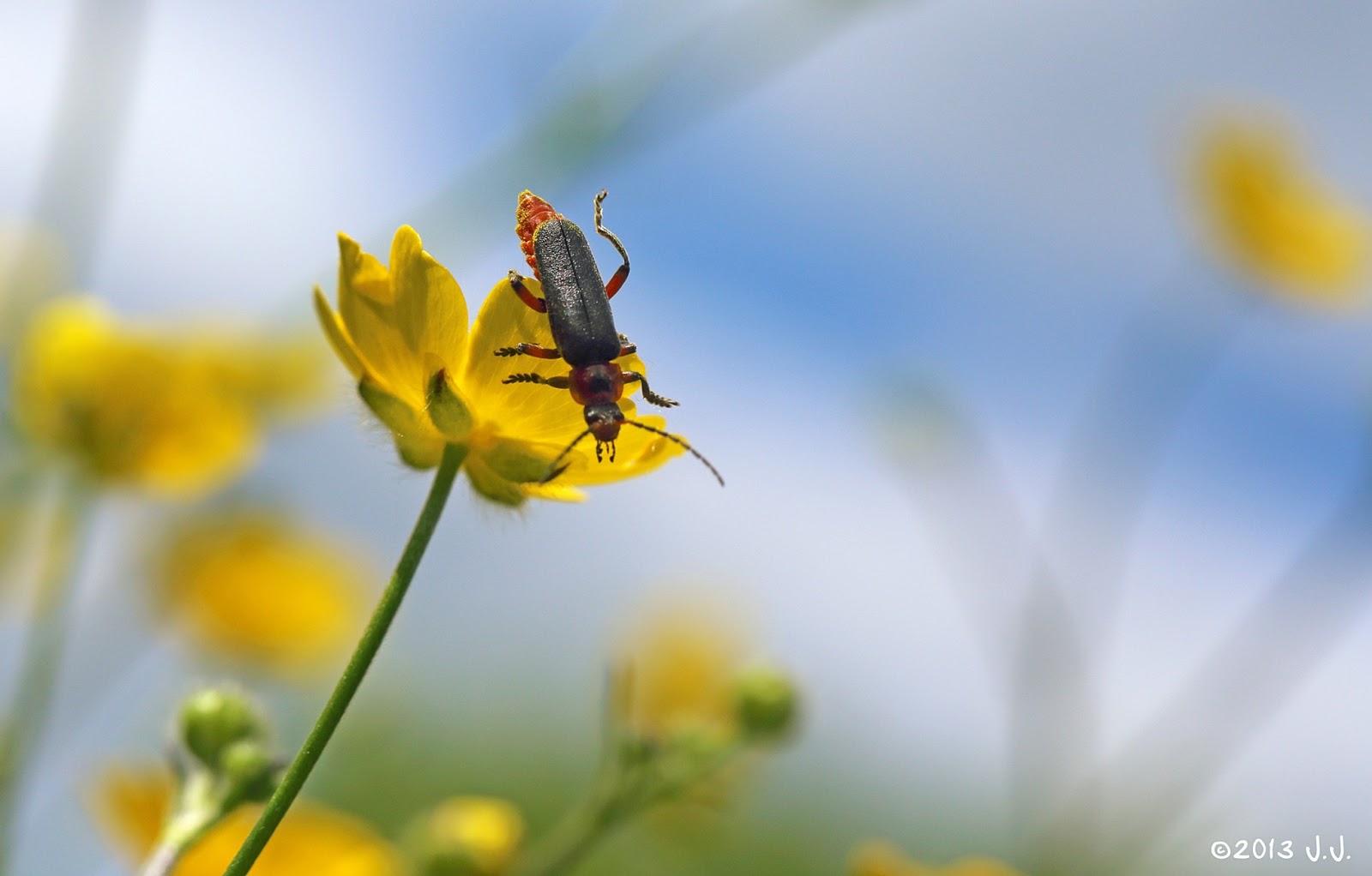
On my last visit,I noticed that these were attracting cantharis beetles. I counted thirty in one area alone...

CLICK ON ANY PHOTO FOR LARGE VIEW ON BLACK


The fabulous wasp beetles were also buzzing around the buttercups as well...


Although these beetles mimic the marking of a wasp, they are completely harmless and are usually happy to pose for photos. Although,I think this one was trying to shake a leg?

If you are one of my readers that dislikes spiders, and I know there are a few...perhaps you might consider skipping the next photo? Although, to my eyes, these are kinda cute!


I think these are probably Araneus species spider-lings  At this stage they bear little resemblance to the adults with this yellow colouring.

Another insect that seems to be around in larger than usual numbers is the snipe fly. These are quite large as flies go and look at first glance, a little like the big robber flies...


Snipe flies of the genus 'Rhagio (which I think this one is) are sometimes called 'down-looker' flies, after their habit of perching head-downward on tree trunks etc.


The news from my garden moth trap is that I seem to be catching fewer than earlier in the year, as far as numbers go. There have been some interesting finds though. I recently had this visitor...

A Common Cockchafer (Melolontha melolontha)
This is the cockchafer or 'May Bug' or even.. Spang Beetle, or 'Billy Witch'.
I think this may be a male? You are supposed to be able to tell male from female by counting the number of 'leaves' on those fantastic looking antennae. Males sport seven,whilst females have six. I am sure that looking closely at the antennae on the right of this picture, I can just about make out seven?

These beetles were abundant once upon a time. That is until the dreaded pesticides were introduced. However, since the new regulations, they are making a comeback.

But the real star of the year so far must surely be this next beauty...

An Eyed Hawk Moth

This took my breath away. What a moth this is. It is a big insect and wings open, measured well in excess of 3" The colouring and markings and texture are superb and when it opens its wings to reveal those eye-spots...Wow!


You might just recall from last year (although, why should you?) that I had some caterpillars of the buff-tip moth that pupated...


I had my doubts as to whether I had managed to keep any of them successfully through the winter months, I kept a close check on them and things didn't look good. Come early spring I felt a few of them for signs of movement but most seemed hard and lifeless.

I had given up hope by late May and decided to clean out the container that housed them. Lucky for me that I did because, on opening the top, right at that very moment, there was a moth emerging for one of the pupae; I grabbed my camera and took some photos...

A Buff-tip Moth just out of its pupa


Once fully recovered from the effort of emerging and having sat for almost 3 hours, just drying out and inflating its wings, the moth looked like this...


Eventually it folded its wings into the recognised resting position, along it's back and the full beauty of this creature and superb camouflage became obvious...


I am so pleased that I managed to keep these and had the privilege of observing the whole life-cycle, other than the egg stage. Since the day this one emerged, I have had a further 4 that I've been able to release.

The only other thing of note, besides the sparse amount of moths in the trap (which by the way I have added to the diary page,but still need to identify most of) is this wasp...


I had three of these one night in the trap. I think they are Ichneumon wasps but wouldn't like to go further than that. They are parasitic wasps and can be tricky to identify fully.

I seem to have lots of new things I could add to the blog,and may even have got a little out of sequence with some finds but, I think that'll do for this time and I'll try and update again soon. I hope once again that you have found something of interest in this latest entry and, as always, thank-you for your interest.

Until the next time then...