Showing posts with label Cerura vinula. Show all posts

Monday, June 29, 2020

Pale legs and a prickly pair...

Many years ago now my sister went through a stage of growing cacti and succulents. Things like Aloe Vera, Ball Cactus, Bunny Cactus and Strawberry Hedgehog, plus the ever present Prickly Pear. Prickly Pear looks like this... 

Or perhaps like this if you are a realist...


If you are wondering what the letter top right is all about; I thought I'd have a go at making my own PPE (think about it - but not for too long).

What in the name of Adam does this have to do with anything JJ? 

Erm, well only that this is exactly what I thought of when I first saw the creature I am about to share with you. So come with me now, back to Saturday June 20, when, on one of the blisteringly hot recent days, I spotted an egg on a wild rose plant in local woodland.

Using the available information: that being the food-plant and shape of the egg, I had some idea what it might be, but having never previously seen one for myself, decided to observe it and record its development. The next eight pictures do just that.


I'm sharing them here in a style  I am calling my 'Full Montage'...


 As you can see it changed considerably over the next week, with most of the significant changes all happening on June 26th...


It darkened considerably and by the morning of June 27 it had a definite craqueleur affect going on.


This (above) was when I first checked at around 6am. It seemed about to reveal what exactly was inside, and so I kept a close eye on it and at just after 9am, this fabulous little creature made its entrance into the big bad world...


Yes, as I suspected, this is a Dock Bug nymph (Coreus marginatus) and this next photo clearly shows those 'Prickly Pair' antennae!


Eggs take around 3 to 4 weeks to hatch and so I guess this one must have already been at least 2 weeks plus when I found it. But what a rare treat to get to see the egg and a nymph right after eclosure (emergence). Those pale, banded legs and disproportionate antennae! They are also amazingly hairy and spiky at this stage.


By the next day it looked somewhat darker...


By the way, before we move on, did you know there is a Prickly Pear Island? No, me either. Yes, it's off the coast of Antigua West Indies and is uninhabited.


Here's another egg that I discovered in the same woodland. This one was about the same size, but a very pale green colour. 


This egg became a beautiful Poplar Hawk-moth larva: the transformation from finding the egg to adult larva took 19 days...


At the time of the final moult we had more very hot weather here in Kent and I could no longer keep up fresh supplies of willow. Even by standing the twigs in water, it would wilt within a few hours. And so I released the caterpillar onto a nice big willow tree, where it can continue its life cycle.

A phone grab of the released caterpillar


That image won't mean a thing to you unless you know about cricket (who does?). I'll give you a clue, should you be even remotely interested; his name is David Lloyd.


'Early one morning, just as the sun was rising, I heard a young maid sing in....' ♫ ♫ Not quite: but I did see this sleeping Bumble Bee. I suppose it was some time after 5.30am and as you may be able to see from the photograph, still a bit of dew around. 

I think this is Bombus lucorum - The White-tailed Bumble Bee, but I could equally be wrong.


Take a look at these two images below...


Remarkably similar huh?

And yet, two photographs of two completely different species of moth larvae. You'd be forgiven for thinking that maybe the only difference is the colour, and it could be just that one has had an extra moult to the other?

But no, not the case Sherlock! The first picture is a Puss Moth larva (Cerura vinula) and the lower photo is of a Sallow Kitten Moth larva (Furcula furcula).


What to end on then? How about this...


I don't often get to photograph flies and so my knowledge is pretty lacking, but I think this may be a type of Snipe Fly? It looked kinda attractive sitting on the Crocosmia  montbretia after rain the other day. 

'One for the road?'

What a ridiculous saying that is by the way; one drink is what is meant by it? 

Witness this exchange in Parliament 1939: 

Lady Astor asked if the Prime Minister would bear mind the fact that even a moderate quantity of alcohol was dangerous.
Captain Wallace [The Minister of Transport] replied: I have read the report and know very well that the noble lady is not favour of what is known as "one for the road".
However, I do believe it harks back to the days when people would be travelling by foot, not by car.

Oh my giddy aunt! (From 'The journal of a disappointed man')
Time to go...

So now you are probably thinking that I have forgotten to enlighten you as to what the mystery object was in my last update eh? Well, no, it's just that I am unsure myself. It appears to be the remains of an insect or bug; but what caused its demise, I cannot fathom as yet.


I'm off to suck on a strawberry hedgehog!


Wednesday, July 12, 2017

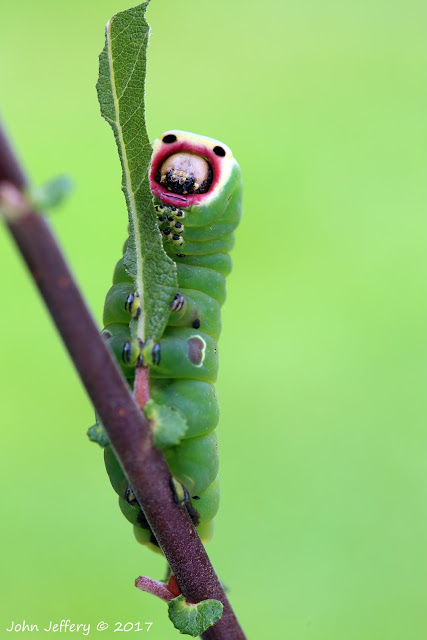
"The most dangerous caterpillar species in Britain!"


Yes, it was Saturday December 18th 2010 when I wrote the following words in my first ever blog post: "In the beginning: I'm making a start on this new blog today. It's cold and snowy in Kent, with little to offer in the way of interesting, outdoor macro subjects to photograph".

And today July 12th 2017 I am here writing my 200th update. According to statistics, most people quit blogging within the first three months (you spend time working on something without a reward, the harder it is to continue doing it). For me the truth is that I love doing these updates and would probably continue even if they weren't being read. Thankfully, due to some loyal followers, my little blog continues to be accessed in at least a dozen countries, with UK, USA, Netherlands, China and Belgium being the top 5 regards amount of views. 

A sample of just some of the bugs and insects that I have featured here over the past seven years...


What have I got that is special for this update? How about...

 "The most dangerous caterpillar species in Britain!"

That is how I have seen the caterpillar of the puss moth (Cerura vinula) described. The puss moth is quite an easy moth to identify and inhabits wooded, or lightly wooded areas where there is plenty of willow or poplar. Here's a recently emerged adult moth that I photographed in 2015...


But it's the larvae that interest me most. As with all larvae, they are predated by many other creatures. In order to protect themselves, they have the ability to spray formic acid at their attacker! 

A Puss Moth Larva - Cerura vinula


Formic acid is interesting in itself and gets its name from the Latin name for ant "Formica". There is a little video of wood ants spraying the acid, it's on YouTube if you feel like having a look. Formic acid is actually found in the bites and stings of many insects, including bees and ants. It is also a contributing factor when you get stung by nettles. It's used by farmers to preserve animal feed, bee-keepers use it as pesticide against the deadly Varroa mite and if all that leaves you wanting more, then I can tell you that it is used in the treatment of warts and as a toilet bowl cleaner.


I'm starting to feel a tad guilty now, because the other day I had to rescue yet another bee from the bird bath. I really don't know why, or how they get into the water, but once in, they seldom get out...


This one however lived to see another day and once dry, flew off seemingly unharmed by its dunking. I think this is probably a wool-carder bee. 

---------
I have been having a few early morning walks whilst this hot weather has been with us. I tried a few evening ones too, but the mosquitoes gave me such a hard time that I soon stopped those. In a local, uncut meadow, I found this large beetle. Unfortunately it was quite low down in the grasses and even so, the light wind was enough to make it almost impossible to get a perfectly focused picture...


This is most likely Nicrophorus investigator. There are other similar beetles but I think judging by its size and the reddish antennae tips (that you cannot see well here because of the movement) it seems to fit. As always, there are mites attached. This is the beetle that uses carrion to house its young.

In the same woods that I found the puss moth larva, I also spotted this fabulous grasshopper nymph. Possibly a field grasshopper but wouldn't put my house on it...that would flatten it for sure!


I was pleased with those two finds but ecstatic over the next: a species of butterfly that I have never seen before, let alone photographed. It was in woods that I know well too and have surveyed for insects in the past. There was another survey in about 2010 I think, and this butterfly was definitely not on their list either. It's the beautiful purple hairstreak...

A Purple Hairstreak - Favonius quercus

The UK Butterflies website says this about it: "It is often difficult to locate, due to its habit of flying in the tree canopy, where it feeds on honeydew. However, the adults are occasionally seen basking at lower levels, on various small trees, shrubs and bracken". It's the side of the wings that you can't see here that have the purple colour, although not as much in the males as females. 

One day whilst out walking without the camera, I managed to capture these 2 pictures of a brimstone butterfly with my phone...


When I found this crab spider, its face was still covered in the remains of its dinner (been there!)


And this is what it had just been dining on...


The crab spider here is Misumena vatia: It's the same spider that in a recent BBC 4 programme about life in our back gardens, Chris Packham
said could change colour to match the background. He didn't mention that it is only the mature females that have this ability; and that the colour changes are restricted to white, yellow and green(ish). 

Well I have lots more that I could share, but I think there is more than enough here for one update, so I shall save it for next time. Instead I will leave you with a few shots of something that has not featured much at all in the updates...until now: it's the humble garden snail...


Wednesday, April 29, 2015

Puss as in pussy cat, not pus as in that 'orrible stuff that oozes out of an abscess...

Towards the back end of last year there was a programme of cutting back the overgrown edges to the rides in our local woods...


A rainy day for the workmen in Comfort's Wood

This left a lot of debris lying around, especially the large stalks of the hedge(?) parsley and just to the left in this picture, I found what I knew was a moth cocoon on the ground. It looked like it might be a Puss Moth but I wasn't sure. Anyhow, I rescued it and nurtured it through the winter until on the 27th of April this year, the adult moth emerged...


Sure enough, it was a Puss Moth and what looked to be a beautiful male judging by the antennae size...


It was such a rare treat to be able to see the abdomen markings which once the wings are fully inflated of course, you can't see, as they are held across the abdomen unless the moth is flying...


I was intrigued to see how the wings gradually inflated over a period of about three hours,from first emergence to ready to fly. These really are beautiful moths and so impressive when in pristine condition like this. 


The yellow tint to the wings disappeared as they inflated further and dried...


There's a head and eyes in there somewhere!

And so that was the emergence of the Puss Moth. I know that I don't usually dedicate a whole update to just one subject, but this was such a fantastic thing to witness and I wanted to share my experience through these photographs.

Until the next time...