Showing posts with label Apoderus coryli. Show all posts

Tuesday, April 14, 2020

Springtails are responsible for the smell of spring...


Yes spring has sprung and this year more than any we need to appreciate and celebrate it. With that in mind, I have just one word to share...Geosmin!

Bear with, bear with, this is going to get interesting...

An article published 6th April this year entitled: 

'Research unearths the science behind the smell of spring'

stated this; 'You may not have heard of geosmin, but wherever you may be on this planet, it's likely that you could recognise its smell.'

The secret, according to the study published in Nature Microbiology, lies in an ancestral mutual relationship between the soil bacteria Streptomyces and primitive, six-legged creatures called springtails (Collembola).

Scientists suspected  some kind of animal or insect  might help distribute the Streptomyces spores. And so to cut a long story short, they conducted a series of experiments which proved the theory.

The studies found that geosmin chemical signals  guide springtails to Streptomyces as a privileged food source. In return, springtails help disperse Streptomyces spores in two ways: by defecation and by distribution of spores that stick to their bodies.

So next time you walk in the woods or dig your garden and notice the smell of spring, spare a thought for the springtails and Streptomyces toiling in the soil below; an example of chemical communication that’s endured for 450 million years.


(Not sure if this works or not; it's just one of those 'sound and vision' phone photos that I thought I would try)


Well that was one of three discoveries I have made over the past few days.

The second one was that springtails sometimes live inside ants nests. It wasn't until I moved a plant pot in the garden and spotted some tiny white moving dots amongst the ants beneath, that I discovered a new species to me. 


Yes, this is 'Cyphoderus albinus' a minute species of springtail that lives with ants. Thought to be fairly frequent here in the UK, but under-recorded. I could only find one record from my part of the world and that was down in Sedlescombe Sussex. 

Cyphoderus albinus - A Springtail (Collembola)

This was the third discovery:


And just what was this third discovery JJ? Well, I had not realised that silver birch trees have both male and female flowers. Male flowers are long and drooping, whilst female are shorter and erect (stop it!).

It was the beautiful purple stigmas that attracted me; something I had not previously noticed. 


What else is to be celebrated in spring? Well procreation is. Procreation is the most basic and important function. Without it nature is good for one generation only. Everywhere you look in springtime the insects and bugs seem to be only too aware of this fact and appear to split their time equally between eating and making more insects and bugs (in fact at times, doing both)...

I think these might be Flesh flies?

Propylea quatourdecimpunctata - 14-spot Ladybirds
What a name eh! I think quatourdecim means 14 and punctata for 'spotted'. Much easier to stick to the shortened version of 'P14'.


I've been seeing a number of ladybird species lately...

The orange ladybird - Halyzia sedecimguttata

The orange ladybird - Halyzia sedecimguttata


A 22-spot Ladybird - Psyllobora vigintiduopunctata

A 22-spot Ladybird - Psyllobora vigintiduopunctata
Whilst we are talking about overly complicated scientific names, I apologise once again if any of these written here are not current: the powers that be are always changing established names and I don't seem to have either the time, or the inclination to keep up to date (although I daresay I will eventually).

Staying with beetles for a moment (because of course ladybirds are just colourful beetles) I have spotted my first one of these for 2020...

A Hazel Leaf-rolling Weevil - Apoderus coryli 
I find these weevils every year, and weevils of course are also beetles. I found this one on the 8th of February, making it my earliest find by 2 days. Judging by the amount of debris it's carrying around, I would hazard a guess that it had only just emerged.
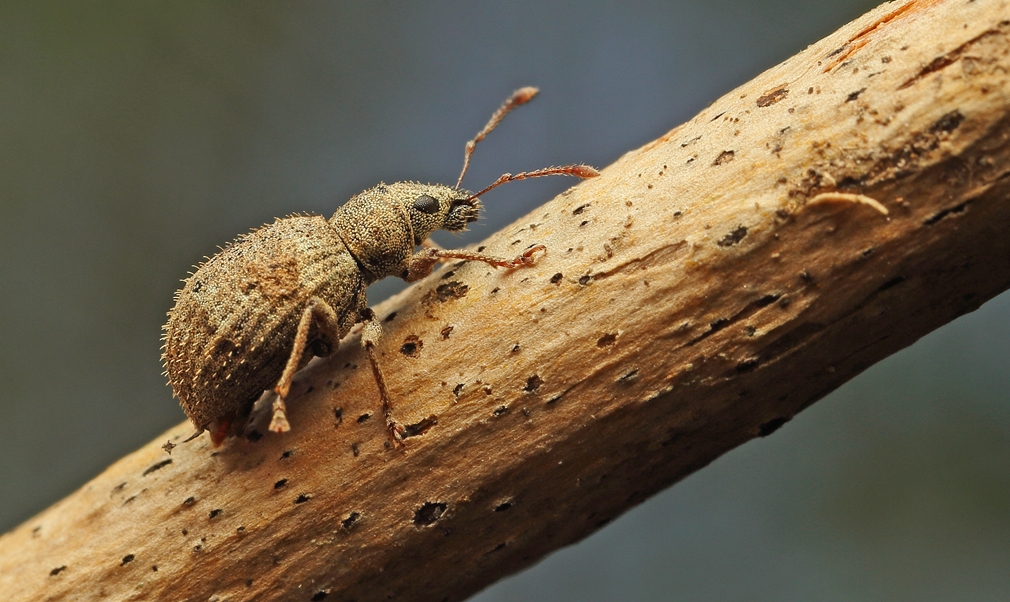

Another weevil I spotted in the same woods; not sure about the identity of this one yet, but possibly Otiorhynchus?


Monday, April 27, 2015

I've been searching in Comfort's Wood for Hazel...


Time to welcome back the leaf-roller weevils to our local woodland. As soon as the hazel leaves begin to appear, I start looking out for these fantastic creatures. With its brick red elytra you would think it would be easy to spot. But being only 6-8mm in length, when it is not moving, it can look just like a part of the tree or at least, a new bud. 

Apoderus coryli (A Hazel leaf-roller weevil)

Apoderus coryli (A Hazel leaf-roller weevil)

Apoderus coryli (A Hazel leaf-roller weevil)


Another bright little thing I found recently was this 22-spot ladybird. Probably the brightest of our yellow ladybirds and added to that, how many other native ladybirds have a 28 letter name? This one is even smaller than the weevil at about 3-4.5mm which is tiny compared to say, the common 7-spot at 5-8mm. Unusually, this one feeds on mildew rather than munching on aphids.

Psyllobora virgintiduopunctata (A 22-spot Ladybird)
Compare it with this next ladybird to get an idea of just how yellow the 22-spot is. But then you might expect it to be yellower than the one below as that one is actually called and orange ladybird, despite it having a yellow head and legs.

Halyzia 16-guttata (An Orange Ladybird)


Issus coleoptratus! There...I can even write that without having to refer to my reference books. Why can I remember the scientific name of this hopper? Because it occurs quite often locally and I have found it regularly over the years. I think this is at the mid-instar stage, so it'll have a bit of growing to do yet. There is only one other similar species, I.muscaeformis, but it is much rarer and not one that I have ever found...or.....have I? Maybe I wouldn't be able to tell the difference if I did spot one?

Issus coleoptratus (A Planthopper)

Issus coleoptratus (A Planthopper)


Whilst on the subject of small creatures, this spider is only about 5mm. This is a female. The males look totally different and don't have the pale legs & brightly coloured palps.

Heliophanus flavipes (A Jumping Spider)

Heliophanus flavipes (A Jumping Spider)

Returning to ladybirds for a moment; what do these next two have in common do you think? Well, although sadly the second one was in a bad way for some reason, they are both 10-spot ladybirds. Variations of the same species, and yet neither have 10 spots, confusing isn't it?


Hmmm..how can I link into the next photo? Oh! I know, ladybirds are sometimes called ladybugs and I have just started to see some real bugs. True bugs that is. C'mon...I tried...I had a go? Ahem...(presses on regardless)...this is the common flower bug. That is its name, it isn't necessarily a bug that frequents common flowers, although, it sometimes does. Ever feel as though your digging yourself into a hole? Here's the photograph... 

Anthocoris nemorum (A Common Flower Bug)
Just to confuse things further, this was not on a flower of any kind but a nettle. Now you're going to tell me that a nettle is a flower I suppose? Let's move on to a moth then...


This longhorn moth is just starting to appear in the wonderfully named Comfort's Wood close to where I live and there are usually good numbers in springtime. It's a male and I think is Adela reaumurella, but it might be A.rufimitrella as it's tricky to be certain from a photo. You can see how long the antennae are in the males, I couldn't even get it all in the frame here.


In the same woods I found a large white butterfly feeding on the wild flowers.I know these have featured in my recent updates too but it's always worth sharing photos of spring butterflies in my opinion...


Pieris brassicae A Large White Butterfly)

Pieris brassicae A Large White Butterfly)

I also had a chance to photograph one in the garden, early one morning...


Well that's about it for another update, I think this one is somewhere around update number 157 and I should be back with another fairly soon.

Until the next time...


Tuesday, May 28, 2013

Fencing weevils and spiders that change colour...

I've been looking out for some fantastic little weevils that usually appear with,or soon after, the first hazel leaves. This year,as with many invertebrates,they were somewhat later than previous finds. But...on a superb spring day that saw rising temperatures recently, I spotted my first...


These are hazel leaf-roller weevils (Apoderus coryli) and although I've yet to find evidence of this (a task for this year) they get their name from the way that adult females roll the edge of a hazel leaf and lay eggs in the cradle it creates.

I did also witness something of a first for me regarding the behaviour of these beetles. I found what seems to be two males,both intent on mating with the same female (although,I'm not sure either was) and this involved lots of posturing by the males. They seemed to be almost 'fencing' with their antennae with heads raised and I am sure they were both sort of, clicking their heads/neck joints as well.

I attempted to capture it on the camera......just a very short clip that is a pretty poor effort but gives you some idea.....


I have read somewhere that the extended length of the head of these weevils may be associated with this activity.
I fully intended finding a female engaged in leaf rolling last spring but failed to do so and will double my efforts this year and hope that I'm lucky.

On a different note-I have not yet added to my moth trap finds. I have set it up twice in the past few weeks but sadly, the first occasion yielded just one (although a rather nice one that I've not had before and will add soon) and the second time, nothing! Not a single specimen, not even any flies.wasps or beetles....today is May 28th and I ran the trap again last night for just a couple of hours and have yet to check it out, so watch this space...


The woods where I found the weevils have been pretty productive for me over the last few visits and beneath the same hazel tree where I witnessed the 'weevil porn' I noticed this looper caterpillar hanging from a very delicate thread. It was spinning and wriggling and seemed to be trying to make its way back up to the leaf above,rather than down to the ground.

The soldier beetles are about now as well....


Again, this was on hazel and I think it's probably Cantharis pellucida but there are several similar ones including C.nigra and C.lateralis. I have a key somewhere to these and really should look it up.

From the same area came this fantastic looking crab spider...


This one seems to rejoice in the name of....'Common crab spider' and does appear to vary quite a lot in its markings (if I have the i.d. correct) with males having a very odd way of mating with females. He will grab hold of a female's legs and hold her until she stops struggling, then ties her down with threads of silk and finally, crawls underneath her to mate-how romantic!


My best find in this woodland though has to be this dragonfly. Not only is it just the second I have seen this year thus far (the other being a four spotted chaser) but is a first for me not only in these woods but anywhere locally....


Again,it's not the best shot but it was not settling for long and when it did, always in bright sunlight. I was very excited to see this one though as I am reasonably sure this is a Downy Emerald Dragonfly (Cordulia aenea) and looking at the abdomen shape a female. I think it is a fresh one too; the eye colour is bright.apple green in mature ones and this muddy brown in immature dragonflies.

I have only ever seen common darters, ruddy darters and southern hawkers at this site until now and after such a bad winter and cold spring, it really did make my day to find this 'newbie'. You can be sure I shall be looking out for more sightings and hoping for better photographic opportunities too. I think this makes three years in succession that I have discovered something new to me in these woods now. 

Misumena vatia
This spider (above) I do recognise. It is one that is common enough and quite easy to spot,unless it does its clever trick of changing colour to match the foliage. It can take a few days to effect a colour change but can vary from white to yellow, through to green.


Finding caterpillars is getting easier with each passing day it seems-here's another....


And another...


This one is not a caterpillar but a sawfly larva...


A the last for now...the tiniest you could imagine. I watched this emerge from an egg and photographed it soon after. It's a moth larva and was probably around 2mm at best...


Plenty of weevils to be found now and a real treat to find something out of the ordinary,or at least, different to the ones that I usually see...


Not actually sure about species here because of the mottled colour. Sitona or possibly Phyllobius? So many weevils,so little time!

To end this update I'll return to those woods where I have been finding lots of nice things this spring. Despite reading that butterfly sightings are well down again, I have found that locally at least, we do seem to be having a reasonable year and certainly well up in numbers and species from last year's appalling results...


A Large White Butterfly

Okay...more to come very soon including the results of last night's moth trapping.

Until the next time...

Tuesday, October 23, 2012

Autumn takes hold...

Various events have kept me away from photography for a couple of weeks, and when I did manage to have a scout around the local woods and fields, I was struck by just how quickly things have moved towards autumn now.

Butterfly and dragonfly numbers have reduced significantly since I last found time to have a wander but there are still invertebrates to be found...


A shot that illustrates the autumnal feel nicely to begin with. This dock bug was the only one that I came across on this particular day. At this time of year they tend to congregate before hibernating and can be found in quite large numbers, usually on...you've guessed it-dock!


CLICK ANY PHOTO FOR A LARGER VIEW
A Hazel Leaf-roller Weevil (Apoderus coryli)


I wasn't expecting to see this leaf-roller weevil amongst the few hazel leaves left on the trees. These are one of the first species I look for when the new leaves appear in early spring and to see one this late is quite unusual.
Having said that, in mild winters, I have found them in November.


Carabid Beetle (Possibly Leistus)

This great looking metallic beetle was out and about the same day as the weevil and positioned itself at the top of the stem just long enough for a couple of nice clear shots.


A Garden Tiger Moth Larva (Arctia caja)
My next find was this caterpillar. I think this is the garden tiger moth larva. It was quite fast and I did wonder, as it was close to the ground if it was looking for somewhere to pupate.


I found a secluded spot where there was still some scabious in flower and as you'd expect, it was attracting a few insects...


I think this large hoverfly is probably Sericomyia silentis. It seems to be quite distinctive and although if the books are to be believed, this is around May-September, as we've already established, timings are all over the place this year again.
Both it's size and the habitat seem to fit as does the wing veneration from what I can make out.


Another hoverfly found on the same scabious plants was this Helophilus species one. Not exactly sure from this shot if it is H.pendulus or H.hybridus? Actually, scrap that! I think looking at the face, it may well be H.trivittatus? (Where's my pal Tim Ransom when I need him?)


There were also a good number of bees taking advantage of the late flowers too.

When I saw this couple of rhododendron hoppers in cop, pictured below, it crossed my mind that this behaviour is usually to be seen in spring-what then would be the purpose of mating this late in the year? Surely no young would result and so perhaps it was just for pleasure? I know...my brain works in very strange ways sometimes.


Graphocephala fennahi

Of course the changing season has meant that we are now getting much damper conditions and that is just perfect for the fungi.....


I do spend a lot of time contemplating just how amazing and beautiful nature is, of course to portray it in such a one dimensional way is wrong on so many counts:nature is a tough environment where survival of the fittest still rules.
We all probably know that butterflies for instance are short lived, but it's still upsetting to see such a beautiful insect reduced to how I found the one in my next photograph...


This red admiral had lost most of its wings to what I guess must have been bird attacks. A very sad sight, especially bearing in mind that these are one of the species that can overwinter. It was amazingly still alive (just) at this point but there was nothing I could do to help, other than putting it out of its misery-and I couldn't bring myself to do that.

To complete this update I think I'll share a photo of another of nature's inventions that appear in all kinds of forms and manifestations at this time of year-these are the galls that are usually the work of tiny wasps and are to be found on all manner of trees and shrubs. This one I'm calling a marble gall. I have no idea if that is its correct title, it seems to fit though!


I suppose I should add that I found this one on oak. Now you're going to tell me it's actually called an 'oak gall' aren't you?

Until the next time then...


All photos taken using Canon 40d-Canon 100mm Macro and natural light, with the exception of the rhododendron hoppers where I added fill flash.