Showing posts with label Diaea dorsata. Show all posts

Saturday, January 12, 2019

10-Legged Spider found in Kent...

We start this update with a recent newspaper clipping...


Yes, this is the BIG news that I have discovered a ten-legged spider. It was a huge story right across all media...


Even made the main CNN bulletin!

Oh yes...I have become a huge celebrity now you know: you are no longer fit to tug at the hem of my garment.

However, as we have known each other for quite a while now, I feel it wouldn't be beneath me to share the full, unexpurgated story with you. Here goes:

There is no story! 

I just found a spider that looked as though it had ten legs. Like this...


So what is really going on here JJ? Well, this is a Buzzing Spider, no, honestly it is! Its scientific name is 'Anyphaena accentuata'. During courtship the male is known to emit a high pitched buzzing sound by vibrating its abdomen on a leaf, and that is the origin of the name. 

I think this one is immature, because when I found it, its room was a mess. Or...it might have been the fact that I found it under loose bark and the wonderful British Spiders website says this: Adults of both sexes are mostly found in early to mid-summer with females sometimes surviving through to the autumn. Immatures can be found in ground vegetation, leaf litter and under bark in the autumn and winter.

You have to admit though, those legs are a bit of a tangle and it takes a bit of working out to sort out which is which.

Here's another one that I saw the same day (because I know you were praying that I would share more spider photos). This one has a rather distinctively marked abdomen. Usually that central, dark design is shaped like 2 chevrons, or arrow heads, pointing forwards...


Meantime, back in the real world. Sometimes when I have been out walking in the woods, I get back home to find that I have brought home a hitch-hiker. On the day I found my 'special spider', I was sitting at the laptop, uploading the photographs, when this next critter ran across the table...


This is Scaphidium quadriguttatum - A Shining Fungus Beetle. Lovely...you can't beat a bit of fungus on your kitchen table! It belongs to the Rove Beetle family. I couldn't actually find much information on this species, even my usually trusty Collins Complete Guide has no reference. I do know it favours making its home in rotting wood, and so I made sure I relocated it suitably. Or should that read: I suitably relocated it?

As we are talking fungus, this might be a good point to share some slime mould I recently photographed. C'mon, it isn't as bad as it sounds: quite pretty in its own way...

Fruiting bodies of a slime mould, Trichia decipiens

I wasn't sure what these next objects were; eggs of some description perhaps?


Another thing that I found under a piece of loose bark, and probably hibernating, was this cool longhorn beetle...

Rhagium mordax (Lepturinae)
I say it was probably hibernating because I do usually see these quite early on in the year, and have found them out and about in February, although not January. Once again, I ensured he was tucked up safely before moving on. 


What do you think these are (pictured above)? They are not beetles; but are beetle larvae. Yes, the larvae of Soldier Beetles. There are several similar ones and so cannot be confident which species these are. 


As for this next one, well, totally confused by this; it looks very like some Darkling Beetle larvae I have seen. But also quite like other fly larvae...


I can't actually see any little legs in this photo, so maybe fly would be a better choice? Your guess is as good as mine though. In fact, better probably.


One last beetle find: I have more chance of knitting fog than finding an identity for this one. There are just so many black beetles to search...


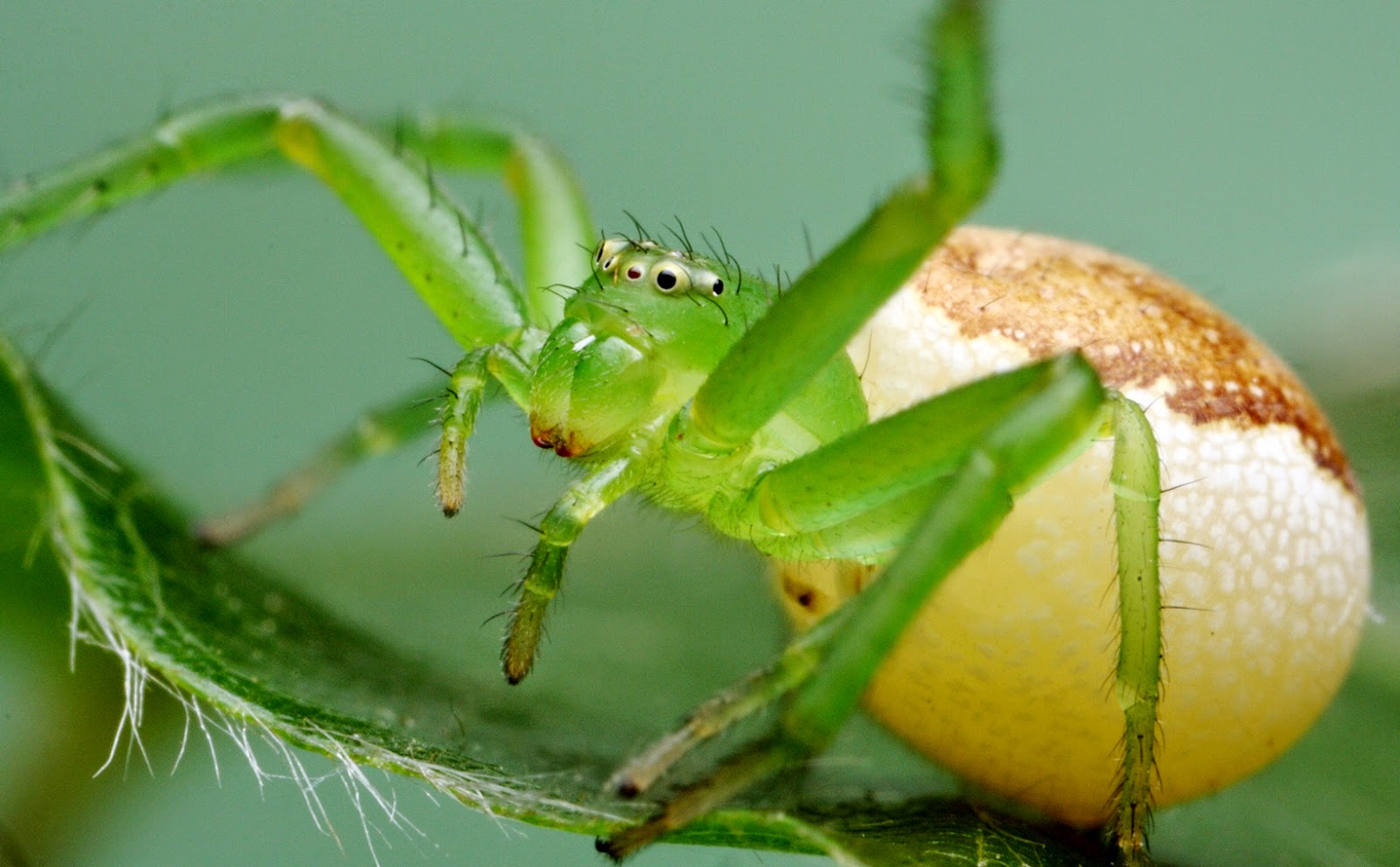
I think my favourite recent find would have to be this beautiful...yes...beautiful, green spider...

Diaea dorsata - A Crab Spider (Araneae)

I would not be expecting to find one of these spiders in the middle of winter. This is a female; males are quite similar, but can have speckled, or spotted legs. Like this...


I have quite a lot more that I could share but I realise time is tight and so will save that for the next update. For now I will leave you with a tiny Collembola that I found in my garden...

Dicyrtomina saundersi (Collembola)


Sunday, April 19, 2015

Green, Light Emerald, White with an Orange Tip...

The first thing I need to say right at the start of this update is that I have had several enquiries about the Blue-tits and so let me tell you about them; I have to report that they have stopped visiting the nest-box over the past few days. It seemed to happen suddenly and not only that, but I haven't even seen them in, or around the garden. 

Perhaps the noisy neighbours are to blame, or even the local cats that seem to be constantly on the prowl close-by? There is also the possibility that something has happened to one or both of them. It's really disappointing as I was looking forward to having them and observing the nest building and raising of chicks. I did my best to encourage them and will do the same again next year. I might re-site the box though.


Shall we start with some spider pictures then? Oh yes please JJ! You know how much we all love spiders...

Click on any photo for a larger view on black
Diaea dorsata

Diaea dorsata

Diaea dorsata

This is Diaea dorsata, the Green Crab-spider. A reasonably common spider in the southern half of the UK but scarcer as you venture north and not recorded at all in Ireland. It is strongly associated with woodland, where it can be found on trees such as oak, yew and conifers. This one was actually on hazel. A short-lived spider, probably a year at best.


My first sighting and photo of an Orange-tip Butterfly
Moving along then, as I appreciate that there are a few poor souls who find spiders pedestrian subjects. Something much more mainstream here with my first sighting of the early spring butterflies that surely nobody could object to?
The photo above was my first 'snap' of the species and demonstrates my technique of getting what I like to refer to as an 'insurance shot'. I usually try to just get something on the camera's sensor as a record of the sighting, and then move in for what I hope will prove to be a better series of shots if I am lucky...

Anthocharis cardamines (Orange-tip Butterflies)

I caught these two soon after, doing the jiggy-jiggy thing. Blimey, only just emerged and they're at it already.
 Before the orange-tips arrived, there were already good numbers of small tortoiseshell butterflies on the cuckoo-flower...

Aglais urticae (Small Tortoiseshell Butterflies)


Peiris brassicae (A Large White Butterfly)
I have been looking after three Large White pupae over the winter and one has now emerged. The other two are pretty close also. This photo (above) was taken around 30 minutes after it eclosed.

This picture is of the chrysalis as it looked a few hours before the butterfly emerged. I just love how much detail you can already make out. You can see the eyes, wings, antennae and even how the proboscis lays flat at this stage and only curls up once the insect has emerged... 


I took the opportunity to get a close-up photo as well whilst it was waiting for its wings to inflate fully...


Let's move on to the case of the invisible caterpillar shall we? Here it is(nt)...


C'mon, you have to agree that the camouflage here is pretty amazing? What's even more amazing for me is the fact that I managed to see it at all! Once the macro has been focused on it, the true detail is revealed in all its glory...


Shine some light on it and suddenly, it doesn't seem to be half as well camouflaged? Yes, this is the same caterpillar that you can(t) see in the previous photograph. I think this is Campaea margaritaria,a Light Emerald larva.

On the subject of moths, I have run the moth trap three times now and had about the same amount of moths! Hopefully now that the weather is improving, my count will increase. I did get this early caddisfly on one night recently...   

Stenophylax permistus

Stenophylax permistus


I think this one could be the species I have named it as but of course, as always, I am willing to be corrected by anyone who knows differently. 


I always love to find something new to me and so when I spotted this next critter, I really was hoping that it wasn't the click beetle that it seemed to resemble..

Orchesia undulata (A False Darking Beetle)


According to the Royal Entomological Society Book of British Insects, this family of beetles (Melandryidae) are all associated with fungi and most are confined to ancient woodland. Nearly all are scarce species, with Orchesia undulata perhaps the most frequently found. It also seems that this beetle was first discovered in the UK in about 1907 and locally at that, in West Kent. 

Meanwhile, in the garden I came across another little beetle sitting pretty on the lavender. This one is the Pea Weevil (Sitonia lineatus) which is a pest of both beans and peas apparently. Not that it worries me as I have neither...

A Pea Weevil (Sitonia lineatus)

I guess I should think about winding up this update then as it's getting rather long already. Perhaps I'll leave you with one more beetle, this one is the rather shy and retiring cereal leaf beetle...


Until the next time...

Friday, July 25, 2014

How time flies when you're having fun...

It all started a couple of weeks ago when I spent some time in very good company on Ashdown Forest, even stayed overnight, but since then I have struggled to find any time to update the blog for lots of reasons. However, now that I have, let's crack on shall we?

There's an old photographic maxim that says, 'If it's bright, give it more light' but even using that as my guide, the long, hot, sunny days we have been enjoying in the U.K. have been far from ideal for macro photography. I have been reduced to early mornings or evening time to get my pictures, hence my tally for each day has been way lower than usual.
That has not prevented me from observing and enjoying nature of course, there is plenty to tempt the eye at this time of year.


Cabbage Moth Eggs
Let me start with updating the story of the moth eggs pictured here-I found these in my moth trap one morning and eventually pinned down the ID to Mamestra brassica. At least I am reasonably sure just from the ova that's what they are? 
I was fully intending to keep and raise these through to pupating, to observe the larvae and to that end, they did emerge a few days later. But it happened to coincide with my trip to the High Weald and so I had to decide, should I take them with me or release them on a suitable food plant.

I settled on the latter option and so before I left, I found a nice quiet and secluded spot to return them to the wild. I do have other larvae that I am raising though and so I will be able to share those with you instead very soon.


Diaea dorsata 
When I came across this crab spider recently I suspected that it's huge abdomen was down to it being heavily gravid (or would just gravid have been enough- perhaps heavily gravid is tautology?) anyhow, I decided to keep watch as it was only in the garden.

Sure enough, a couple of days later she looked like this...


What she did next was to fold the leaf half over the eggs and seal them in. Unfortunately I didn't get to be around to witness that, I would have liked to get some photos really. And there she remained for almost three weeks, sitting guard over her brood, not even moving to feed as far as I could tell. Eventually the little spiderlings began to emerge and although they were little bigger than a pin-head at this stage, what they lacked in size, they made up for in cuteness...


Another interesting little spider, with a sputnik-shaped egg sac I found was this Paidiscura pallens...


Although this one can readily be found on a variety of trees and shrubs throughout the summer months, oak seems to be a favourite. Even without the   female spider as in my photograph, the distinctive egg sac is sign enough in itself of the spider's presence. It is an extremely small one though and often wrongly identified as a juvenile being just 1.5mm


Eriocampa ovata
Those egg sacs are quite odd looking aren't they but how about this strange critter that looks like it has a bad case of Eczema or Psoriasis? It is actually Eriocampa ovata or more commonly, an Alder Sawfly Larva. They grow to about 2 cm as a larva and are covered in this white powdery substance. It's easily rubbed off when the larvae are moving around and is lost altogether at the final instar stage, when they take on a pale green colour. Found on Alder from May-August with most records appearing to come from the south of the U.K.

Oh, go on then! As we seem to be doing oddities again; how about another type of sawfly larva?

Oak Slug Sawfly - Caliroa annulipes

I think this one is the Oak Slug Sawfly larva, I say 'think' because there are others...there are the Rose and also Pear Sawfly to consider. But as this one was found underneath an oak leaf, I am taking that as a clue. Doesn't make it conclusive though as they also use lime and other trees.


Meanwhile, in the garden, a new addition to the plants,' Liatris spicata' has been attracting the attention of several butterflies, bees, hoverflies and plant-bugs...


Also in the garden I spotted this little bug nymph...


Rhopalus subrufus
It is one of the Rhopalid bugs that turn up most years in the garden and is my first sighting of one for this year.


There is a photo of an adult bug on the excellent BRITISH BUGS Website that I took in the garden back in 2009 HERE


The only other thing of note from the garden would be to mention these odd looking caterpillars that I have been finding on the woundwort plants...


I haven't found an ID for these yet and am assuming that they are different instars of the same species.


Well I think that's more than enough to be going on with but I will be back just as soon as I can and hopefully with an answer to what has emerged from either or both of these egg species pictured below-unless of course, you have already guessed?


 Until the next time then...