Showing posts with label Rhagium mordax. Show all posts

Monday, April 15, 2019

Bluebells and weevils...

Well this on-off spring continues to frustrate, but we are turning a corner now, I just hope that there is something  encouraging up around the bend to quote CCR. Not sure about the 'rising wind' in that song though-but 'fix your mind on a crystal day' sounds good to me.

My local woods are turning from a dull moth to a colourful butterfly, if you know what I mean? Winter's drab, pensioner beige's are being replaced by spring's zestful primary colours and soft pastels that can only mean the spring flowers are bursting into life...


If only the skies were as blue as the first of the bluebells. To be fair, they have been on some days; just not enough days. It's not only the bluebells that are blue though. Look at this cracking little weevil I found on the newly emerged hazel leaves the other day...

Involvulus caeruleus 
I think this may be a weevil called Involvulus caeruleus because...that's what I think it is. And I actually found one in the same woods and on the very same date in 2015. 


The difference in colour between these two photographs is almost entirely caused by using flash on the first image; whereas the bottom one was taken using just natural light. Which ties in nicely with this next subject...


When I spotted my first Orange-tip butterfly of the year recently, I was keen to get a shot of it but only had the extreme macro lens with the big diffuser attached to the camera. That's the photo at the bottom of the two pictures above; yes there's quite a lot of nice detail, as you would expect, but the flash fall-off results in that dark background. 

And so on this occasion the only other option was to grab a phone shot, which is the top photo here. For me the phone pic wins hands down. Makes ya wonder sometimes eh? Why lug all this heavy kit around!


Wood anemone

There are carpets of Wood Anemone across local woodland now and I really should try to find out just what creature likes to bite holes out of the flowers. 

I did find this information about the herbal uses (or not) of these plants: 

Medicinal use of Wood Anemone: 

The leaves are antirheumatic, rubefacient and tonic. The plant is sometimes used externally as a counter-irritant in the treatment of rheumatism. The herb is gathered in spring before the plant comes into flower. Various parts of this herb used to be recommended for a variety of complaints such as headaches and gout, though the plant is virtually not used nowadays. A homeopathic remedy has been made from the leaves.

I have to say that I had no idea what rubefacients were. Here's the answer for me and any other dim-witted folk though: Topical rubefacients cause irritation and reddening of the skin, due to increased blood flow. They are used in the treatment of pain in various musculoskeletal conditions. S'pose you knew that?


Here's my Brexit find...

IN, OUT...IN, OUT...


I think this is probably a larva of the longhorn beetle Rhagium mordax. If those silly nomenclaturists haven't changed its name that is! Did I just invent that word nomenclaturists? Well you know what I mean, the people who name these critters.

This is encouraging: on a recent walk I found good numbers of ladybirds and even better, all but one were our native 7-spot species. The errant blighter was a Harlequin or Asian ladybird. The 7-spot is on the left of the pictures below. Notice how much more white there is on the Harlequin. A good clue when trying to identify them. 


Having said that; it is not an altogether reliable aid to identity. Take a look at this 10-spot ladybird in my next pictures...


Very similar patterning on the pronotum, that area right behind the head. But, this particular beetle, even though it doesn't look it in my macro images, is actually a bit under half the size of the other ladybirds. So in this instance, size does matter.


I can't tell you the trouble I have had trying to bring this update to you: well, I could but it would bore the a*** off ya! Damned internet. Been up and down faster than a fiddler's elbow.

And so I shall quit whilst I am ahead and leave you with this photograph of a Bee-fly. These are cunning little parasites that flick their eggs (in flight) towards the entrance of underground nests of solitary bees and wasps. Then when the larvae emerge from the eggs, they feed on the grubs within the nest. Nice huh!


Oh! By the way, this half and half vegetable kinda sums up my mood. Can you guess?


Saturday, January 12, 2019

10-Legged Spider found in Kent...

We start this update with a recent newspaper clipping...


Yes, this is the BIG news that I have discovered a ten-legged spider. It was a huge story right across all media...


Even made the main CNN bulletin!

Oh yes...I have become a huge celebrity now you know: you are no longer fit to tug at the hem of my garment.

However, as we have known each other for quite a while now, I feel it wouldn't be beneath me to share the full, unexpurgated story with you. Here goes:

There is no story! 

I just found a spider that looked as though it had ten legs. Like this...


So what is really going on here JJ? Well, this is a Buzzing Spider, no, honestly it is! Its scientific name is 'Anyphaena accentuata'. During courtship the male is known to emit a high pitched buzzing sound by vibrating its abdomen on a leaf, and that is the origin of the name. 

I think this one is immature, because when I found it, its room was a mess. Or...it might have been the fact that I found it under loose bark and the wonderful British Spiders website says this: Adults of both sexes are mostly found in early to mid-summer with females sometimes surviving through to the autumn. Immatures can be found in ground vegetation, leaf litter and under bark in the autumn and winter.

You have to admit though, those legs are a bit of a tangle and it takes a bit of working out to sort out which is which.

Here's another one that I saw the same day (because I know you were praying that I would share more spider photos). This one has a rather distinctively marked abdomen. Usually that central, dark design is shaped like 2 chevrons, or arrow heads, pointing forwards...


Meantime, back in the real world. Sometimes when I have been out walking in the woods, I get back home to find that I have brought home a hitch-hiker. On the day I found my 'special spider', I was sitting at the laptop, uploading the photographs, when this next critter ran across the table...


This is Scaphidium quadriguttatum - A Shining Fungus Beetle. Lovely...you can't beat a bit of fungus on your kitchen table! It belongs to the Rove Beetle family. I couldn't actually find much information on this species, even my usually trusty Collins Complete Guide has no reference. I do know it favours making its home in rotting wood, and so I made sure I relocated it suitably. Or should that read: I suitably relocated it?

As we are talking fungus, this might be a good point to share some slime mould I recently photographed. C'mon, it isn't as bad as it sounds: quite pretty in its own way...

Fruiting bodies of a slime mould, Trichia decipiens

I wasn't sure what these next objects were; eggs of some description perhaps?


Another thing that I found under a piece of loose bark, and probably hibernating, was this cool longhorn beetle...

Rhagium mordax (Lepturinae)
I say it was probably hibernating because I do usually see these quite early on in the year, and have found them out and about in February, although not January. Once again, I ensured he was tucked up safely before moving on. 


What do you think these are (pictured above)? They are not beetles; but are beetle larvae. Yes, the larvae of Soldier Beetles. There are several similar ones and so cannot be confident which species these are. 


As for this next one, well, totally confused by this; it looks very like some Darkling Beetle larvae I have seen. But also quite like other fly larvae...


I can't actually see any little legs in this photo, so maybe fly would be a better choice? Your guess is as good as mine though. In fact, better probably.


One last beetle find: I have more chance of knitting fog than finding an identity for this one. There are just so many black beetles to search...


I think my favourite recent find would have to be this beautiful...yes...beautiful, green spider...

Diaea dorsata - A Crab Spider (Araneae)

I would not be expecting to find one of these spiders in the middle of winter. This is a female; males are quite similar, but can have speckled, or spotted legs. Like this...


I have quite a lot more that I could share but I realise time is tight and so will save that for the next update. For now I will leave you with a tiny Collembola that I found in my garden...

Dicyrtomina saundersi (Collembola)


Saturday, March 17, 2018

Another cold weekend, little wonder the tits are blue...

I had hoped to be able to begin this update by conveying that we have turned a metaphorical (or perhaps, more aptly, meteorological) corner. However here in sunny Kent this morning, the skies have become ashen and snow is once again in the forecast. Not to worry; I have given myself a good, stiff talking to and promised that it won't last more than a nano-second or two. 
Let's concentrate instead on the past few days, which have been most encouraging. 

As with many of my finds, and indeed photo opportunities at this time of year, they come when out walking the dog. In fact this first find came when dog-walking somebody else's doggies: Benny, the German Shepherd, and Dotty the Jack Russell...


Walking around yet another plot of land that will soon become a building site, I spotted a square of roofing felt which I carefully lifted to reveal these little beauties...


These are quite young, female slow worms. As I am sure you know, slow worms are not snakes but legless lizards: they have the  ability to shed their tails and blink with their eyelids. These were probably still in hibernation mode and so I quickly replaced the felt, which I assume had been placed there for exactly this reason.

After last year's debacle with a neighbour's cat destroying the blue-tit nest in the garden, I have taken some measures to try and protect the nest-box this time around...


OK, so it looks a bit messy, but if it works I shall be more than happy to put up with how it looks until nesting season is done for another year. It doesn't seem to have phased the birds at all because they have already been checking out the box again...


On the front wall of the house I saw my first Salticid of the year. A little jumping spider that was sitting in the sunshine. I don't like to photograph bugs and insects in direct sunlight and so I was attempting to provide some shade with one hand, whilst taking the photo using the macro in the other, hence the shallow depth of field...


In my little work studio that is situated at the bottom of the garden, I had a visit from a rather dopey wasp. I say it was dopey: mainly because it was quite docile and also when I asked it who is the current reigning monarch, it had no answer!


In previous years Comfort's Wood (a real favourite bug-hunting area) has by mid March seen both primrose and wood anemone in flower, as well as the odd violet and green bluebell shoots. That's green shoots by the way, not green bluebells. I have often seen bee-flies in the woods too. However, this year, on a recent visit, all I could spot were the primroses...


10:05am Saturday March 17
Image result for it's snowing again

It's okay though, are we down about the weather? Noooo.... as Dame Vera Lynn sang back in 1939: 'Keep smiling through,Just like you always do,
Till the blue skies drive the dark clouds far away'. 


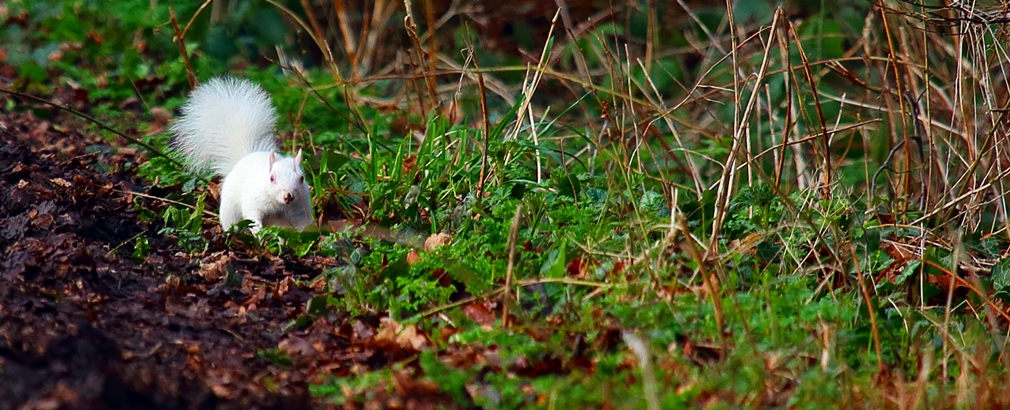
This next discovery should be enough to put a smile on anyone's face. I had seen this animal a few times on my early morning dog walks, but it took a few tries to get even a half-decent shot, as no sooner had I spotted it, than the dog did too...


Yes, it's an albino squirrel. According to the BBC the odds of a squirrel being born white is thought to be about one in 100,000.  Only a few white squirrels are albinos, recognizable by pink or blue eyes and the absence of pigmentation anywhere on the body. The gene for such an absence of the pigment, melanin, is recessive, so each parent must carry it to produce an albino squirrel. Albino squirrels have vision problems and are at a disadvantage in the wild. Many white squirrels  are genetic colour variants of the grey species, as are the less common black squirrel.

I have seen albino squirrels before, here in Kent, but not for a while. This was the last time I photographed one, it was 2016...


I think I may have saved my best find until last? Well, for me it has to be a favourite. I love the longhorn beetles and finding one out and about in March was a real treat for me. This is 'Rhagium mordax' and is a species of the Lepturinae subfamily in the long-horned beetle family. The adults favour open-structured flowers, particularly hawthorn and umbellifers where they feed on nectar and pollen. I have already seen some thorn in flower this year, but thought it was blackthorn, rather than hawthorn...


And that is a wrap as they say. Yes, another update comes to a close. Thank-you for reading this far and for your continued support: I very much appreciate you being there.

I am entering my seventh year of writing for 'The Wealden' and my latest little article can be found HERE as well as on the dedicated page accessible from the button at the top of the homepage, where you will also find every other article since 2012