Showing posts with label Dicyrtomina saundersi. Show all posts

Saturday, February 09, 2019

Concrete bollards and soft bodies...

Yes, it's Solmonath or Mud-month once again.

Have you heard of Anna Quindlen I wonder? She was a journalist for The New York Times, before becoming a successful novelist. In her semi-autobiographical novel 'One True Thing' (1994) she wrote this dark piece:

 "February is a suitable month for dying.  Everything around is dead, the trees black and frozen so that the appearance of green shoots two months hence seems preposterous, the ground hard and cold, the snow dirty, the winter hateful, hanging on too long." 


C'mon! February isn't all that bad; shortest month and all that. No, I much prefer this upbeat writing:

"Keep your faith in beautiful things; 


in the sun when it is hidden, 

in the Spring when it is gone." 

A fella called Roy R. Gibson penned that: no idea who he is, unless he's related to Henry Gibson? Oh yes you do! Well, if you don't know of him, shame on you. Loved his poetry back in the day...


The alligator is my friend
He can be your friend too
If only you would understand
That he has feeling too

The alligator is my friend
He likes to wink and flirt
I'd rather have him as my friend
Than wear him on my shirt

The alligator ate my friend
He can eat your friend too
If only you would understand
That he needs protein too.

    Henry Gibson 1935 - 2009                   


Shall we get right on with the update then? May as well, after all we are both here. Oh yes, just before we do; I read that a picture of an egg garnered over 11 million likes on Instagram recently, and so I thought my own  photo of eggs must be worth a few likes?  If not, a giggle?


And so what has been happening on the nature front since I was last here about three weeks ago? Not a great deal in my back yard is the answer. At least nothing exciting enough to warrant a change of underwear! Our seasonal weather has pretty much precluded any form of macro photography, and when I tried one day to venture out with my 'biggy' birding lens, I could barely hold it steady against the strength of the wind. 

I could share a couple of photos that I did manage though...


Sorry! Can't find the photos: be with you in 2 shakes, recite the soliloquy from Hamlet to yourself or something whilst I locate the file...you know the one, 'slings and arrows of outrageous fortune' etc...


Winter can be hard on the poor little robin...


I feel another of those 'did you know' moments coming on...


Did you know, that your forefinger is the most sensitive? Apparently so; imagine how great we would be with our hands if each hand was composed of four-forefingers! But that isn't the 'did you know' I was wanting to share. No, it was this:
Did you know that February didn't even exist until around 750 BC. The month’s quirky timing dates back to the 10-month Roman calendar, which began in March and ended in December. They eventually added Jan and Feb to sync better with the 12 lunar cycles.


How is it possible for tiny aphids to withstand the worst winter can throw at them?


I somehow managed to grab a picture of this unusual aphid on a concrete bollard whilst out walking. They do seem to be okay in the coldest of cold weather. Despite their soft bodies and fragile appearance, aphids have quite low super-cooling point values. Which in layman's terms I think means they are able to lower their temperature to below freezing without becoming solid.

How do you feel about getting excited by me? Yeah...thought so! Well this next photo opportunity got me excited, I don't mind admitting. The list of critters spotted in my little semi-urban garden is  ever increasing, but until now, has never included this next visitor...


What do you mean "Doh! it's only a grey squirrel" I know most folk view them as vermin, but I love to see them and think they are much maligned. He (if it is a 'he', how do you sex a squirrel?) was hoovering up the loose bird seed with some relish.

Well I 'Googled' how to tell the sexes apart and learned that you need to look for a descended scrotum and testes in males! Yeah...maybe not then.


Collembola or springtails, are also tiny creatures that do well in winter; here's one that was out for a stroll on a frosty plant pot...


I am still finding collembola in the garden, but mostly just the common ones this year...


These are both Dicyrtomina saundersi, a quite common species.


Slightly less common, at least in my garden is Entomobrya intermedia...


Lichtensia viburni!

Who, or indeed what, is Lichtensia viburni JJ? If I told you that it has an alternate name of Viburnum Cushion Scale would it help?

In that case, a picture paints a thousand words...


Providing I have my ID correct, this is the creature in question. Now I know it looks a little like a UFO, but it is actually classified as an insect. In fact, I believe this to be an immature female (aren't they all!) of the species.

Would you like a little info on these? Good, because I am about to impart the very same. By the way, this is not information that I hold somewhere in the recesses of my cranium, no, I cribbed it from Wikipedia: Scale insects vary dramatically in appearance; from very small organisms (1–2 mm) that grow beneath wax covers (some shaped like oyster shells, others like mussel shells), to shiny pearl-like objects (about 5 mm), to creatures covered with mealy wax. Adult female scales are almost always immobile (aside from mealybugs) and permanently attached to the plant they have parasitized. They secrete a waxy coating for defense; this coating causes them to resemble reptilian scales or fish scales, hence their common name.

And an adult one looks like this...


Oh no it doesn't!


The blue tits have been constantly checking out the nest box since early January...


Erm...I think that might do for this update and so I will take the advice of the great Ray Charles and hit the road Jack. I will leave you with this waffle-like fungi that I discovered in local woodland...


Saturday, January 12, 2019

10-Legged Spider found in Kent...

We start this update with a recent newspaper clipping...


Yes, this is the BIG news that I have discovered a ten-legged spider. It was a huge story right across all media...


Even made the main CNN bulletin!

Oh yes...I have become a huge celebrity now you know: you are no longer fit to tug at the hem of my garment.

However, as we have known each other for quite a while now, I feel it wouldn't be beneath me to share the full, unexpurgated story with you. Here goes:

There is no story! 

I just found a spider that looked as though it had ten legs. Like this...


So what is really going on here JJ? Well, this is a Buzzing Spider, no, honestly it is! Its scientific name is 'Anyphaena accentuata'. During courtship the male is known to emit a high pitched buzzing sound by vibrating its abdomen on a leaf, and that is the origin of the name. 

I think this one is immature, because when I found it, its room was a mess. Or...it might have been the fact that I found it under loose bark and the wonderful British Spiders website says this: Adults of both sexes are mostly found in early to mid-summer with females sometimes surviving through to the autumn. Immatures can be found in ground vegetation, leaf litter and under bark in the autumn and winter.

You have to admit though, those legs are a bit of a tangle and it takes a bit of working out to sort out which is which.

Here's another one that I saw the same day (because I know you were praying that I would share more spider photos). This one has a rather distinctively marked abdomen. Usually that central, dark design is shaped like 2 chevrons, or arrow heads, pointing forwards...


Meantime, back in the real world. Sometimes when I have been out walking in the woods, I get back home to find that I have brought home a hitch-hiker. On the day I found my 'special spider', I was sitting at the laptop, uploading the photographs, when this next critter ran across the table...


This is Scaphidium quadriguttatum - A Shining Fungus Beetle. Lovely...you can't beat a bit of fungus on your kitchen table! It belongs to the Rove Beetle family. I couldn't actually find much information on this species, even my usually trusty Collins Complete Guide has no reference. I do know it favours making its home in rotting wood, and so I made sure I relocated it suitably. Or should that read: I suitably relocated it?

As we are talking fungus, this might be a good point to share some slime mould I recently photographed. C'mon, it isn't as bad as it sounds: quite pretty in its own way...

Fruiting bodies of a slime mould, Trichia decipiens

I wasn't sure what these next objects were; eggs of some description perhaps?


Another thing that I found under a piece of loose bark, and probably hibernating, was this cool longhorn beetle...

Rhagium mordax (Lepturinae)
I say it was probably hibernating because I do usually see these quite early on in the year, and have found them out and about in February, although not January. Once again, I ensured he was tucked up safely before moving on. 


What do you think these are (pictured above)? They are not beetles; but are beetle larvae. Yes, the larvae of Soldier Beetles. There are several similar ones and so cannot be confident which species these are. 


As for this next one, well, totally confused by this; it looks very like some Darkling Beetle larvae I have seen. But also quite like other fly larvae...


I can't actually see any little legs in this photo, so maybe fly would be a better choice? Your guess is as good as mine though. In fact, better probably.


One last beetle find: I have more chance of knitting fog than finding an identity for this one. There are just so many black beetles to search...


I think my favourite recent find would have to be this beautiful...yes...beautiful, green spider...

Diaea dorsata - A Crab Spider (Araneae)

I would not be expecting to find one of these spiders in the middle of winter. This is a female; males are quite similar, but can have speckled, or spotted legs. Like this...


I have quite a lot more that I could share but I realise time is tight and so will save that for the next update. For now I will leave you with a tiny Collembola that I found in my garden...

Dicyrtomina saundersi (Collembola)


Monday, October 22, 2018

Round the twist?

I don't know how many years I have been writing my blog now, but it's a lot. In all that time it is quite possible, even probable, that I have duplicated something in an update. However, I am quite certain that not only have I never included my opening gambit for this update, anywhere else, but also that you will have never seen it anywhere on the internet, or I suspect in real life! Neither have I ever typed the following words until this special moment...

"Ever seen a dead aphid standing on its head, with a large hole in its ar*e?"

Today is your lucky day. stand by to be amazed...


Well, how can I possibly follow that? C'mon! May as well cut and run...


Oh alright then, who could resist such a cute kitty?

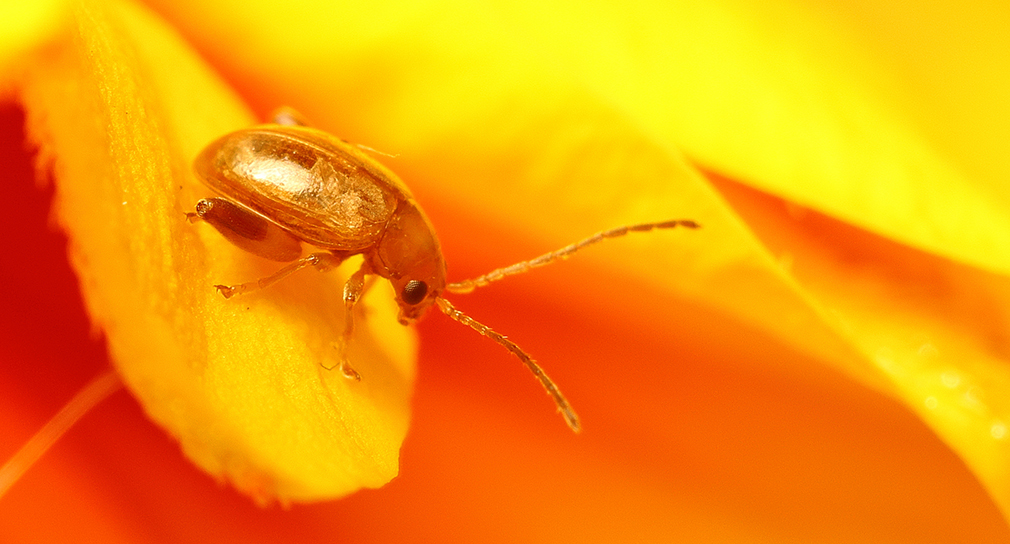
Shall we stay with the macabre for the next photo? I found this tiny flea beetle on the Gaillardia in the garden recently...

Longitarsus sp?
It seems to be missing a tibia and tarsus (leg) on the right. Perhaps it had a run in with a wasp or some other nasty predator. Maybe it had just been to fill up with fuel and has an 'arm' missing on the other side? I know it usually costs me an arm and a leg!

Meantime, back in the house, I spotted an equally small jumping spider on the living room wall...

These pics were not taken while it was on the wall by the way.

Yeah, I wondered at first whether this could be a fencepost jumping spider spiderling? I have never seen one and so cannot be sure, but somehow the shape and markings seemed to be about right. After some research though, I think that 'Pseudeuophrys lanigera' which is strongly associated with man, and is one of the few spiders that is characteristic of roofs and walls of buildings could be a much more likely choice?


Do you pick up the autumn leaves and turn them over to see what might be hiding beneath? No, thought not! You should you know: there are surprises unbounded awaiting you if you care to take a moment to study.

I once had a contact on my Flickr photostream who lived in Brazil and she had some amazing finds and photos. She told me that 90% of her finds were from the underneath of leaves. She's gone now, I probably got too weird for her! Anyhow, this next photo is of something that I found by doing just that... 


It's a tiny barkfly nymph.


Something else that I regularly find under fallen leaves is Collembola....


A juvenile Dicyrtomina saundersi Springtail (Collembola)


An adult  Sminthurinus quadrimaculatus


A tiny juvenile Sminthurinus quadrimaculatus
Some of these creatures are so small that they are barely visible to the naked eye...


If you have been reading my monthly articles for the Wealden magazine: it's okay, I know you haven't, so please don't be embarrassed. If you do feel the urge though, they are all on their own page, which you can access from the button at the top of the blog homepage. Maybe, just maybe, there was nothing worth watching on the telly one night, or you had to stay in to wash your hair, or do some grouting, and bored with all that you decided to brighten your evening by catching up with my published articles, then you would know that my latest one was all about craneflies. Phew! Was it worth that just to link into my next picture?


This cranefly was sitting on the patio window one day and so I took the opportunity to photograph it. Two full days later, it was still there, in exactly the same place; so why did I rush getting the photo?

Finally (yes, at last he says the word 'finally') as this has been an update of oddities, I thought I may as well see it through to the bitter end in the same vein. I'll leave you with a photo of something that I have seen before, even featured on my blog before with the hope of getting help with an identity, but it remains a mystery for now...


Is it a pupa? An egg sac? A seed pod? 

Oh yes, before I get my coat: the answer to the mystery object in my previous update is that it is a moth egg. In fact an egg of the Puss moth.