Showing posts with label Exoskeleton. Show all posts

Saturday, November 07, 2020

He seemed, by all accounts, to be such an important personage...

Just yesterday I had the most exciting find. What I thought was the remains of some kind of bug, which was a brownish, seemingly hollow, husk: at one end there was a tiny bit of white poking out and so I gently pulled on that and managed to extract what looked exactly like an exoskeleton, but had several bright red, metallic spots, almost like glitter! 

I would love to be able to share the photographs I took at the time; but as it was just a dream, will be unable to! 

"Dreamer, you stupid little dreamer"


Enough of this ridiculous preamble! 'Less dreaming, more doing' - isn't that what they say?

-------------------------------------------------------------

ERM, YOU'RE NOT BY ANY CHANCE VIEWING THIS IN YOUR EMAIL ARE YOU?
You are!


No, you need to view the web version, or you will miss the videos in this update: just click on 'JJ's Photoblog' at the top of the email, or even the actual blog update title, both will get you here.


We all know that insects have what's called an 'exoskeleton' don't we. We don't! Okay, well here's an explanation for anyone who's in doubt: An exoskeleton is the external skeleton that supports and protects an animal's body, in contrast to the internal skeleton (endoskeleton) of, for example, a human. The only way insects can grow is by periodically shedding the exoskeleton.

I recently spotted a large aphid doing just that (I know, my life is so exciting) and captured a picture as it began the process...


Have you ever heard this old saying?


Top man David: and the only person I can think of with the middle name; Takayoshi !

It's true though, look at this example I spotted recently...


A dead wasp provides shelter for a 'Billy Baker' (Woodlouse).


Anybody of a certain age will know exactly what this image represents...


Yes!


Right about here...


I decided to set up my trail camera. I had located a badger's sett that looked as if it might be in use: I'd actually been watching another sett close-by, but that one seems vacant now. This one however had recent scratch marks where they might have been digging, and a strong musky smell! 

On the night of November 5th, I set the camera up at dusk and hoped for the best. By the way, take no notice of the date and time on these videos, I didn't set the clock... 

(If you are viewing on your phone, you may need to rotate)

I think this is a big male badger judging by the shape of the head, pale tail, and overall size. I am calling him 'BigSpot' because of that strange pale spot on his body. 

That pale area (he also has a less obvious one on the opposite side) leads me to believe that this might well be a Leucistic badger. Leucistic badgers suffer partial loss of pigment which results in light coloured patches, and even in some cases, whole areas that are paler.

This next video, although not that interesting in itself, does show just how big and bulky this individual is...

Of course, he will be at his heaviest at this time of year as he gears up for winter. Badgers feed on snails, slugs, soft fruit and worms: up to 200 worms per night in fact! It has been recorded that if food is in scarce supply, they will also take hedgehogs. Now that's gotta stick in yer teeth huh? 

To find and film one badger was pure joy, and so when I reviewed this next video, imagine how excited I was...

It can be very tricky to tell male from female badger, even the experts have been caught out. But I think this may be a female following BigSpot out of the entrance. Either that or a younger male maybe?

I'm including this final video (although I have many more I could share) because it does show just how fast BigSpot can be when spooked: watch closely at the very end of this clip...

Badgers can run short distances at around 16-19 miles per hour. They have quite good hearing but their eyesight is not so great. Naturalists universally agree that badgers have an acute sense of smell, pretty good hearing and rather poor vision. However, this view is based almost entirely on anecdotal evidence: very few experiments have been conducted to investigate the nature and limits of the badger’s sensory world.

It is thought that they have small eyes because they are 'semi-fossorial', spending most of their time underground where no light penetrates. Even large eyes are not much use in the pitch black.


And so that was my very first filming of badgers at night. I hope to improve the lighting next time, as the camera seems to suffer from unwanted brightness (By the way, that is his tail in the animation above!).


Oh! One last image to share: what could this be the camera (almost) captured?


A stoat or weazle perhaps? Rat? Rabbit? Any ideas welcome.

Look after yourselves during this pandemic; I can't afford to lose any viewers!


Tuesday, June 25, 2019

Eggs for breakfast...

I feel that I need to start this update with an apology. In my last update I stated that the Red-legged Shieldbug I found was the first mid instar for this year. In fact, I had found and featured one just a couple of updates previously. Ooops! Memory may be worse than anticipated.

I can now advance this story though, because recently I found three final instar nymphs...


It's amazing how your mind works isn't it. Well, it's amazing how mine works at all! But somehow my mind went from three little nymphs, to three little maids, which led me to Hinge & Bracket. You won't remember them of course: Dr Evadne Hinge and Dame Hilda Bracket were elderly, intellectual female musicians who played and sang songs to comic effect back in the day. Anyhow, I interviewed them once for a radio show and they were actually 2 guys. Problem for me was that they were in character, but not in costume; quite confusing.

I digress! Back to the business in hand. There seem to have been an inordinate amount of aphids this year. The garden has been full of greenfly, Whitefly, Blackfly, pick a colour fly: but they haven't had it all their own way...

Emerging ladybird larvae

The Blackfly were decimating my cherry tree and so when I spotted this group of emerging ladybird larvae, I released them onto the tree. They love aphids and within a few days were having their fill.


Eventually these youngsters will grow into something like this...


Although not with a face full of pollen hopefully!


Ladybird larvae are voracious feeders and it's not just aphids they will eat. I know they prey on most soft-bodied insects; but what I witnessed in this next photo was another first for me...


Yes, this ladybird larva is actually having eggs for breakfast...ladybird eggs!

I think this one is the dreaded Harlequin larva, which will indeed eat other larvae and eggs.

Of course insects preying on each other is part of nature's cycle and happens all the time. A couple more examples...


A tiny Cucumber spider makes a meal out of a fly, and a wasp has caterpillar for lunch. Actually, the wasp could be parasitising the caterpillar I suppose.


It's not just dog-eat-dog in the natural world though: there is lo♥e too. I know this might look like a double-ended, two-headed moth, but actually this is boisterous convivial fun - they are busy making whoopee.


When it's like these of course...


I've written about it here many times now. Bugs moult to allow themselves to grow, and these pictures (above) are of the discarded 'skins' of hoppers. Even though I have seen probably hundreds of these over the years. it still amazes me how a bug extracts itself and leaves the 'exuvia' so complete. These always look like the ghosts of  bugs to me.


What about these two bugs: do you think they look similar? Both found on grass. Maybe they are the same species, but the one on the left is a juvenile? 

Well I can tell you that the species is Leptopterna dolbrata and they are both adult. 

The one on the left is actually a female though. Notice how the males are always macropterus (fully winged) whilst females are brachypterous, or partly-winged. That's pronounced as brak-ip-ter-us by the way. 


Whereas this, is a pronounced limp!


And so I guess I will end this update with what was not only the highlight of my week, but possibly THE best find I have ever made? A morning spent at the beautiful coastal resort of Tankerton in Kent was not only good for the soul, but also provided an unexpected delight...

Some of the beautiful beach huts at Tankerton
I was walking one of the paths above these huts when something flew (and I use the word flew, loosely) past me at head height. It was dark, huge and ungainly. I could be heard saying out-loud..."What the f..." erm, I mean.... "Crikey, I wonder what on earth this might be?" I tracked it to a private garden where it, well to say landed is being kind: it kinda crashed into some low growing foliage where it bumbled around for a few seconds before taking to the tree tops, never to be seen again.

What was it? My first EVER sighting of a wild Stag Beetle, that's all!


A male too. Only males have the large 'antlers' which they use for fighting other males. But yes, in all of my years on this earth, this is the very first time I have seen one of these rare British beetles up close in the wild. I may have seen them as a kid I suppose, but even with my memory, I surely would remember such a striking encounter?

I would have loved to spend more time in its company, and possibly get clearer photos but it wasn't to be and the episode was still enough for me to keep mumbling for the rest of the day..."I just saw a stag beetle!"


Saturday, September 05, 2015

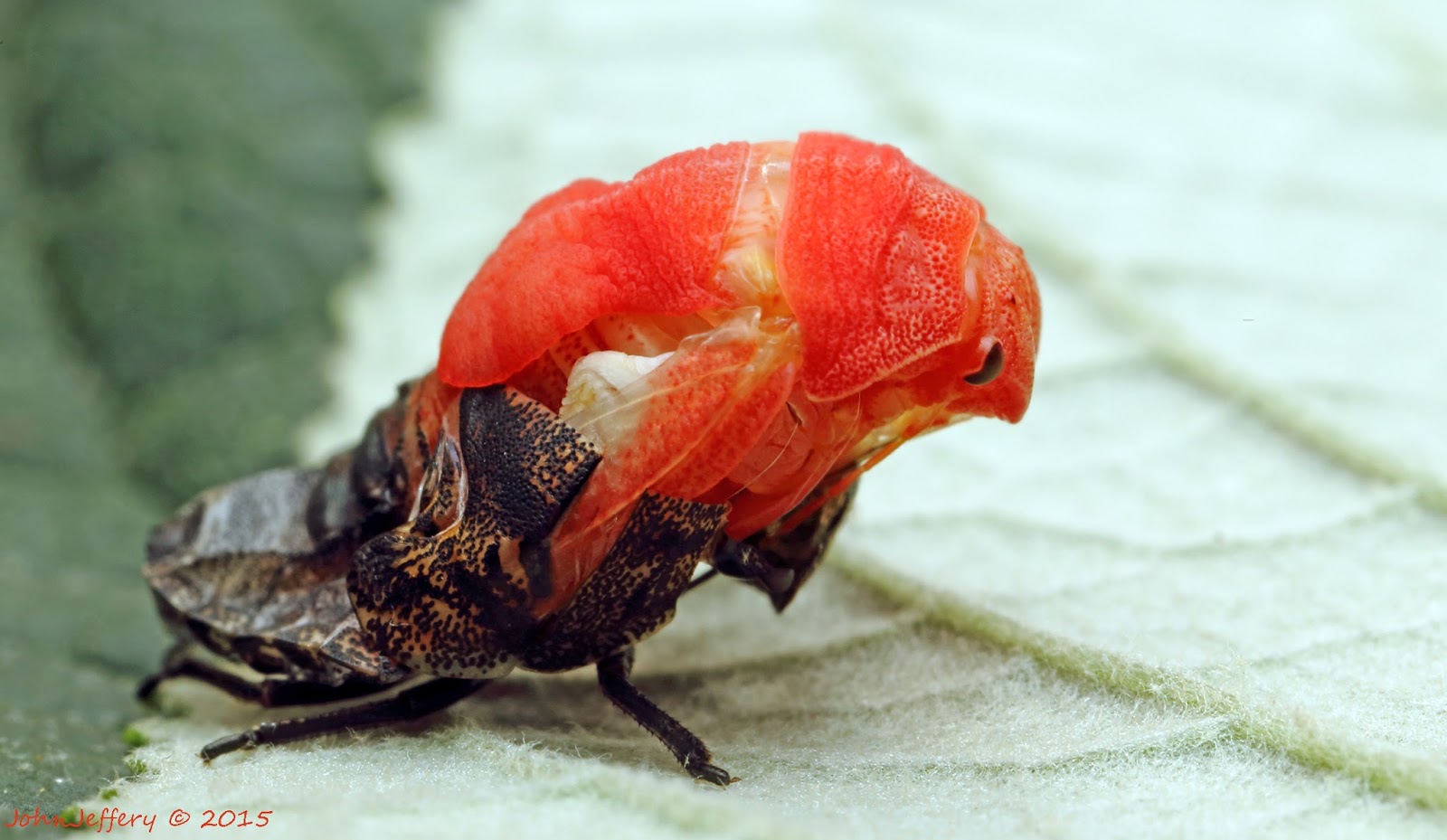
Ecdysis in motion...


I thought you might need this when you realise that I have posted a second blog update so soon after the last one?

What are the exceptional circumstances that warrant such actions? Just that I found this Tortoise Sheildbug final instar nymph and it looked kind of...well, odd to me...


When I say odd, I really mean that the colour seemed very different to other late instar nymphs I have found and so I wondered if it might be close to moulting. Whether the colour was an indication of that or not, I still can't say for sure but I did return to where I found it a couple of hours later and...guess what? I had to hunt around for it and found it eventually underneath a leaf...


11:53 am

11:53am

11:55am

11:56am

11:58am

12:04pm

12:06pm


12:10pm

12:12pm


13:04pm


15:35pm


16:02pm
I decided to let the photographs do the talking for this update. I was lucky with this one that it was so close to home and I could keep popping back to check progress. I have seen this happen a few times now with different species, but it never fails to amaze me just how tricky and dangerous, let alone, exhausting the whole process is.  Hope you enjoyed seeing the pictures.

Until the next time...