Showing posts with label Nymph. Show all posts

Saturday, September 05, 2015

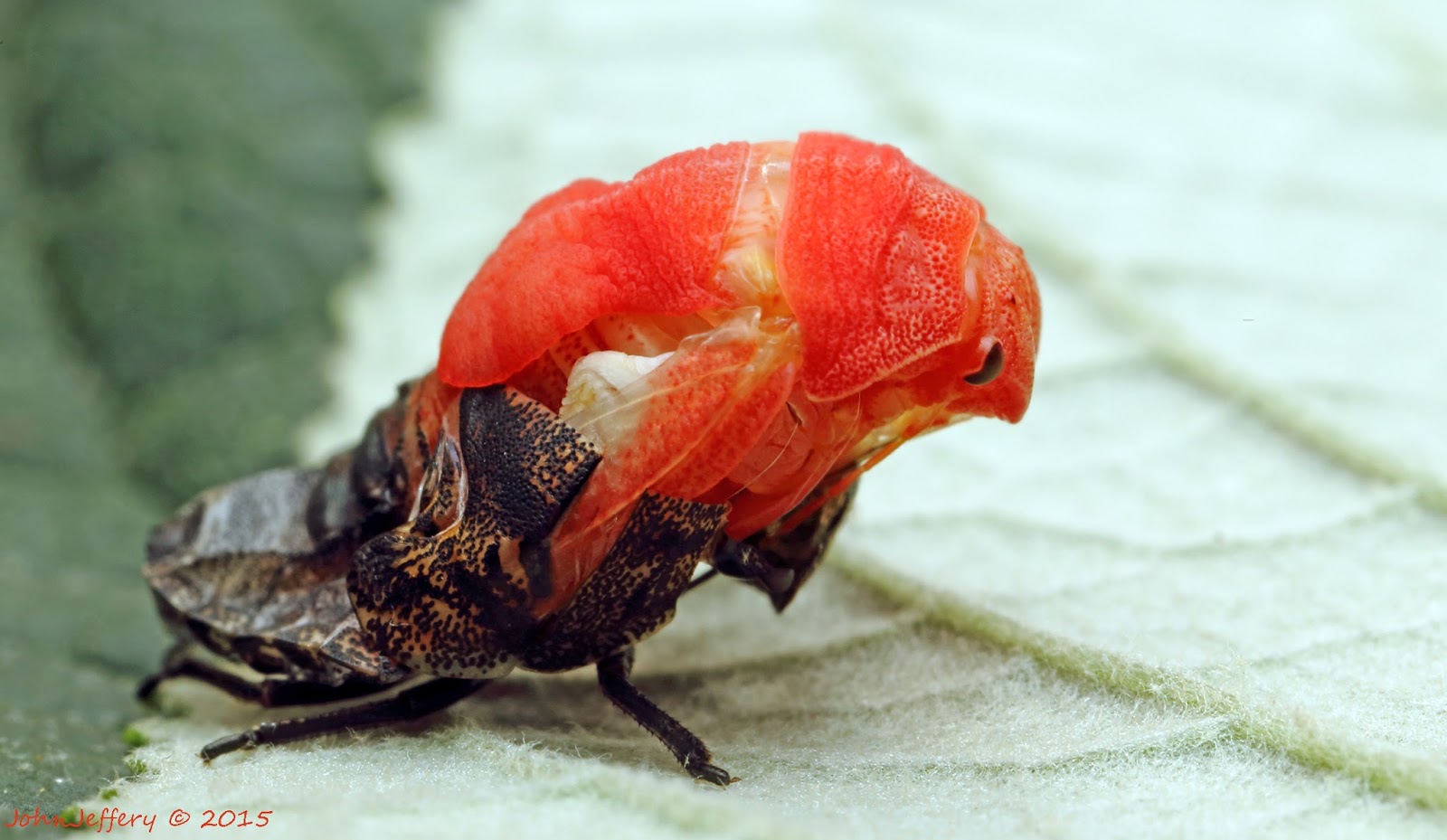
Ecdysis in motion...


I thought you might need this when you realise that I have posted a second blog update so soon after the last one?

What are the exceptional circumstances that warrant such actions? Just that I found this Tortoise Sheildbug final instar nymph and it looked kind of...well, odd to me...


When I say odd, I really mean that the colour seemed very different to other late instar nymphs I have found and so I wondered if it might be close to moulting. Whether the colour was an indication of that or not, I still can't say for sure but I did return to where I found it a couple of hours later and...guess what? I had to hunt around for it and found it eventually underneath a leaf...


11:53 am

11:53am

11:55am

11:56am

11:58am

12:04pm

12:06pm


12:10pm

12:12pm


13:04pm


15:35pm


16:02pm
I decided to let the photographs do the talking for this update. I was lucky with this one that it was so close to home and I could keep popping back to check progress. I have seen this happen a few times now with different species, but it never fails to amaze me just how tricky and dangerous, let alone, exhausting the whole process is.  Hope you enjoyed seeing the pictures.

Until the next time...

Tuesday, September 11, 2012

Don't ask stupid questions, unless you want a stupid answer...

`It seems hard to believe but my stats tell me that I've had this blog since November 2010 and in that time I've had close to 10,000 views.

The map below also shows how it now gets read in an ever growing number of countries too, with the green shaded ones being where folks are kind enough to read these missives.

Time then to thank everyone that's either been here from the start or has joined along the way. I'm very grateful that you're there for me, it would all seem a little pointless without you.


Let's crack on with the latest update then...

A couple of things to tie-up from the last entry:in fact, this relates to the previous one as well-the shieldbug nymphs that I've been finding on alder recently.
I've been observing how the nymphs are progressing and today found something rather special.

This was one of those 'Wow' moments that leave you feeling that you have been privileged to be an observer of nature at its most remarkable...


These tiny nymphs were mid-moult when I found them and were struggling to free themselves from their old skins. I was transfixed by this and somehow felt sorry for them, unable to help. It seems such a hazardous thing to have to undergo and to think they have to do it several times before becoming an adult.

I've only been lucky enough to photograph this behaviour once before,and never with this species. It really made my day.


Once the nymphs had fully emerged I could see that underneath there was an adult parent bug. There also seems to be a hawthorn shieldbug nymph looking on.

Hawthorn Shieldbug nymph
Whilst I seem to be compiling quite a nice little set of shieldbugs and their nymphs, here's another to add to the count...

Final instar Woundwort Shieldbug nymph


I hinted in my last update that the rare sawfly larva I'd found wasn't the only uncommon find and I can reveal that my other rarity was...well, have a look at the following photo...


By the way, before I tell the identity of this beetle (if you haven't already guessed that is) why does it always seem to be that when something of real interest like this turns up, you can bet there will only be just one chance of getting a photo and then you'll probably mess-up?

This is not the best shot you'll ever see of this small beetle, but it is the only shot I managed!

Platycis minutus is an 8mm beetle that has a Notable B. status in the U.K.
Looking for all the world like a miniature cardinal beetle but identifiable by amongst other things, the buff antennae ends.


Angle Shades Moth
A couple of moths now:always a pleasure to see these beautifully marked moths. This one was resting on teasel as you can probably tell.

 It has also reminded me of something else that could be considered another unwritten law of macro photography-why is it that just as you settle down to take a photo, in what appears to be total solitude, as soon as your finger hovers over the shutter button, somebody materialises out of the ether and insists on either telling you their live history, or asks the immortal and familiar question..."What are you doing?"- "I'm fishing! What does it look like I'm doing pointing a camera at a moth?" Well that's how the reply goes in my head sometimes, I've not been brave enough to voice it......yet!


The Herald
Clock this one! Scoliopteryx libatrix or The Herald to you and me. This is possibly where I should add the usual bit about clicking on any photo for a larger view, you won't regret it with this stunning insect. If there's a more beautifully marked moth then...well O.K.There are so many moths that chances are there will be, but still, what a beauty and fresh as a daisy.

I seem to be skipping from one species to another here- It's just not cricket is it? But next up is member of the Tettigoniidae family. 


Oh! It is cricket after all! To be precise, a female oak bush-cricket. (I'm never quite sure as to whether I should use caps for species names?) Nothing too remarkable about finding an oak bush cricket on oak of course, a couple of things struck me about this individual though.

The first obvious one was the wing position. I've not seen them being held in this way before. and what about that dodgy antennae too? Then (and now might be an opportune moment to do that 'view larger' thingy again) I noticed something strange about the 'knees'.

I think this may be in the early stages of succumbing to the fungus that takes over its host and encourages it to climb to a high point, in order to spread the wind blown spores over as wide an area as possible?


Enough of the grizzly side of nature-time for an arty spider shot. Taken from quite a distance this one, I liked the way the seeds from the nearby willow herb had settled in the web.


I'm thinking that one more species might well be enough for this update and so I'll leave you with a mollusc...


I was really pleased that this shot turned out as well as it has because the little snail here is only around 5-6mm and I didn't use flash. I haven't been able to put an i.d. to it but I really like it-it reminds me of the coloured glass marbles we used to have as kids.

Until the next time...


Finally,finally! No news to impart regarding the African snail eggs I'm afraid-have given up hope now.


All photos taken with Canon 40d Canon 100mm macro lens and natural light.

Thursday, June 07, 2012

Cuckoo spit and fly **** (apologies, couldn't resist)


I wanted to begin this blog entry with the photograph you see below to prove a point more than anything else.
I added the picture to my  flickr photostream recently and was disappointed with how the image looked. I have read complaints of how some images once loaded to flickr look over-sharpened and that's what happened to mine. I've compared the two, side by side and the photo reproduced here is much nicer and truer to the original.

Besides all that, I thought perhaps the folks that don't get to see my flickr photos might enjoy seeing this strange beast?

A Horned Tree Hopper
Having got that off my chest, I'll get down to the business of updating you on what's been happening of late.

This year, as last, we have had Blue Tits nesting in the garden, Also replicating last year, when the time came to fledge, one little runt got left behind.


As you can see from the photo, this tiny thing was way behind the others and didn't even have it's flight feathers.
Last year we managed to get the casualty to the local wildlife rescue home-this time we had a problem though, we wouldn't be able to get to the home (around a 16 mile drive) on the same day.

What to do? This little one looked to be quite a bit less developed than last year's too. We phoned the home and explained and they suggested we try and keep it overnight, and then take it to them the following day.

As for food-we were to feed it on scrambled egg, made with water and feed every half and hour until about 9pm, then begin again at first light.


We hurriedly made-up some food and did manage to persuade it to eat a little, but it needed to be convinced, it wasn't asking as perhaps you'd have expected.
Before its next feed was due we began to worry about its condition-it seemed to be fading away and so resolved to change our plans and make the journey to the wildlife rescue centre after all.

Sadly nature took its course even before we'd readied ourselves for the journey and the little bird passed away. We were so upset but being realistic, it probably didn't have much of a chance.


On a brighter note, there's a happy ending to the next story...

At one of our local ponds I spotted a cat that I've seen hanging around previously (in fact I feel this same cat may have been responsible for the demise of the ducklings from a few weeks ago?) and it was pawing at the ground. As I got closer I thought it might have a small frog or toad.
Once the cat had beaten a hasty retreat, I could see that it was in fact a dragonfly nymph that must have climbed from the water very recently, as it was still quite wet.


A Dragonfly nymph
I wasn't sure if the cat had injured the nymph but resolved to find a quiet spot to re-locate it and hope all would be well-I'd check an hour later.

On my return I found the cat had also made a return visit and there out in the open, upside down, was the nymph.


This time I took it home. We have an old water-filled,butler's sink it the garden and I put the nymph on one of the reeds at its edge.
I wasn't at all convinced that it would survive the cat-battering but at least it would be safe for now.

I kept a watch on it for any signs of the adult dragonfly emerging. I've seen and photographed damselflys emerging and they have done so very shortly after leaving the water-perhaps dragonflies are different in this respect because a full 4 hours passed with nothing to see.

Maybe it was not going to happen and the cat had interrupted the process?
I'd have like to photograph the emergence but we had to go out, and would'nt be back for around 3 hours.

On our return, I was a little shocked to see that it had indeed emerged and was starting to dry its wings and expand the abdomen prior to being able to fly.


It didn't seem to be damaged in any way and continued to get ready to enjoy it's brief, hectic life. By dusk it was just about ready for lift-off. By now though the temperature had dropped and it decided to spend its first night with us.

The following morning it was looking great and I knew that it would be leaving as soon as the sun had warmed it. 


That was exactly what happened as this beautiful, male, Broad Bodied Chaser took to the skies.
A great relief to me and I still marvel at how something as dull and frankly, unattractive as the nymph, can morph into this spectacular insect.


----------------------------------------------------

We once lived in a hundred year old, ham-stone built cottage in Somerset, these days however we have a more modern house that boasts the kind of garden most newer properties seem to be afflicted with! A very small-compact-bijou, call it what you will area that limits the possibilities for wildlife.
We've been doing our utmost each year to improve things and encourage nature and at this time of year, we're starting to get more and more creatures either take up residence, or pass through.


Philaenus spumaris-The Common Froghopper may not 'float your boat' but for me, it represents a really nice sight. These little hoppers are now appearing in ever increasing numbers in the garden and with the adults being so variable, with many varied colour forms, they do make interesting subjects to observe.

Add to which, these juveniles or 'nymphs' are responsible for what we all used to call 'cuckoo spit' as kids.


I also found a green tortoise beetle in the garden for the first time this year.
Although this is a somewhat unconventional view of the little critter-it did make me smile and although I did manage shots showing the other side, decided I preferred this one on this occasion.


Lastly for this update I wanted to share this next bit of insect behaviour with you-I'm not sure if it is a reflection on my blog in general but here goes.....

It's a fly taking a dump! Te,he!


By the way, if you're thinking this looks more like a bee than a fly? It is in fact one of the bee-mimicking hoverflies.

Until the next time then...