My blog bible (How To Blog Made Easy) says to never mention, or apologise, for the gap between posts. Therefore, I will not even go there and say that it was September 12th when I last sat here and...oh bugger! I did, didn't I!

Okay, so it took me those 45 days to settle enough to formulate coherent thoughts and convert them to legible text. But now that I have (I think) let's take a 'deep-dive' into it!
Take a look at this rather grainy image of a couple of European frogs please...
 |
These are only late-night phone images, taken by the light of the security lamp on the house, but what struck me right away was the female on the left looks gravid/pregnant/knocked-up/stung by a serpent/up the duff/pudding in the oven? And the male on the right seems to be in his pale-mating colours?
Now I'm not suggesting that he is responsible, but if my theory holds water, somebody is. So what is going on here? Are these frogs so confused by the recent mild weather that they think it's already spring, without even hibernating, and have already been having...rumpy-pumpy?
I suspected they might! This article was then shared with me by a person 'Gotye' sung about in 2011: this article was published in a national newspaper in 2014
Mild autumn is causing frogs to breed early, as climate change affects seasonal animal behaviour, say naturalists.
Mild autumn weather has led to frogs breeding five months early, with frogspawn sighted in Cornwall this week. It is the earliest frogspawn recorded in nearly a decade. This year frog spawn was seen on 21 November, which is early, but not unheard of.
Not conclusive evidence I agree, but I shall be keeping an eye on the little pond in the garden and any froggies I see for developments.

Tenuous link time I think; here goes then...'speaking of hoppers', how about this tiny critter I spotted during this week:
 |
| Eupteryx aurata - Potato Leafhopper |
As you can see from the size of the nettle this bug is on, it's really small: around 4mm. Even so, I think the identity is correct. It's actually a familiar and common species in low vegetation, especially nettles and brambles.
Would you like to see a really funky hopper? Yes, I thought so. I can supply exactly that; look at this cool dude...

And this one?

Don't you think that the markings on the head and eyes of these two hoppers are strikingly similar?
That's because it IS in fact the same hopper. Remarkable I know. But true all the same. They are both 'Cicadella viridis', the Green Leafhopper.
The first image shows a nymph, and in the second photo, the nymph has just morphed into and adult form, hence the pale colour, that will soon turn green, as reflected in its scientific name of 'viridis'.
I've got one more hopper to share, and I chose this one specifically to link into the creature that follows: something I have never seen before, (this update isn't just thrown together you know) - I like a good segway! Firstly though, here's the last of the hoppers for now...
 |
| Common Froghopper - Philaenus spumarius |
Most folk like to call this a froghopper; I on the other hand (which is the other hand by the way?) like to refer to it as the 'meadow spittlebug'. Especially when it would totally destroy my contrived link by calling it anything else.
I suppose you will be wanting to know just what this amazing, never before seen creature is now then? Jeez, you can be so demanding! (insert one of those FB stylee smiley face thingies?) I wouldn't get over-excited about it: you're not going to require a change of underwear when I reveal what it is. At least, not for that reason!
You see how cunning I am? I left a little extra blank space there, just so that you couldn't scroll right past my writing to the photo, without even bothering to glance at it. Now that we are all here though, here are the photographs...
 |
| Nabis ferus -A Field Damsel Bug |

Okay, so even the link is kind of tenuous, I agree. A meadow isn't quite a field is it? But I do my best under trying circumstances you know. The point is, this is a new species for me, even though they are apparently quite commonplace. I have seen and photographed a few other damsel bugs, but not this one, until now.
Here's another species I found recently...

I thought at first that this one could be Nabis flavomarginatus, but then the length of the wings suggested more likely Nabis limbatus the Marsh Damsel Bug. Then there's Himacerus apterus to be considered? This species has a black connvexivum (that small triangle between the wings) and the wings themselves are a reddish-brown, and the antennae are longer than other species. And so my conclusion has to be that this is indeed H. apterus - the Tree Damsel Bug: Phew! Got there....I hope.

So, I walked into a COSTA Coffee place today (somewhere I don't normally frequent) and asked for a flat white coffee. The big guy serving, said rather gruffly, "Don't sell flat white"..."What's the equivalent then?" I meekly asked, "There isn't one!" was his still gruffer reply. "I'll have a Latte then" I said, whilst all the time thinking to myself, I wonder which charm school he attended, because I'd be asking for my money back!

A couple of Shield bugs next...

The one on the left is a Common Green Shieldbug, and t'other is a Hawthorn Shieldbug. Both of these bugs are common in various habitats, across Britain and Ireland. They are also of a similar size, at between 12-15mm length.
Yet more bugs...

Now this one is interesting to me because at first sight I was sure I knew that it was a Nettle Ground Bug. However, as often happens, once I got a better view of it on the laptop, I could see that...I was no longer as certain!
And so what is it? I am throwing it open for YOUR expert opinion: is it Lygaeidae? (Heterogaster urticae) Or something else?
Edit: Thanks to Maria J for the correct ID on this one:Rhopalidae - Stictopleurus sp.

A couple of beatles now...

Ahem! A couple of BEETLES now...
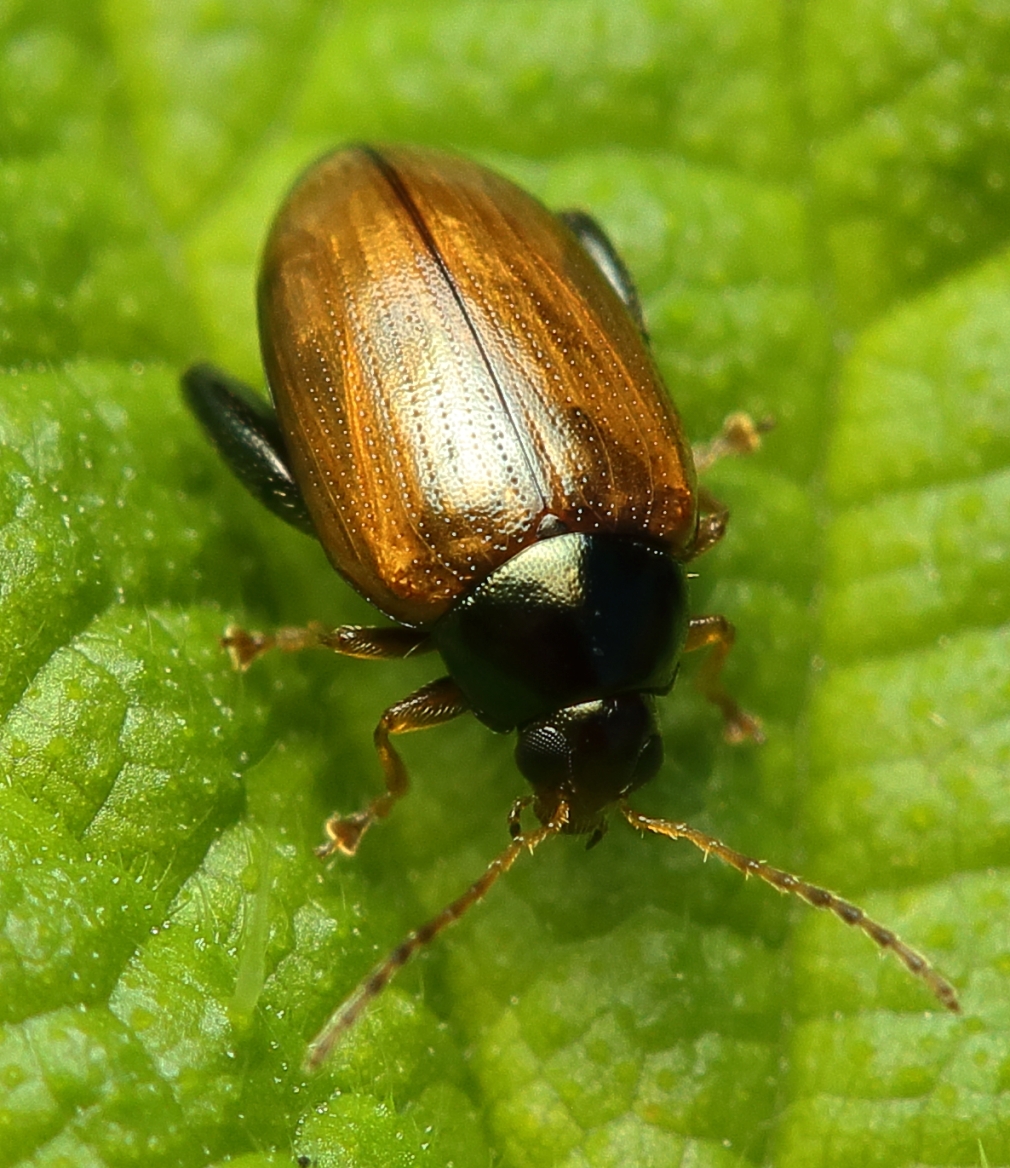
I do know that this first one is a Flea beetle of some description, but the following one is another matter...

This one was even smaller than the flea beetle, which was only a few millimetres long. Maybe a ground beetle? Another that you could help pin down for me?
Edit: Thanks to Maria J for the correct ID on this beetle: Cartodere bifasciata (Latridiidae)
I think probably that's enough for this update, and so I'll leave you with the scary photo! At least some of you will think it scary: at least I saved it until last though...
 |
| A Stretch Spider |
Oh! Just one moment though...

That's a footnote in case you hadn't sussed it!
Back to the frogs for one moment; I sure hope that it all works out for them. There are obvious advantages to starting the breeding season early, but frogs can only spawn once each year – any spawn lost to freezing weather is not replaced.

By the way; I always thought the Goyte song was totally original. It turns out that it actually samples something from way back in 1967!
Here, try these links for yourself if you are interested enough:
And here's the answer to the field vs meadow conundrum:
What is the difference between a field and a meadow? A field is used more often to describe an area managed by people. A meadow is used to describe a wild area.
Note to self: this blog update completed October 31st, I wonder when it will get posted?