Showing posts with label Greenfly. Show all posts

Monday, October 22, 2018

Round the twist?

I don't know how many years I have been writing my blog now, but it's a lot. In all that time it is quite possible, even probable, that I have duplicated something in an update. However, I am quite certain that not only have I never included my opening gambit for this update, anywhere else, but also that you will have never seen it anywhere on the internet, or I suspect in real life! Neither have I ever typed the following words until this special moment...

"Ever seen a dead aphid standing on its head, with a large hole in its ar*e?"

Today is your lucky day. stand by to be amazed...


Well, how can I possibly follow that? C'mon! May as well cut and run...


Oh alright then, who could resist such a cute kitty?

Shall we stay with the macabre for the next photo? I found this tiny flea beetle on the Gaillardia in the garden recently...
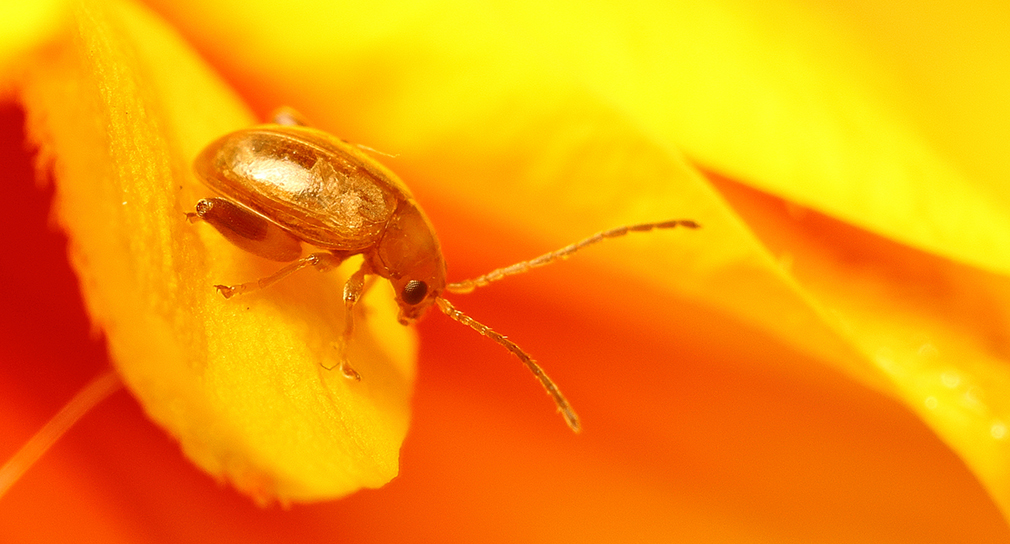
Longitarsus sp?
It seems to be missing a tibia and tarsus (leg) on the right. Perhaps it had a run in with a wasp or some other nasty predator. Maybe it had just been to fill up with fuel and has an 'arm' missing on the other side? I know it usually costs me an arm and a leg!

Meantime, back in the house, I spotted an equally small jumping spider on the living room wall...

These pics were not taken while it was on the wall by the way.

Yeah, I wondered at first whether this could be a fencepost jumping spider spiderling? I have never seen one and so cannot be sure, but somehow the shape and markings seemed to be about right. After some research though, I think that 'Pseudeuophrys lanigera' which is strongly associated with man, and is one of the few spiders that is characteristic of roofs and walls of buildings could be a much more likely choice?


Do you pick up the autumn leaves and turn them over to see what might be hiding beneath? No, thought not! You should you know: there are surprises unbounded awaiting you if you care to take a moment to study.

I once had a contact on my Flickr photostream who lived in Brazil and she had some amazing finds and photos. She told me that 90% of her finds were from the underneath of leaves. She's gone now, I probably got too weird for her! Anyhow, this next photo is of something that I found by doing just that... 


It's a tiny barkfly nymph.


Something else that I regularly find under fallen leaves is Collembola....


A juvenile Dicyrtomina saundersi Springtail (Collembola)


An adult  Sminthurinus quadrimaculatus


A tiny juvenile Sminthurinus quadrimaculatus
Some of these creatures are so small that they are barely visible to the naked eye...


If you have been reading my monthly articles for the Wealden magazine: it's okay, I know you haven't, so please don't be embarrassed. If you do feel the urge though, they are all on their own page, which you can access from the button at the top of the blog homepage. Maybe, just maybe, there was nothing worth watching on the telly one night, or you had to stay in to wash your hair, or do some grouting, and bored with all that you decided to brighten your evening by catching up with my published articles, then you would know that my latest one was all about craneflies. Phew! Was it worth that just to link into my next picture?


This cranefly was sitting on the patio window one day and so I took the opportunity to photograph it. Two full days later, it was still there, in exactly the same place; so why did I rush getting the photo?

Finally (yes, at last he says the word 'finally') as this has been an update of oddities, I thought I may as well see it through to the bitter end in the same vein. I'll leave you with a photo of something that I have seen before, even featured on my blog before with the hope of getting help with an identity, but it remains a mystery for now...


Is it a pupa? An egg sac? A seed pod? 

Oh yes, before I get my coat: the answer to the mystery object in my previous update is that it is a moth egg. In fact an egg of the Puss moth.


Monday, October 29, 2012

Daniel Craig says it all...

Back in June of this year I came across a family of bugs underneath a maple leaf in local woodland...


I thought at the time they were perhaps aphids of some description and one of my flickr contacts Maria (Rockwolf) did what she has done so many times for me now, found a correct identity for the little things. (Thanks again Maria.)

Maple aphids (Periphyllus aceris) Is what they turned out to be. If only I'd considered it was as easy as finding an aphid named after the tree it was found on! Anyhow, that's only half the story.

These little critters have a fascinating and complicated life (honestly!) for instance...

Some are born as 'aptera' individuals. Meaning:Wingless,parthenogenetic,female aphids.Pathenogenetic meaning: Reproduction by development of an un-fertilised egg.This is basically asexual reproduction or to simplify it further-cloning.

Asexual reproduction
Asexual reproduction is the production of offspring by only one parent. No fertilisation of an egg cell or mixing up of the genes takes place, so all the offspring are genetically identical copies of the parent. Greenfly, hydras and strawberry plants can all reproduce asexually as well as sexually.Humans next?

Some are born as 'alates' meaning:Having wings.

If at this point you are still with me, the following photo shows how they now look. This was taken a few days ago...


I now know that the first picture shows what are known as aestivating nymphs. This means that they enter into a kind of hibernation until they resume development in the late summer.

Notice also how most of the heads are pointing towards the centre of the circle in the first photo.

The second photo shows that they have now matured into 'oviparae' (egg laying adults) the oviparae then lay their eggs on the maple twigs and bark and the whole cycle starts afresh.....fascinating! (Perhaps I should have suffixed that with a question mark?) Come to think of it that raises its own question-can a question mark be a suffix?

Let's move on shall we before, as I heard Daniel Craig saying in a radio interview this week,"I'm in danger of disappearing up my own ********"


This photograph of a crab spider isn't the sharpest shot you'll ever see but leaving aside my excuses as to just why it isn't that crisp-I wanted to include it because of what it shows.

If you look closely, you'll see that what appears at first glance to the a parasite attached to the right side as viewed here, is actually a red spider mite.

Now I may be wrong about it being a red spider mite but assuming that I'm not, I was always under the impression that these mites got their name from the fact that they look like spiders and not that they attacked spiders in any way. If that's true, then why was this one all over the little crab spider? Just hitching a lift?


Right...how about a red weevil? "Red weevil? Don't be silly!" 


Apion frumentarium
Or as it's commonly known the Red Rumix Weevil. I think that rumix refers to dock as that's where these are usually to be found. I have photographed these little beetles before but never managed a natural light shot until now.

Everyone has been commenting on how few wasps there have been this year and I had to say that I have also noticed a big reduction in numbers,although I have also noticed an increase in hornets locally.

I did spot this insect recently and I'm guessing this is one of the Ichneumon's?


This next photo is of a bug nymph that I found a while ago now but have been unable to put an i.d. to that I'm happy with...


My initial though for this one was a 'hairy-bug' nymph but that didn't seem to fit when I checked it out. Then I thought perhaps it could be Corizus hyoscyami, a rhopalid bug? The only nymph photos I've seen of these though have little spurs/spikes at the edges of the abdomen.

Here's another view...


I seem to remember that the plant it was on was ragwort but not sure that is relevant.

As always, if you recognise this one, please do let me know.

Last up for now is this robberfly that I photographed in the garden as a bit of an experiment. It was taken using just natural light but is a stack of 20 hand-held images.

Whilst I guess I have to be pleased with the resulting level of detail-for me, I am not sure I like the effect, it seems a bit too sharp to be realistic?


Until the next time then...