Showing posts with label Flies. Show all posts

Saturday, November 19, 2011

The hardest part of moving forward is not looking back.....

I don't know just where the quote came from that forms the title of this blog entry. What I do know is that although it may well be true, I'm about to ignore it!

As I write this text it is now a foggy late evening at the back end of November and although today has been just amazing weather for this time of year, we have to face the fact that winter will be here very soon. That in turn means invertebrate life has slowed and even stopped altogether in some cases and until the warm spring sunshine kick-starts another bug-hunting season, pickings will be few and far between.

Meantime, why not take a brief trip back to sunnier days and re-visit some of my past finds. 


This white squirrel was something that I'd been trying to photograph for a while before finally it came down to ground level and posed for me. Last year my good friend Tim Ransom (well worth a visit to check out Tim's flickr photostream by the way) told me about a red squirrel that had been sighted in Seal near to Sevenoaks. There have also been some reports of black ones being seen locally too.


I have found lots of beetle larvae in the past and there can be huge differences in their appearance as the two photos above demonstrate; both are beetle larva but worlds apart. The top one I have been unable to secure an identity for but I've been told it may be a Wireworm or Click-beetle larva. The second one is of a pair of Cereal-leaf beetle larvae.


This last larva is that of a cardinal beetle.

Sometimes, in fact quite often, nature can surprise me and I'm left thinking "What one earth?..." One of those moments arose when one day I was walking local woodlands looking for a particular weevil when I came across the following insect...
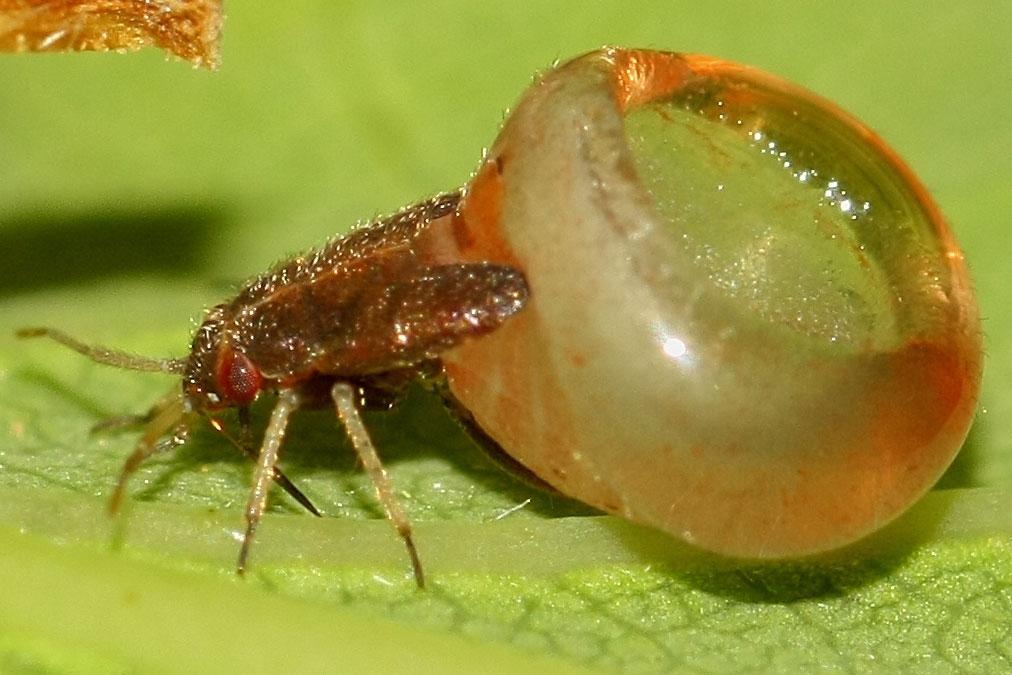

Having shown this photograph to 'The experts' the best explanation seems to be that it's a small bug that has picked up a parasite somewhere that's caused this enormous appendage. I hadn't seen anything like this before and I'm happy to report since!


Whilst I didn't find the particular weevil I was seeking that day, I did, a couple of days later have the compensation of finding this one. A really nice find it was too-this is the Birch leaf-roller weevil and is a rare sight that is on the list of notifiable species that are considered to be endangered.


There are in excess of 400 species of weevil in the U.K. and so I guess it's not that surprising that from time to time I will come across some of the lesser known ones. However, a fly, is a fly, is a fly, right? Well actually no! Far from it-there may be 400 or so weevil species but they pale into insignificance when compared to U.K. fly species, of which there are...are you ready for this? O.K. .....close to 6,900 that reside here.

The first of the three photos above is of a Snake-fly-the second a Cleg-fly and the last is Sciomyzidae species; again all very different from each other. 

In size U.K. flies can be anything from just 1mm to an astounding 30mm.


Every now and then something comes along that looks as though it belongs in a science fiction movie. Take this wonderful creature for instance, doesn't it look a bit like an armour plated alien? It's yet another example (as if another were needed) of just why I love nature and photographing/observing these amazing creations we all share our world with.

If I live until I'm a hundred, there still won't be anywhere near enough time to see all the insects and bugs just on our little island, let alone the rest of the world.

As it happens, there is no need to be frightened of this particular being. What is it? Actually it's a harmless Leafhopper nymph and is little more than 5mm in size.


If I haven't impressed you yet with nature's diversity, then how about this one-surely you can't fail to be impressed by this beastie?
 Did you ever consider that something so strange could be living right here in the United Kingdom? After all, isn't this the kind of thing we are used to being shown by Sir David Attenborough on one of his foreign adventures? 

It rejoices under the catchy title of 'Platyrhinus resinosus' and is one of our most impressive weevils in both size and colour.


The last of my reminiscences for now is this uber-rare water gremlin. These are hardly ever seen by humans as they are shy creatures and live in water droplets. They are usually to be found around springtime and especially on April 1st...or so the legend goes!


Only one thing left to do now and that's provide you with an answer to my 'guess the photo' from the last blog entry. It was in fact  a close-up of a Leopard slug. To be precise it is the respiratory pore, or pneumostoma.

Leopard slug


That's it then, until the next time...


Wednesday, September 07, 2011

If the rain comes they run and hide their heads...

I cribbed the blog title of course from what has been called The Beatles' finest B-side. It's the first line of the song 'Rain' for anyone who doesn't know it (Shame on you).


It seemed apt as the weather here in darkest Kent U.K. over the past few days has been just that. 
"Run and hide their heads" however, is less pertinent because I wanted to feature a Horsefly that was doing just the opposite one morning when I went out on my early (and rainy) walk.


It was sitting in the open and was either cold due to the time of day and inclement weather, or, had been asleep.
These big flies have fantastic eyes but the females are known to administer a very painful bite-and so it's not too often that I get a chance to photograph one that seems docile and poses little threat (hopefully).


I've also been toying with the idea of doing some 'image-stacking' for sometime and thought this'd make for a superb subject.


I had the 100mm macro lens on the camera and just to make things even more difficult (macro can be taxing at the best of times, throw in low light levels and it becomes even harder to obtain decent images), I found the  Raynox DCR-250 in my camera bag and added that to the macro to increase magnification. No tripod or monopod and so hand-held was the only real option. The insect was too high up to kneel down or brace myself against anything. I took this first shot.


Click on any picture for an enlarged version.


This was just a single frame/exposure and although the light isn't brilliant, or all that even, for a dull and rainy morning it could be worse!
I took a few more similar photographs and then had the bright idea (no pun intended) of enhancing the light by holding a small, makeshift reflector underneath the insect; or at least, as far underneath the insect as it would allow without wanting to annoy her!


This second photo is the result of that-as you can see, there's not too much difference other than the reflector was in shot, hence the lighter background to this shot. It has removed some of the darker areas at the bottom of the eyes to be fair; trying to balance everything wasn't fun though..


Image stacking for macro purposes can be used as a tool to increase depth of field; a problem that we all suffer from. That is, by being so close to the subject being photographed, there is very little depth of field. Hence, almost inevitably, some part of the image will be out of focus.


To try and overcome this problem, it's possible with digital photography to take a whole series of shots from a single position focusing on a different part of the subject with each fresh exposure. Perhaps, closest to the camera for the first shot ending up with the last frame being farthest from the camera.


Then using software, the images are combined, or 'stacked' in order to form one final photograph that should have everything in focus. Well that's the (simplified) theory! Depending on which software is chosen for the job, it can be a little forgiving of any slight movement but really it's a sturdy tripod and focusing-rail job for best results.


I've already mentioned I didn't have a tripod with me (in fact, I don't even own a decent one!) and so my only choice was to try a hand-held series of shots. I've seen some photos done this way and it can be achieved, armed with some previous advice from a 'flickr' contact (you know who you are) I tried for a series of around 8-10 shots. As far as I could tell by reviewing them on the camera's screen, they didn't seem too far off the mark.


WRONG!  Well I know now that I've tried to stack those images that they weren't good enough for several reasons. It seems to me looking at the resulting photograph that the main one is the lack of good lighting that has culminated in a lot of 'noise' spoiling the image. Possibly the alignment isn't actually all that bad for a first attempt?


8 image stack
Whilst there is quite a lot more of the image in focus, more frames would have made such a difference. I'm not even sure that the detail is that much better either than the photo below that is a straight crop from a single-exposure photo taken at the same time?


Cropped from a single exposure


However, hindsight is a wonderful thing and at the time I felt it was worth a shot at say, 30 frames to try and get a nice, smooth transition between shots. I braced my arms tightly to my sides and got into position, all the time the rain was still falling, agreed, not as hard now but just to make me feel a complete idiot for even attempting photography in these conditions, the wind began to howl too. If this is beginning to sound like a poor excuse for a poor result, you could be right but what the hell; in for a penny in for a pound as the old saying goes.


I managed 27 shots before giving in to the conditions and my aching arms. Once again I reviewed my handy-work on the camera's screen.
Hmmm.... looked reasonable but then how often have I thought the very same thought, only to get home, download the images and view them on the P.C. only to be disappointed?


The software and my ageing P.C. took quite a while to process the 27 images and even before  I had loaded them I realised that the chances of an acceptable resulting picture at the end of it all was, well, let's say less than certain. 


Admittedly I only have free software for this operation and there are (much) better programmes available but even if I had available funds, I wouldn't want to invest in something until I knew that stacking would be something I'd take to and do on a regular basis. Moreover, even the best software is unable to cope with my amateur attempts at providing sensible raw materials to work with.


And so here it is then, my hugely disappointing first real attempt at a 'proper' stack! 


As you can see, the lighting is awful and one-sided, the frames aren't aligned correctly and the whole thing looks a bit of a mess. By the way, I didn't use the full 27 shots in the end.
As usual I had jumped in at the deep end before learning to swim. What have I learned? Well, not to be so adventurous in future. Get back to basics before attempting anything as ridiculous as this again and try not to ignore the basic rules of image stacking. 


I share this with you all in the hope that it will prompt anyone with greater knowledge than I (stop it) to offer advice/solutions and general criticism to aid any further excursions into 'stack-land'. 


Until the next time then...