Showing posts with label Image stacking. Show all posts

Wednesday, April 18, 2012

I'm a meanderthal man...

If you look up 'Meanderthal' in the urban dictionary, you'll see that it's a word that suits me well-not only that but it might be applied to this blog entry with equal merit.


From http://www.urbandictionary.com

Meandethal: An old person who walks about at an extremely slow pace. This word is a combination of 'meander' which means to walk slowly with no apparent destination, and 'neanderthal' which refers to something old, ancient or prehistoric.

Definition 2 : Conversationalist who wanders from one subject to another with no apparent point, never reaching the end of the story.


Well, definition one certainly describes how I appear at least to wander about aimlessly whilst out bug-hunting:and slow would also be apt for fear of missing anything. As for the old,ancient or prehistoric part? Well I'm no Justin Bieber that's for sure!(Thankfully.)


Definition 2 Could be useful to quantify this particular blog entry because unless my writing skills are more deft than I myself feel they are,I may well be struggling to keep on the straight and narrow.


Shall I explain?... Easy! Easy!...just "yes please" would have been sufficient.


O.K. What I'll do to placate you after suffering this much text at the start of a blog-entry is add a pretty little picture here and then go on to 'add filling to the sandwich' thereafter...


I was pleased that my photograph (above) of an Orange-Tip Butterfly was published recently in the newspaper 'Kent On Sunday' in their section 'Images Of Kent' I apologise for the quality of the photo reproduced here but it was the best I could manage from a pdf download of the newspaper page.

Why am I sharing this with you? Firstly I've taken the liberty of assuming that you'll be interested and secondly, it demonstrates nicely just how the weather has impacted on my bug-hunting of late-even the butterflies have all but disappeared for the time being.

And all this brings us back to my opening gambit of trying to pre-warn you that consequently, this entry may wander a little with no real theme other than that of a total lack of bugs and insects due to our great British climate.


What to do when the weather is against you?


Having been experimenting with image stacking and knowing that this is for the most part an indoor sport, I have spent a few afternoons with all manner of tubes, bellows, lenses and frankly, ridiculous, Heath Robinson looking contraptions trying to produce some quality images this way but mainly managing to try my patience!


This bee pictured above was one of my first efforts and is a full-frame shot that although shows promise, was not exactly what I was hoping for with either lighting or detail. My problem to some extent is that the better these stacked shots get, the more critical I become of them. I suppose though that it's better than getting complacent and thinking that it's all just a bit too easy?


Having fiddled with the lighting and changed to a different lens, I progressed to this shot of a common earwig. Once again I was reasonably pleased with the outcome but was still looking to improve my technique.


The other major consideration with photographing tiny critters in this manner is the prerequisite of a non-moving subject: by that I mean that they be deceased! Now bug-hunting is one thing, but to then add in searching out dead creatures is even by my own twisted values, verging on 'weird'. Of course there are those who are willing to kill their subject to obtain the best possible image but that rankles with me and kind of goes against the grain.


Dead creatures are as much a part of nature as are those in the land of the living of course and once you begin to look for them, are not too difficult to locate but I'm not sure it's something that'll become 'de rigueur' for this particular nature lover.


CLICK ANY PHOTO TO VIEW LARGE AND ON BLACK

On this final image I had started to get to grips with the whole process a little more and had also realised that the lack of image sharpness was probably due to vibration and not lens quality. I resolved to improve again on my set-up by making a new rail/stage and at the same time, add some extra lighting before attempting any-more focus stacked images.


I'm pleased to be able to report that I've now carried out the improvements but have yet to find the time to road-test them.


---------------------------------------


Following on from a very warm March, April has been a real let-down and spring seems to have been put on hold for now. It has just been too cold and wet for most invertebrates.There has emerged something of a pattern lately though, in that the day seems to start well with early sunshine following on from even earlier, or indeed, overnight frost-that then degenerates into a grey gloom for the rest of the day.


Perhaps in the absence of anything else an early morning meander would be an idea?
"Yes, that's what I'll do" I thought as my head hit the pillow at the end of yet another wet and bug-less day, and so it was that the very next morning at 6.30am I was out and about 'meanderthal-ling' all over the place.


Early morning Hoverfly
On some long grass beside a local pond I spotted this little hoverfly that had obviously spent the night perched here and as it was still too cold for it, it made an easy subject to photograph without fear of it flying off.


At more-or-less the same location I saw another beefly perched in the same position as the one I photographed a while ago. Perhaps I'm getting better at finding these because until this year I've not seen this behaviour at all and now I've witnessed it twice in as many weeks.
It's interesting too that once again it's one of the paler specimens.


I decided to opt for natural light only for these early morning shots:it means that there's a little less detail but set against that is the gain of a more naturalistic light and hence, hopefully, photo.

Since I ventured out to get these few shots the weather has worsened again and now even dawn photography sessions are impossible. Until things improve, there's always the image stacking to return to I suppose but what we really need is the return of spring and so if anyone has influence in such matters?

Until the next time then...


Wednesday, April 04, 2012

The eyes have it...

Can I start this post with a thank-you to all those that have shown an interest in my blog, I can't believe that the viewings have just passed 6,000....thank-you so much.


The weather continues to fluctuate between summer and winter here in Kent, with a few spring-like days thrown into the mix for good measure.
Probably the reason then, that bug-hunting is sporadic, or at least, bug-finding is to be more correct.


Butterfly sightings have been good over the last week or so with temperatures peaking at around 20deg. I've already spotted Comma, Peacock, Red Admiral, Orange-Tip, Small White, Small Tortoiseshell, Brimstone and Speckled Wood. This week we are down to around +4 with early morning frosts again, and so numbers now appear to be down.


There are however a fair number of bee species to be seen locally. As for just how many species, well, it would help if I could differentiate between most of them but alas, that skill alludes me for the most part. That said, there are certain bees that are quite helpful in this respect:at least to species level. By that I mean they have a fairly obvious distinguishing feature.


 A Cuckoo Bee

Cuckoo bees (Nomada) look more like wasps than bees with their yellow and black markings. Called cuckoo bees because they live in the nests of mining bees, mainly Andrena species. These little bees do seem to have brown antennae most times, which is a help with identifying them but what fascinates me about them is their eyes. It's worth taking a closer look at the compound eyes as they are quite striking....

Compound eyes
 The image above is a close-up of the nomada species eyes: it may not be the sharpest image that I've ever produced but it's the result of an on-going experiment with image-stacking and until I either improve my technique or manage to source some better quality equipment (or possibly both) it'll have to do. It does show nicely the compound eye and its fantastic colouring though.


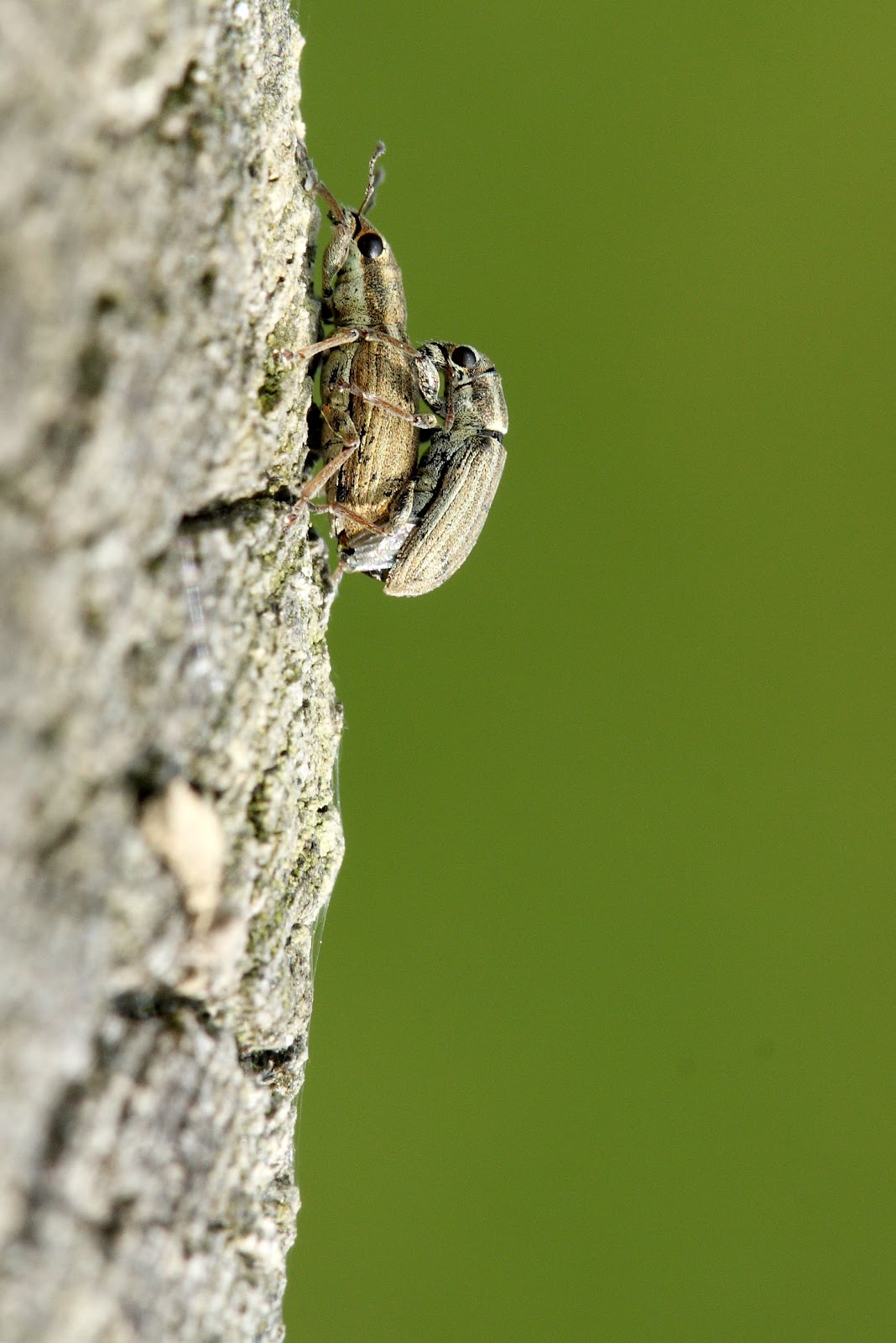
A Pea Weevil
Sitona lineatus- the pea weevil, is omni-present now, with large numbers to be found either sitting atop of fence posts, or as in the case of this one, just  motionless on long grass. At around 4-5mm though, they may not be obvious.
They get their name from the habit of nibbling semicircular holes in the edges of peas and clover.


Both sexes doing what both sexes do!


Of the early butterflies, surely the arrival of the orange-tips is one of the delights of spring-proper. Stunning butterflies at any-time, these delicate insects can be fully appreciated when they are freshly emerged with their strong colours and as yet, undamaged wings. Easily separated into male/female by even an amateur such as myself:the males having bearing the tell-tale 'orange-tip' to their wings.

CLICK ANY PHOTO FOR LARGER IMAGE
An Orange-Tip Butterfly


7-spot ladybirds seem to be around in huge numbers this spring-perhaps the mild March has encouraged them out of hibernation. I have also seen a few harlequin ladybirds locally now but only a handful. The photograph of a 7-spot below is a natural light photo and although it looks as though I have photo-shopped the background out and added a plain cream one, the truth is that it's natural, and is just dry, long grass.

A 7-Spot Ladybird


We are just into April now and what has been a real treat to see is the amount of wild flowers that are now showing. There are primroses, wild violets, wood anemone and lots of bluebells (see photo below for an illustration of some of the paler variety we have growing locally). The roadside verges are also turning green with wild parsley and jack-by-the-hedge and numerous other plants and shrubs.


Bluebell


I think that about updates you on what's happening in the world of nature here, well that's what I've seen anyway, as always there's far more going on than I'll ever witness and long may it be so.


To complete this blog entry I'd just like to add here that I was pleased that one of my photographs was chosen recently as the 'Photo Of The Month by UK SAFARI and will appear on their website for the month of April.


Until the next time then...

Wednesday, September 07, 2011

If the rain comes they run and hide their heads...

I cribbed the blog title of course from what has been called The Beatles' finest B-side. It's the first line of the song 'Rain' for anyone who doesn't know it (Shame on you).


It seemed apt as the weather here in darkest Kent U.K. over the past few days has been just that. 
"Run and hide their heads" however, is less pertinent because I wanted to feature a Horsefly that was doing just the opposite one morning when I went out on my early (and rainy) walk.


It was sitting in the open and was either cold due to the time of day and inclement weather, or, had been asleep.
These big flies have fantastic eyes but the females are known to administer a very painful bite-and so it's not too often that I get a chance to photograph one that seems docile and poses little threat (hopefully).


I've also been toying with the idea of doing some 'image-stacking' for sometime and thought this'd make for a superb subject.


I had the 100mm macro lens on the camera and just to make things even more difficult (macro can be taxing at the best of times, throw in low light levels and it becomes even harder to obtain decent images), I found the  Raynox DCR-250 in my camera bag and added that to the macro to increase magnification. No tripod or monopod and so hand-held was the only real option. The insect was too high up to kneel down or brace myself against anything. I took this first shot.


Click on any picture for an enlarged version.


This was just a single frame/exposure and although the light isn't brilliant, or all that even, for a dull and rainy morning it could be worse!
I took a few more similar photographs and then had the bright idea (no pun intended) of enhancing the light by holding a small, makeshift reflector underneath the insect; or at least, as far underneath the insect as it would allow without wanting to annoy her!


This second photo is the result of that-as you can see, there's not too much difference other than the reflector was in shot, hence the lighter background to this shot. It has removed some of the darker areas at the bottom of the eyes to be fair; trying to balance everything wasn't fun though..


Image stacking for macro purposes can be used as a tool to increase depth of field; a problem that we all suffer from. That is, by being so close to the subject being photographed, there is very little depth of field. Hence, almost inevitably, some part of the image will be out of focus.


To try and overcome this problem, it's possible with digital photography to take a whole series of shots from a single position focusing on a different part of the subject with each fresh exposure. Perhaps, closest to the camera for the first shot ending up with the last frame being farthest from the camera.


Then using software, the images are combined, or 'stacked' in order to form one final photograph that should have everything in focus. Well that's the (simplified) theory! Depending on which software is chosen for the job, it can be a little forgiving of any slight movement but really it's a sturdy tripod and focusing-rail job for best results.


I've already mentioned I didn't have a tripod with me (in fact, I don't even own a decent one!) and so my only choice was to try a hand-held series of shots. I've seen some photos done this way and it can be achieved, armed with some previous advice from a 'flickr' contact (you know who you are) I tried for a series of around 8-10 shots. As far as I could tell by reviewing them on the camera's screen, they didn't seem too far off the mark.


WRONG!  Well I know now that I've tried to stack those images that they weren't good enough for several reasons. It seems to me looking at the resulting photograph that the main one is the lack of good lighting that has culminated in a lot of 'noise' spoiling the image. Possibly the alignment isn't actually all that bad for a first attempt?


8 image stack
Whilst there is quite a lot more of the image in focus, more frames would have made such a difference. I'm not even sure that the detail is that much better either than the photo below that is a straight crop from a single-exposure photo taken at the same time?


Cropped from a single exposure


However, hindsight is a wonderful thing and at the time I felt it was worth a shot at say, 30 frames to try and get a nice, smooth transition between shots. I braced my arms tightly to my sides and got into position, all the time the rain was still falling, agreed, not as hard now but just to make me feel a complete idiot for even attempting photography in these conditions, the wind began to howl too. If this is beginning to sound like a poor excuse for a poor result, you could be right but what the hell; in for a penny in for a pound as the old saying goes.


I managed 27 shots before giving in to the conditions and my aching arms. Once again I reviewed my handy-work on the camera's screen.
Hmmm.... looked reasonable but then how often have I thought the very same thought, only to get home, download the images and view them on the P.C. only to be disappointed?


The software and my ageing P.C. took quite a while to process the 27 images and even before  I had loaded them I realised that the chances of an acceptable resulting picture at the end of it all was, well, let's say less than certain. 


Admittedly I only have free software for this operation and there are (much) better programmes available but even if I had available funds, I wouldn't want to invest in something until I knew that stacking would be something I'd take to and do on a regular basis. Moreover, even the best software is unable to cope with my amateur attempts at providing sensible raw materials to work with.


And so here it is then, my hugely disappointing first real attempt at a 'proper' stack! 


As you can see, the lighting is awful and one-sided, the frames aren't aligned correctly and the whole thing looks a bit of a mess. By the way, I didn't use the full 27 shots in the end.
As usual I had jumped in at the deep end before learning to swim. What have I learned? Well, not to be so adventurous in future. Get back to basics before attempting anything as ridiculous as this again and try not to ignore the basic rules of image stacking. 


I share this with you all in the hope that it will prompt anyone with greater knowledge than I (stop it) to offer advice/solutions and general criticism to aid any further excursions into 'stack-land'. 


Until the next time then...