Showing posts with label orange-tip butterfly. Show all posts

Monday, April 15, 2019

Bluebells and weevils...

Well this on-off spring continues to frustrate, but we are turning a corner now, I just hope that there is something  encouraging up around the bend to quote CCR. Not sure about the 'rising wind' in that song though-but 'fix your mind on a crystal day' sounds good to me.

My local woods are turning from a dull moth to a colourful butterfly, if you know what I mean? Winter's drab, pensioner beige's are being replaced by spring's zestful primary colours and soft pastels that can only mean the spring flowers are bursting into life...


If only the skies were as blue as the first of the bluebells. To be fair, they have been on some days; just not enough days. It's not only the bluebells that are blue though. Look at this cracking little weevil I found on the newly emerged hazel leaves the other day...

Involvulus caeruleus 
I think this may be a weevil called Involvulus caeruleus because...that's what I think it is. And I actually found one in the same woods and on the very same date in 2015. 


The difference in colour between these two photographs is almost entirely caused by using flash on the first image; whereas the bottom one was taken using just natural light. Which ties in nicely with this next subject...


When I spotted my first Orange-tip butterfly of the year recently, I was keen to get a shot of it but only had the extreme macro lens with the big diffuser attached to the camera. That's the photo at the bottom of the two pictures above; yes there's quite a lot of nice detail, as you would expect, but the flash fall-off results in that dark background. 

And so on this occasion the only other option was to grab a phone shot, which is the top photo here. For me the phone pic wins hands down. Makes ya wonder sometimes eh? Why lug all this heavy kit around!


Wood anemone

There are carpets of Wood Anemone across local woodland now and I really should try to find out just what creature likes to bite holes out of the flowers. 

I did find this information about the herbal uses (or not) of these plants: 

Medicinal use of Wood Anemone: 

The leaves are antirheumatic, rubefacient and tonic. The plant is sometimes used externally as a counter-irritant in the treatment of rheumatism. The herb is gathered in spring before the plant comes into flower. Various parts of this herb used to be recommended for a variety of complaints such as headaches and gout, though the plant is virtually not used nowadays. A homeopathic remedy has been made from the leaves.

I have to say that I had no idea what rubefacients were. Here's the answer for me and any other dim-witted folk though: Topical rubefacients cause irritation and reddening of the skin, due to increased blood flow. They are used in the treatment of pain in various musculoskeletal conditions. S'pose you knew that?


Here's my Brexit find...

IN, OUT...IN, OUT...


I think this is probably a larva of the longhorn beetle Rhagium mordax. If those silly nomenclaturists haven't changed its name that is! Did I just invent that word nomenclaturists? Well you know what I mean, the people who name these critters.

This is encouraging: on a recent walk I found good numbers of ladybirds and even better, all but one were our native 7-spot species. The errant blighter was a Harlequin or Asian ladybird. The 7-spot is on the left of the pictures below. Notice how much more white there is on the Harlequin. A good clue when trying to identify them. 


Having said that; it is not an altogether reliable aid to identity. Take a look at this 10-spot ladybird in my next pictures...


Very similar patterning on the pronotum, that area right behind the head. But, this particular beetle, even though it doesn't look it in my macro images, is actually a bit under half the size of the other ladybirds. So in this instance, size does matter.


I can't tell you the trouble I have had trying to bring this update to you: well, I could but it would bore the a*** off ya! Damned internet. Been up and down faster than a fiddler's elbow.

And so I shall quit whilst I am ahead and leave you with this photograph of a Bee-fly. These are cunning little parasites that flick their eggs (in flight) towards the entrance of underground nests of solitary bees and wasps. Then when the larvae emerge from the eggs, they feed on the grubs within the nest. Nice huh!


Oh! By the way, this half and half vegetable kinda sums up my mood. Can you guess?


Wednesday, January 21, 2015

An Orange ladybird has 12-16 spots...whilst a 16-spot ladybird has 13-18 spots, does that make any sense?


Having recently introduced some random logs to the garden, in order to both provide a low feeding perch for the birds and to encourage more bugs, they have already started to pay dividends...


This rather large ground beetle was scurrying around one morning and with patience, I managed a few shots. As usual with these Carabid beetles, I can't be certain of an ID...


An Orange Ladybird (Halyzia 16-guttata)
Also known as Halyzia sedecimguttata. This ladybird was tucked away on one of the evergreen shrubs in the garden. The species usually sports 16 white spots, although it can be as few as 12 and is one of the ladybirds that gets attracted to the light of my moth trap in summer.


We've had some hard frosts and even a little snow of late and so the bug finds have been few, but I did get out one morning to take some pictures of the ice etc..


It seems that I really need to add a small tree of some description to the back garden, if I want to get as many species of wild birds visiting as possible. Most aren't keen on feeding in the open. Until that happens, I've placed a couple of feeders in the tree beside our front drive and in no time at all, have had good numbers of visitors that include these amazing Goldfinches...

 The usual reminder here that these videos won't appear in the e-mail version of this update-you will need to view online.


Amongst the ground feeding birds was this lovely Dunnock...


They are quite well camouflaged once they get into the leaf litter...


The Blue tits and Great tits have also been enjoying the sunflower hearts...


You are supposed to be able to tell in the summer months, how many yellowy-green caterpillars a tit has eaten by the yellowness of the male blue tit's breast.
They were certainly having a good feed of seeds and have been regularly emptying the feeder in less than a day; I even spotted one checking out one of the nest boxes...


Amazingly, there are still aphids in the garden too...


I suppose it is conceivable that this is the very same snail-eating beetle I found in the garden a while back? 


Silpha atrata


Silpha atrata 

Erm...what else have I come across in the garden since my last update? Well there was this rather beautiful moth cocoon...


Again I couldn't say with any certainty which moth this might be but I aim to find out. I have placed it in a small open-top container in a quiet corner, so that I can keep tabs on how it is doing come springtime.


I do know what this one is though; a butterfly pupa this time-the pupa or chrysalis of an Orange-tip butterfly in fact...


You can see in this photograph that the silk girdle has been broken; probably by the strong winds and rough weather we have had. However, the cremaster (that little dome between the stem and the pupa) is still holding the pupa fast against the twig and so I think all is well.


Macro photography offers huge rewards and satisfaction and a real sense of achievement when things are going well, but one of the curses of macro-photography is undoubtedly sensor dust. It is almost an occupational hazard that we all have to confront at some time and that time is now for me...

  
Cleaning your camera's sensor can be an expensive business with most stores charging an average of £50 per clean. For most jobs, these quality swabs are the alternative I choose to use: Costing me around £23 including delivery, they should be enough for 4 sensor cleans. That's my job sorted for this afternoon then...

Until the next time...

Sunday, April 29, 2012

Part two....

As I mentioned in my last post, I had too much for one entry and so here goes with part 2...

I'm at last starting to see a good variety of hoverflies here in Kent. 

CLICK ON ANY PHOTO FOR A LARGER VIEW
Helophilus pendulas-female
This one was a nice, clean example and my guess is that it had not long emerged.I've read that it's scientific name means 'dangling sun lover' 

A close-up shot shows the facial strip nicely that can be used to help identify the species.As this fly seemed oblivious to my presence, I decided to try a natural light shot as well...


It didn't occur to me at the time, but later wondered if there was something wrong with this one because when I walked the same route early the next morning, it was still in the same place.

It even allowed me to lift it on to my finger for a photo...


It sat there quite happily whilst I wondered what I should do when it suddenly lifted-off and was gone:possibly it was as simple as it being late in the day when I first saw it (hence, coldish) and by the time it had recovered from emerging and its wings were ready for flight, it was too late and so rested there overnight.

As you'd expect in springtime, there are  things emerging all the time and so I have another freshly emerged fly photo to show you next. This one was very fresh, as witnessed by it's teneral colouration...

CLICK ON ANY PHOTO FOR A LARGER VIEW
Tachina fera
I'm fairly sure the identity is right.It belongs to the Tachinidae family of flies and is quite a large thing at 12-15mm. They are all parasitoids, with larvae that grow up inside other insects. This particular one is know to parasitise caterpillars.

Here's another shot of it from a little later one when it has coloured up.....


And another view, a dorsal shot ...


Enough with the flies already! 

Rhopalus subrufus
The rhopalid bugs are back in the garden at last. There are four species of these in the U.K. and all are rather hairy with wings that are reddish in colour.


This profile view (above) shows just how hairy they are. I've only found two species in the garden thus far, this one and the striking, red and black Corizus  hyoscyami.

What next? Oh yes-I wanted to show you a photo I'd forgotten about until now. It's of Goldfinches on a bird-feeder in a friends garden from a few weeks ago. It's taken with a point and shoot and through the window but still shows just what beauties these little birds are...


From something of beauty that can be appreciated with the naked eye, to something that would be impossible to see with the naked eye but is just as wonderful when viewed through a microscope...

Orange-Tip Butterfly Wing
This is an ultra close shot of an orange-tip butterfly wings seen through a microscope lens that I managed to attach to the camera. I have to say that I've been wanting to try shots like this for a while but wasn't expecting too much from this first attempt. It's a really tricky process and the lens that I used could hardly be described as top quality: in fact, it came from e.bay and cost me just £1.04 plus postage!
 Even so, the result made me smile, it's something unseen without the aid of a microscope and once revealed is stunning-alright, the quality of my photo could be better (and probably will be as I progress) but who would have imagined that a butterfly wing would look like this?

Here's another photograph showing a different area...


The thing that struck me about this is, when we see orange-tips in the wild they appear to have shades of green on their wings for camouflage. What it actually is though is yellow and black and that makes me wonder why mother nature didn't just use green if that's the effect she was looking for?

Sightings of butterflies have been pretty sparse through April but I did manage a shot of a comma a few days ago...

A Comma Butterfly
Well this blog entry is starting to reach epic proportions itself now and so I think it may be time to add a final image and then high-tail it outta here!

A Wood Ant
That's it-quite a variety bag for this edition and I already have some nice and hopefully interesting items for the next one.

Until the next time then...


Wednesday, April 04, 2012

The eyes have it...

Can I start this post with a thank-you to all those that have shown an interest in my blog, I can't believe that the viewings have just passed 6,000....thank-you so much.


The weather continues to fluctuate between summer and winter here in Kent, with a few spring-like days thrown into the mix for good measure.
Probably the reason then, that bug-hunting is sporadic, or at least, bug-finding is to be more correct.


Butterfly sightings have been good over the last week or so with temperatures peaking at around 20deg. I've already spotted Comma, Peacock, Red Admiral, Orange-Tip, Small White, Small Tortoiseshell, Brimstone and Speckled Wood. This week we are down to around +4 with early morning frosts again, and so numbers now appear to be down.


There are however a fair number of bee species to be seen locally. As for just how many species, well, it would help if I could differentiate between most of them but alas, that skill alludes me for the most part. That said, there are certain bees that are quite helpful in this respect:at least to species level. By that I mean they have a fairly obvious distinguishing feature.


 A Cuckoo Bee

Cuckoo bees (Nomada) look more like wasps than bees with their yellow and black markings. Called cuckoo bees because they live in the nests of mining bees, mainly Andrena species. These little bees do seem to have brown antennae most times, which is a help with identifying them but what fascinates me about them is their eyes. It's worth taking a closer look at the compound eyes as they are quite striking....

Compound eyes
 The image above is a close-up of the nomada species eyes: it may not be the sharpest image that I've ever produced but it's the result of an on-going experiment with image-stacking and until I either improve my technique or manage to source some better quality equipment (or possibly both) it'll have to do. It does show nicely the compound eye and its fantastic colouring though.


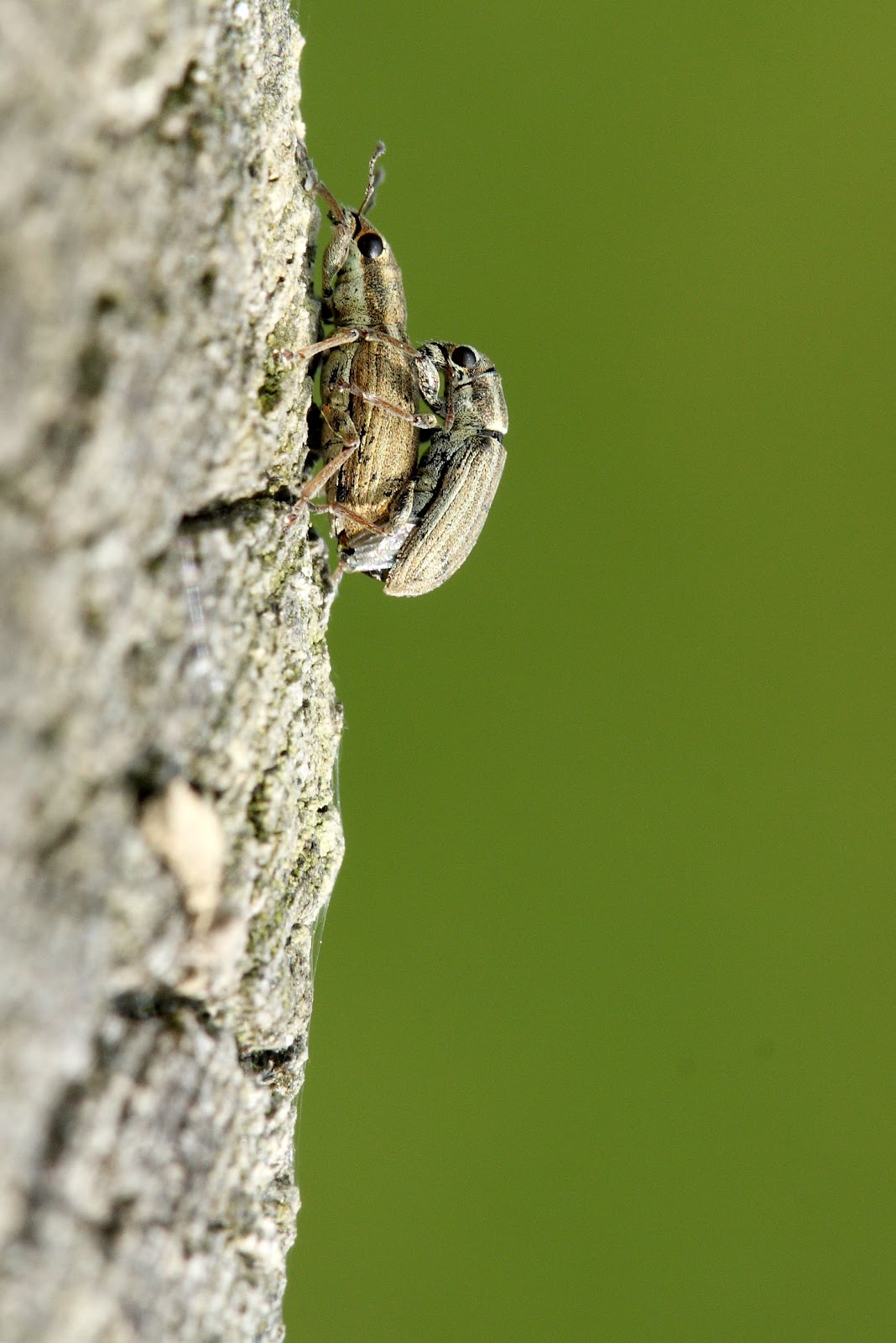
A Pea Weevil
Sitona lineatus- the pea weevil, is omni-present now, with large numbers to be found either sitting atop of fence posts, or as in the case of this one, just  motionless on long grass. At around 4-5mm though, they may not be obvious.
They get their name from the habit of nibbling semicircular holes in the edges of peas and clover.


Both sexes doing what both sexes do!


Of the early butterflies, surely the arrival of the orange-tips is one of the delights of spring-proper. Stunning butterflies at any-time, these delicate insects can be fully appreciated when they are freshly emerged with their strong colours and as yet, undamaged wings. Easily separated into male/female by even an amateur such as myself:the males having bearing the tell-tale 'orange-tip' to their wings.

CLICK ANY PHOTO FOR LARGER IMAGE
An Orange-Tip Butterfly


7-spot ladybirds seem to be around in huge numbers this spring-perhaps the mild March has encouraged them out of hibernation. I have also seen a few harlequin ladybirds locally now but only a handful. The photograph of a 7-spot below is a natural light photo and although it looks as though I have photo-shopped the background out and added a plain cream one, the truth is that it's natural, and is just dry, long grass.

A 7-Spot Ladybird


We are just into April now and what has been a real treat to see is the amount of wild flowers that are now showing. There are primroses, wild violets, wood anemone and lots of bluebells (see photo below for an illustration of some of the paler variety we have growing locally). The roadside verges are also turning green with wild parsley and jack-by-the-hedge and numerous other plants and shrubs.


Bluebell


I think that about updates you on what's happening in the world of nature here, well that's what I've seen anyway, as always there's far more going on than I'll ever witness and long may it be so.


To complete this blog entry I'd just like to add here that I was pleased that one of my photographs was chosen recently as the 'Photo Of The Month by UK SAFARI and will appear on their website for the month of April.


Until the next time then...